
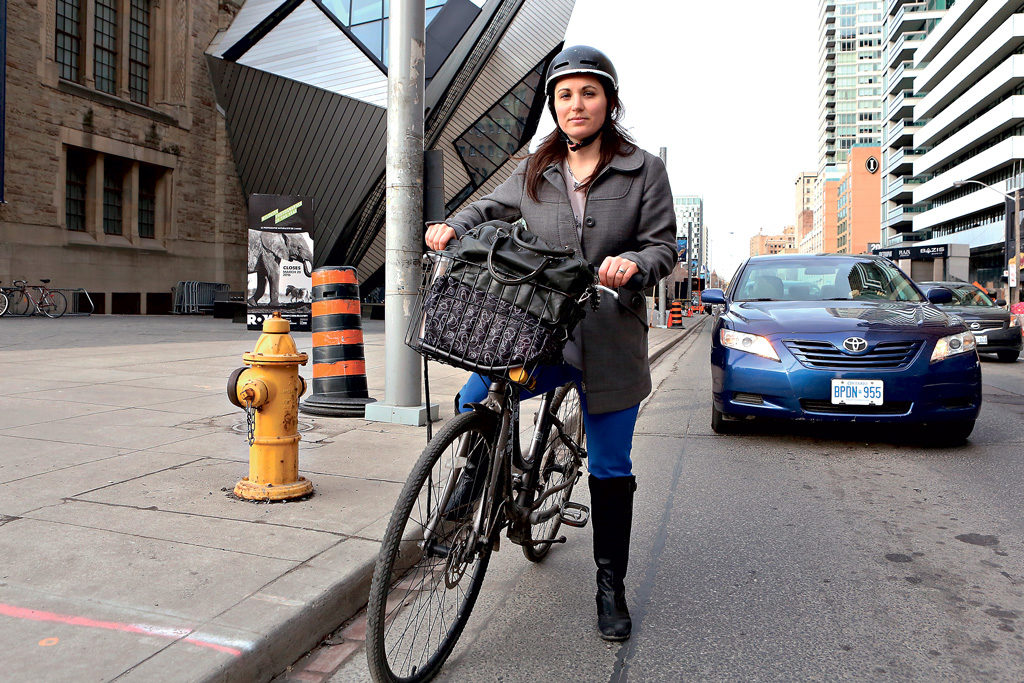
It’s been a slow ride for cycling advocates en route to safer infrastructure in Toronto. Many have lobbied for years — to the displeasure of some motorists — to see more bike lanes in the city. An ambitious cycling plan enacted during David Miller’s tenure as mayor, has been implemented at an underwhelming pace. But with a newly proposed pilot project along Bloor, bike lanes coming along Eglinton Avenue and studies in other cycling-deficient areas such as North York, the pace of change has increased.
But the question remains: can City of Toronto planners balance drivers’ concerns about gridlock and business owners’ demands for parking against a need to make cycling safer?
The city’s 10-Year Cycling Network Plan has also proposed three major corridor studies this year, one of which would occur on the five kilometres along Yonge Street between Sheppard Avenue and Finch Avenue, in conjunction with a streetscape study.
The plan intends to assess whether any improvements and upgrades can be made to the existing cycling network on that strip of Yonge.
The city also unanimously approved recommendations for the Eglinton Crosstown LRT to include almost 20km of protected bike lanes last year. Stretching across the entire length of Eglinton Avenue, the bike lanes will connect to transit stations, trails, and convenient bike parking facilities for a comprehensive cycling network. But, the plan does not include the removal of street parking, a major point of contention with the Bloor Street project.
Yvonne Bambrick, author of The Urban Cycling Survival Guide and executive director of the Forest Hill Village BIA, has been cycling along Bloor Street for more than 20 years and expects that the bike lanes will help every party involved.
“Bike lanes serve everyone. They make the roads more predictable, and they allow people who are less confident about riding or who are newer to riding a bike … to feel safe,” she said.
After years of advocacy, the City of Toronto has proposed bike lanes on Bloor Street between Shaw Street and Avenue Road to commence this summer.
Although various configurations are being considered, the current preferred design involves a cycle track that will be separated from car traffic by flexible posts. It would also include a partition between cyclists and parked cars to avoid the all-too-common occurrence of cyclists crashing into the doors being opened by car passengers.
Although the city has commissioned multiple studies to review the feasibility of bike lanes on Bloor Street going as far back as 1992, it wasn’t until December of last year that it held its first public consultation meeting to seek feedback on the idea.
The city also opened a live online survey in January. As of March 14, the survey results highlighted that although nearly 40 per cent of respondents cycle on Bloor Street between five and seven days of the week, more than half of them feel unsafe doing so. To make matters worse, almost 50 per cent of drivers feel uncomfortable while driving next to cyclists. About 97 per cent of respondents strongly support the idea of bike lanes on Bloor Street.
However, business owners, such as Prem Sharma of Piya’s Boutique on Bloor Street near Bathurst Street, said bringing bike lanes to the area is a poor choice.
“It will make things tougher for any of the restaurants who require parking,” he said. “If [the city] thinks that they don’t need parking for restaurants, [the city’s] … dreaming,” said Sharma.
Sharma said bike lanes would also disrupt customers’ abilities to engage in “in and outs” where they can park their car and grab items from stores before heading on their way.
Jacquelyn Hayward Gulati, manager of cycling infrastructure and programs for the City of Toronto, said taking local businesses’ concerns into account was an important part of the pilot project. In fact, engaging in several meetings with business improvement areas (BIAs) and conducting door-to-door visits at local businesses helped shape the design, she said.
“There was one option that we looked at earlier on in the process that included the removal of all on-street parking and loading from Bloor Street, and we’ve ruled that out,” she said.
“We know that activity on street — for landing purposes in particular but for on-street parking as well — is quite important for the way that this section of Bloor Street operates.”
To accommodate both cyclists and business owners, the city plans to have on-street parking spots alternate between one side of the street and the other.
The local daycare and UPS store, for example, have particular drop-off needs that validate the need for on-street parking on their side of the street.
A 2014 report by the Toronto Centre for Active Transportation (TCAT) highlighted that in areas of Toronto such as Danforth Avenue, individuals who arrive by foot spend an average of $100 per month at shops in the area versus the $25 that drivers spend. Additionally, while 46 per cent of shoppers arrive to the area by foot, only 19 per cent arrive by car.
In terms of congestion, other areas of Toronto where bike lanes have been introduced have experienced no increase in traffic slowdowns.
After the installation of cycle tracks along Richmond Street, Adelaide Street and Simcoe Street in 2014, the City of Toronto reported that cycling volumes tripled along those streets while traffic times remained unaffected.
The Bloor Street bike lane pilot project proposal will be brought forward at the city’s public works committee meeting on April 19.

