
LAST WINTER HAVING chosen not to ski with my macho (and yet beloved) family members (whose idea of fun is a double black diamond at warp speed), I met some interesting people while skiing alone.
Actually the most interesting thing was how many people used the chairlift ride as a cellphone opportunity. And there I was, being hopelessly old-fashioned and thinking it was a scenery moment.
One afternoon I’m riding the chairlift with a couple, he makes a work call and she is goodnaturedly irritable.
Result: He has kept in touch with his work, guaranteed we don’t interact, he doesn’t interact with his wife.…And he may have made a deal.
He — not as an individual but as part of the social force he represents — is the reason why 30,000 U.S. schools have cancelled recess in the last five years. As parents, we raise our children in an increasingly competitive world.
My grandparents would have shaken their heads with surprise — and perhaps dismay — had they witnessed the pressure I put on my own children to get into the “right” schools.
Tutoring, tutoring homework, practice exams, interviews, SSAT’s: What does all that have to do with childhood?
The answer of course is that we want only the best for our children, which includes opening doors for their future … and can lead to the occasional case of overprogramming … which reduces time and opportunity for plain old-fashioned unstructured play. Which is further reduced by the “new play.”
This of course is playtime that involves keyboards and screens — wherein children seem to be interacting with each other, but it’s virtual rather than face-to-face.
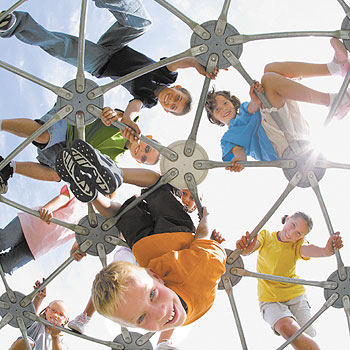
Old-fashioned face-to-face unstructured interaction is a highly sophisticated and educational opportunity.
It blows SSAT prep courses out of the water when it comes to growing human beings who will be the leaders of tomorrow and will excel at relationships both at work and at play.
We hear more and more frequently that people who succeed at work (and in building strong families!) are not the ones who were at the top of the calculus class, but the people with E.Q .— emotional intelligence.
You don’t learn that in a school classroom or a dance class or an art class or a karate class — or any other class.
Kids learn people skills at play, and if their time is mostly programmed, play goes the way of the dinosaur.
In unstructured face-to-face play, kids learn to get along with others, problem-solve relationship challenges, get their needs met and empathize with others’ needs, tolerate differences, make and keep friends. The true learning of childhood is social skills.
In an over-programmed childhood, with too much time spent in virtual reality, children need more time in the precious haven of face-to-face play, where they have their inherent goodness confirmed.
Play is the developmental opportunity to have their very selfhood confirmed.
The message they receive from their peers, via interactions in play, is very simple and very powerful: Between the lines of playing cards and the September games of driveway basketball and going for a bike ride around the block together, they’re getting the message:
“You’re a good person and I like you just as you are.”
Then they have a fight and then they figure out how to work it out and make up and stay friends, and the message deepens to: “Even when we don’t get along, I still care about you, and we can work it out and still be friends.”
That’s where the magic happens: Your child is now a relationship expert, with a high E.Q. — thanks to the positive power of play.

