
Nhung Tran won’t eat commercial blueberries. They don’t taste as sweet when she remembers her childhood. Back then, her parents and six siblings, who had been sponsored by a Dutch Reformed Church as refugees from Vietnam in 1979, were forced to pick blueberries on a farm in western Michigan. She was a young child at the time.
“As a kid I thought it was kind of fun,” says Tran, associate professor at the University of Toronto and Canada research chair in Southeast Asian history. “Now I won’t eat commercial blueberries.”
In her car, on our way to lunch, I ask about Vietnam, hoping to understand the influence French colonialism had on the cuisine. Her historical narrative works back to the first century BC — touching upon the Chinese colonization of Vietnam — and we barely get up to the early 15th century Ming occupation by the time we pull up to St. Clair’s Pho Xua, our hunger taking precedence over conversation.
Flipping through the menu, Tran picks a few southern Vietnamese dishes. Speaking with the owner in Vietnamese, she adds to our lunch choices.
“She’s from the north,” says Tran. As is the restaurant’s chef.
“Bun cha,” the owner says, tapping the laminated menu, emphasizing her pride in the Hanoi dish that Barack Obama gulped down while in Vietnam.

Ca kho to, clay pot catfish (IMAGE: CJ BAEK)
While we’re waiting on our food, Tran educates me on a primary untruth about Vietnam.
“I want to separate the popular narrative, the myth of women’s equality. Because history, myth or legend notes that the two who led the rebellion against the Chinese in the year 42 were women,” she says. “The idea that women had a strong position in political and social affairs was and continues to be an important force in the Vietnamese historical imagination.”
The mid-20th century image — popular in western media — of a machine gun–toting North Vietnamese woman is discussed. While having some basis in historical fact — after all, the entire population of Vietnam was mobilized — it’s largely an exaggerated icon of Soviet propaganda, Tran says.
“There’s no word for feminism. There’s no discourse on it because the state is able to point to that and say, ‘Since time immemorial, Vietnamese women have always had equal rights.’ In practice, women do not enjoy equal rights. The courts have gone out of their way to affirm the property claims of men and, in particular, to affirm the principles of patrilineal succession, despite the law.”
A natural-born agitator, Tran’s unrelenting passion for the complexities of history surprised her child’s teachers. They had Tran reconsider her volunteer services.
On a day trip to a mock pioneer school, a historical re-enactor asked Tran what role she would like to play.
“I asked, ‘Do you want me to be a colonial specimen or do you want me to be a Chinese prostitute working on the railroads?’” Tran says. “I didn’t want my daughter to get too romantic about it because, if this was 19th-century Canada, her parents would be tried for miscegenation. So they said, ‘Maybe it’s best you don’t volunteer anymore.’ ”
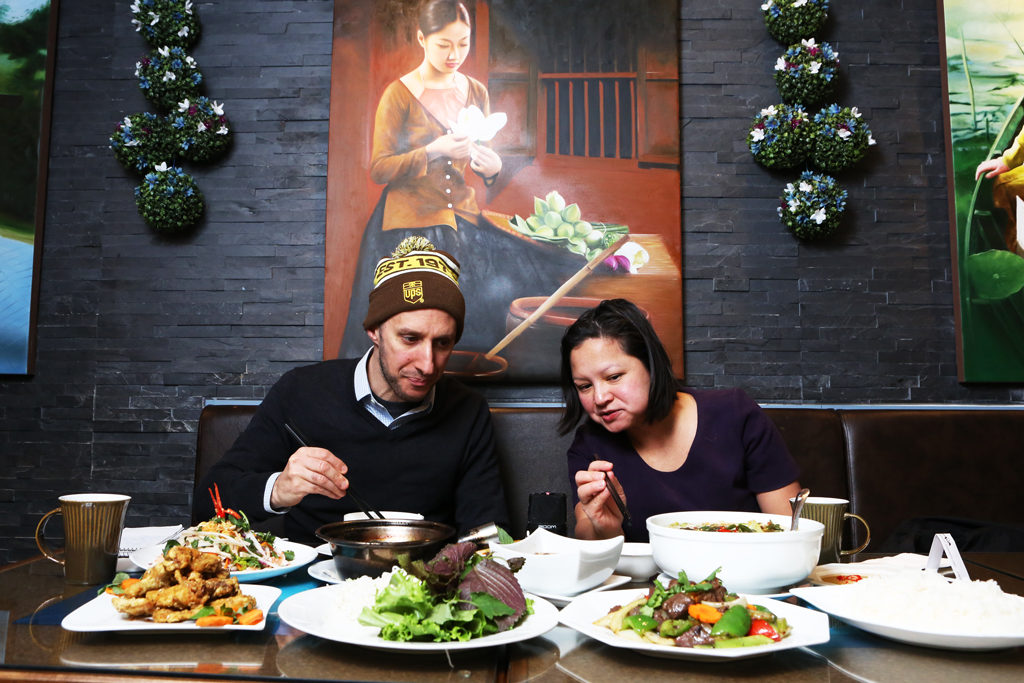
She’s cut off by the arrival of the bun cha, grilled pork soaking in a bowl of diluted fish sauce and vinegar. We pack it into lettuce leaves and eat it over chilled rice noodles. The meat is sweet and fatty. But the flavours are mild, as is the goi ngo sen, a salad of lotus root with pork and shrimp.
“Northerners like to season their food at the table,” says Tran as the server brings us a side dish of fish sauce and chilies. “Southerners season it in the kitchen. That’s the popular saying. But it’s a southern term, and it’s a way to disparage northern cooking.”
The okra in the canh chua ca (sour fish soup), she guesses, is a nod to the south. It packs the promised sweet and sour punch. And it’s brimming with the fleshy plant stem of bac ha (a.k.a. elephant ears, based on the appearance of the plant’s leaves). But it should have tart tamarind in it, and the pineapple shouldn’t be canned.

Goi ngo sen, lotus root salad (IMAGE: CJ BAEK)
Tran had warned me that she’s never quite satisfied with Vietnamese food at Toronto restaurants and prefers home cooking.
“We don’t eat shrimp in our house because of the sourcing of shrimp and the slave labour that is used in the shrimping business. But when I go to a restaurant, I think it’s disrespectful for me to engage in a conversation with the waitress or owner about their sourcing. It would be an imposition of my class sensibilities. The way I was raised, I eat what is served to me.”
She does, however, have to tell me that I’m eating out of order.
“Vietnamese food is always a salty dish (meaning meat or tofu), a vegetable, rice and soup. Salad is also a new thing.”
I’ve done it all wrong. I should have put rice in the bowl, then poured soup over top. And I also should have waited to eat it last.
“Eating soup,” she says, as I ladle the canh chua ca into my bowl, “is a signal that you’re done with the meal.”

