
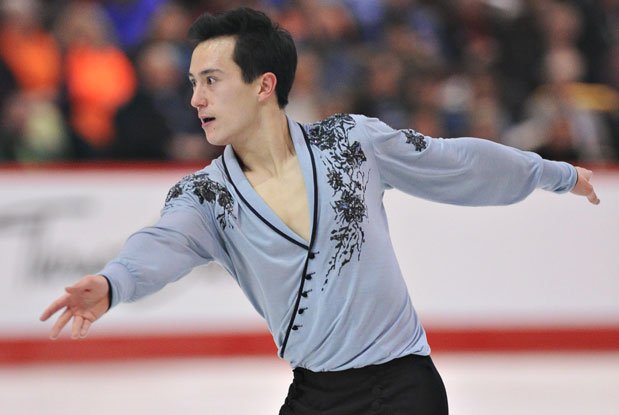
PATRICK CHAN, MEN’S FIGURE SKATING
MEN’S SHORT PROGRAM: FEB. 6 at 19:30 EST
When Patrick Chan steps onto the ice at the Sochi Olympics, he will be carrying the expectations of a nation on his shoulders. The brightest star and biggest name in a Canadian skating team that is targeted to make the podium at least three times, anything less than a gold for Chan will, inevitably, be seen as something of a disappointment.
At 23, Chan is three times a world champion and has become one of the most recognizable faces on the Canadian Olympic team. His technical superiority and exceptional artistry have made him a powerful force in ice skating in recent years. But with competitors such as Japan’s Yuzuru Hanyu and Spain’s Javier Fernandez nipping at his heels — not to mention his history of occasionally faltering when it counts — fans will likely be planted on the edges of their seats watching Chan at Sochi.
Few places will feel that exquisite anxiety more than Toronto’s uptown, where the skater was raised and still has countless friends and fans.
Growing up near Yonge and York Mills, the young athlete spent much of his time skating at the Granite Club on Bayview Avenue. Chan, who is of Chinese descent, grew up speaking Cantonese with his mother and French with his father. He picked up English outside of his home, though he was educated at the French-speaking École secondaire Étienne-Brûlé, where school staff remember him fondly as a self-confident teen who took his skating seriously but was modest about his success. The school now has an annual sporting award named after him.
Among those supporting Chan will be former Canadian figure skating world champion Donald Jackson. Now semi-retired and coaching at Forest Hill Figure Skating Club, Jackson was one of the first people to teach Chan skating, showing him how to do basic crossovers in a CanSkate program when he was a young kid.
“I’ve got my fingers crossed for him,” says Jackson, who has followed Chan’s career closely and believes the skater is in great shape ahead of the Olympics.
“I just hope he skates his best. If someone beats him, then that’s competition, but if he skates his best then he does have the great opportunity of being our Olympic champion.”
At Sochi, Chan will be hoping to banish the memory of his performance at the Vancouver Games in 2010. There he made a hash of his short program routine and ended up finishing fifth, one of Canada’s few medal hopes that failed to make the podium during a wildly successful Games for the country. In January, Chan, who was just 19 at the time of the last Olympics, said he was overwhelmed by the whole experience and compared himself to a puppy or a wide-eyed teen at his first cool party. Since then, he says, he has grown, both as a skater and a person.
After controversy in Vancouver, when American Evan Lysacek took gold with a free skate routine that didn’t even attempt the sport’s most difficult maneuver — the quad — male figure skating has been dominated by the explosive jump. Chan himself was criticized for putting together a routine at Vancouver that didn’t feature the fiendishly tricky quad, which calls for a skater to spin four times in the air in under a second. He rectified that deficiency shortly after the games and has since embraced the challenging jump.
Figure skating watchers are widely predicting that the Sochi games will be a jump fest, with skaters pushing themselves with ambitious and athletic routines. But in a field where the world’s top 10 skaters can all have the quad in their arsenals, it’s still Chan’s seemingly effortless flow and artistry, which he developed under his first coach, veteran Canadian figure skater Osborne Colson, that separates him from the pack.
Chan has been in strong form in the run up to the Sochi Olympics. In 2013, he squeaked a win in London, Ont., to become the first Canadian man to win three world championships since Elvis Stojko, with Kurt Browning’s four now the number to beat. Chan won gold at Skate Canada last October and then put in a dazzling performance at the Trophée Eric Bompard in Paris in November, breaking three of his own world records. In January, to nobody’s great surprise, he added his seventh Canadian championship title.
But he hasn’t had it all his own way and hit a substantial bump in the road in at the Grand Prix Final in Japan before Christmas where he came a distant second to 19-year-old Hanyu, who trains in Toronto. There, as in Vancouver, Chan alluded to his mindset, telling reporters afterwards that he had difficulty getting the memories of past disappointing performances on Japanese ice out of his head.
According to Jackson, Chan’s chances of gold at Sochi will once again depend on his ability to put the weight of Canadian medal expectations to one side and skate as he does in practice at the Detroit rink where he trains.
“There’s a lot of pressure on him but you just have to keep that out of your mind as best you can and focus on your skating and your training,” Jackson says. “I’ve always said your bad days have to be good and your good days have to be outstanding.”
If Chan achieves that and brings back gold, expect there to be much celebrating across the country.

