
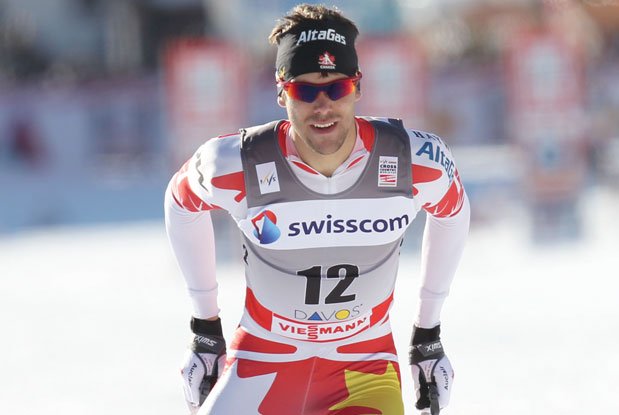
LENNY VALJAS, CROSS-COUNTRY SKIING
MEN’S SPRINT FREE QUALIFICATION: FEB. 11, 14:25 EST
“We can all ski fast enough to win the gold, but there are so many variables,” says Canadian cross-country gold medal hopeful Lenny Valjas. The 26-year-old Olympian is currently between training sessions out in Canmore, Alta. It’s the pre-Olympic crunch, and stress levels are mounting as the final month before Sochi seems to evaporate.
The Canadian men have yet to snag the coveted Olympic gold in cross-country sprinting, but by Olympic standards the sport is still young. Cross-country sprinting was introduced at Salt Lake City in 2002, though men’s cross country skiing has been around since the first Games in 1924. Valjas explains that, even though there are favourites to win, cross-country sprinting isn’t like some of the more controlled winter sports such as speed skating. Sprinters need to consider the snow, the temperature and which skis to use. “Our skis make such a difference; they’ll make or break our day,” says Valjas, who now owns almost 50 pairs of skis.
“If your wax techs don’t find the combination for the best skis and wax, you won’t win, even if you’re the fittest guy out there,” says Valjas, who pauses briefly, his speaking cadence slowing. “On the other hand,” Valjas continues, his usual chipper tone returning, squashing any sense of anxiety that was beginning to permeate the conversation, “even if you aren’t the fittest guy out there, you can win with the right skis.”
At six foot six, Valjas will be the tallest cross-country skier competing at the Olympics this year, and although his lengthy limbs give him an advantage, his body can also work against him on the hillier courses.
“I have to carry 200 pounds up those hills, and these little guys move up effortlessly,” says Valjas, who has been known to kick it into high gear at the end of races. With 300 metres to go, the skier will turn on the afterburners and dust his competitors in the final stretch of the sprint.
During high school, Valjas trained by sneaking into Uplands Ski Centre after sundown to take advantage of the recently groomed snow. One night Valjas was trailing the groomer, skiing up the recently combed sections of hill. The groomer, annoyed that he would have to regroom, chased Valjas around the hill. The game of cat and mouse came to an end when the groomer trapped the snow vandal on the top of the hill.
“Eventually, I just tucked in and flew down the hill at 60 to 70 kilometres an hour and jumped in the car and gone I was,” says Valjas.
Valjas’ faint accent can easily be mistaken for California surfer, but he grew up in Bayview Village (he actually attributes his slight accent to being brought up speaking Estonian as a first language). He attended Bayview Glen where, during high school, he and his group of nine super-athletic best buds dominated the school’s sports team rosters. Although they played just about every sport, Valjas remembers the baseball team most fondly. They went three seasons undefeated, and although they found the league less than competitive, that’s what made it so fun.
Today, Valjas has an equally close bromance with his three fellow senior world cup teammates, Alex Harvey, Ivan Babikov and Devon Kershaw. Valjas, the youngest of the quartet, says that the four are “like brothers” because they spend more time on the road than they do with their families.
“Living out of a suitcase for five or six months at a time can get tough, but when we have those tougher moments, we help each other stay positive,” says Valjas, who goes out with his teammates daily for cappuccinos.
“I have a coffee addiction,” jokes the Olympian. Although Valjas isn’t superstitious — he doesn’t have a lucky pair of briefs or a dance he has to do before he races — he does have one race ritual. A half hour before each race, the caffeine fiend has to quaff an espresso. “We actually travel with an espresso machine,” Valjas says with a laugh.
Valjas’ path to the Olympics wasn’t always so clear. If he had chosen differently a decade ago, Valjas may have been donning the maple leaf for the Summer, rather than the Winter, Olympics. In Grade 11 Valjas made both the provincial mountain biking and cross-country skiing teams, and although he was better at biking (according to him), he ended up pursuing a cross-country career.
When pressed as to why he made the decision to ditch wheels for skis, Valjas explains that it all came down to the sports’ conditioning requirements. Training to be a world-class mountain biker was, according to Valjas, “long and monotonous.” Meanwhile, “to be good at biking you really just had to just bike. With skiing I could bike, run, ski, play soccer for training.”
Despite competing in both mountain biking and cross-country skiing throughout high school, Valjas never thought he’d actually be an Olympian.
“I didn’t believe it. The Olympics was one of those goals that if you don’t reach it that’s fine because it’s such an extreme goal,” he says. Valjas is comfortable on any type of terrain be it a steep, snow-covered hill (alpine skiing), a rugged forest (mountain biking) or the open ocean (surfing).
Once the Olympics wrap up, the athlete is planning to take a much needed break from snow and skis. Valjas loves Maui and has made of habit of annually hitting Hawaii’s second largest island. In past years the athlete would landscape in exchange for rent. “I guess I landscaped too well because he [the homeowner] doesn’t need me anymore,” Valjas chuckles.
The ever down-to-earth Olympian says he’d be more than happy to strike the same bargain with any other Maui snowbirds — regardless of whether or not he brings home the gold.

