
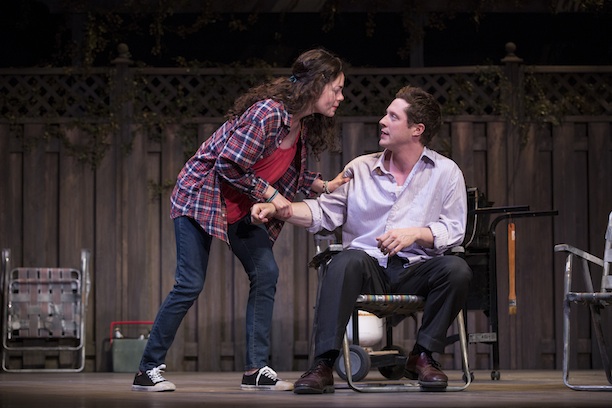
Dead Metaphor, a new dark comedy from Toronto playwright George F. Walker, is gritty, foulmouthed and hilarious, as if HBO hired Quentin Tarantino to remake Seinfeld. But Dead Metaphor isn’t a show about nothing.
The humour in this story of Dean, a sniper who has come home from Afghanistan and is struggling to find work, comes not from gags but from frank discussion of uncomfortable realities. Dean is unashamed to admit his work experience is limited to “killing people from a distance,” and he sensibly makes the point that he will be as good at his next job as he was at his last.
Unlike Dead Metaphor’s world premiere in San Francisco last year, this Canadian premiere, Canadian Rep Theatre’s third and final production of the season, (co-produced with Mirvish), is directed by the playwright himself. Some early exchanges are exceedingly polished and clipped but the delivery becomes more naturalistic as characters drive each other deeper into exasperation.
Walker’s humour is apparent from the first lines. When government employment officer Oliver Denny (Michael Healey, funny as ever) tries to find selling points in Dean’s work history, Dean (likeably played by Noah Reid), speaks of his effective work as a sniper in the same way a typical job seeker might speak of typing speed or software skills. He presents himself as a conscientious worker.
Members of the cast are familiar both to the audience and to Walker. Healey and Eric Peterson were, for example, both featured in Walker’s CBC TV series This is Wonderland. Actor and emerging playwright Haley McGee plays Dean’s pregnant wife in a role not dissimilar to the role of Tina that she played last year in Walker’s Moss Park.
Peterson, as much a member of Canadian theatre royalty as Walker, is at his best playing Dean’s cantankerous, progressive and intermittently senile father, Hank. Hank hurls obscene but clearheaded invective at politician Helen Denny (Julie Stewart) who, over the course of her career and her marriage to Oliver, has leaned so far right in pursuit of voters that she is ready to topple over.
Although Helen’s extremism brings the Tea Party to mind, the home to which Dean has returned is not specified and could be American or Canadian. The stage is arranged in thirds; the home of Hank and his wife Frannie (Nancy Beatty) in the middle and most other locations represented to one side or another (set and costume design by Shawn Kerwin).
The dialogue is realistic and R-rated throughout. Pretty much all the characters say flat out what they are thinking, in a way that is healthy for the characters, and believable but sometimes shocking for the audience. Observations about war, politics, aging, unemployment and human nature aren’t forced into the dialogue; they rise to the surface of everyday conversations and blistering rants. For example, Hank and his family speak openly and unsentimentally about the implications of his degenerating mind, with no sugar coating.
Although not discussed explicitly, the story contrasts degrees of marital devotion. Whereas Dean’s aging parents have grown utterly devoted to each other, and Dean and his wife are still sorting out their friction, Oliver and Helen are in a state of marital blister.
Using humour and extremes, Dead Metaphor looks intensely at everyday matters of life and death that can be too serious for people to talk about comfortably. Even for those unconcerned with issues like politics, unemployment and, you know, mortality, Dead Metaphor is a highly entertaining and very current comedy.
$19-$79. Dead Metaphor plays at the Panasonic Theatre until June 8.
Evan Andrew Mackay is a Toronto playwright and humorist who writes about culture and social justice.

