
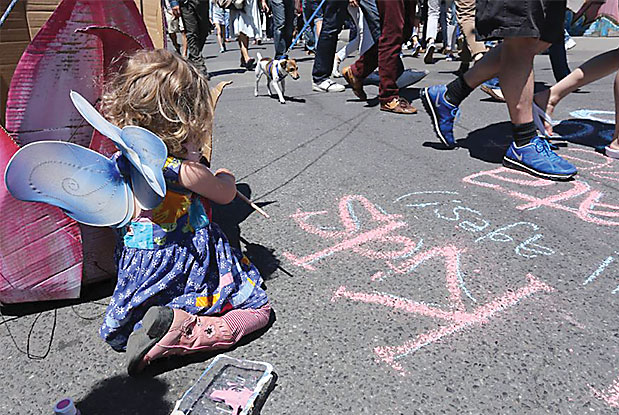
Toronto is used to streets being closed for construction as soon as the snow melts. But there is a growing trend to close many neighbourhood thoroughfares for public events as well. A recent proposal for a massive shutdown of Bloor Street was rejected, but not without some consideration to test the idea on a smaller scale.
The Open Streets Toronto initiative began in 2013, spearheaded by councillor Kristyn Wong-Tam, representative of the Toronto Centre-Rosedale Ward. The festival would see Bloor Street and parts of Yonge Street closed to all motor vehicles, freeing up 10 kilometres of city streets and giving pedestrians, skaters and cyclists free rein.
“With the limited number of community recreation centres for the population of Toronto, activating 10 kilometres of city streets buys you a lot of running track and cycle space,” says Matthew Browning, a senior transportation consultant at Arup, the civil engineering and design firm that planned the Open Streets Toronto route.
The most notable example of street-closing fun in the city comes courtesy of community group PS Kensington. Kensington Market’s Pedestrian Sundays is in its 11th year. Shamez Amlani, co-founder of Pedestrian Sundays Kensington, says: “[We aim] to reinvigorate public space — to let spill into the streets what’s normally behind closed doors.”
But, there are also a growing number of mainstream festival events that close down everything from Queen Street East for the Beaches Jazz Festival, to Danforth, College and St. Clair for various food-themed events, and even the Don Valley Parkway for fundraising events.
Anyone can apply for a temporary road closure permit for $77.39 plus HST. But will Toronto’s city managers decide there’s room for something on a mass scale such as the Open Streets festival? Amlani is strongly opposed to the city council committee’s current stance. “It just shows how backwards Toronto is,” he says.

