
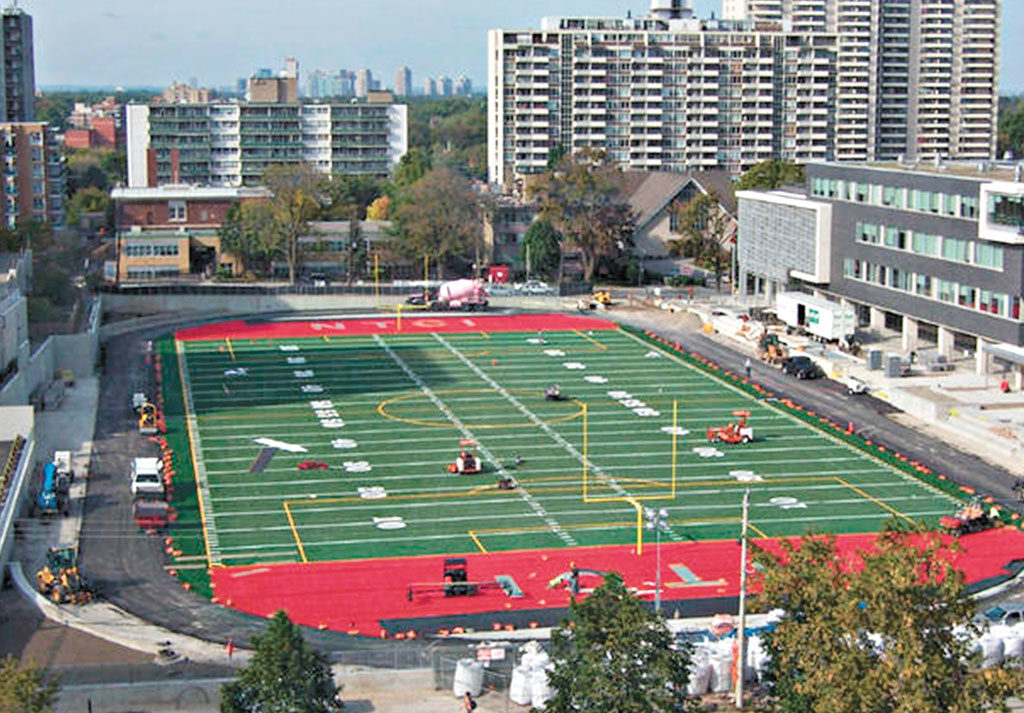
Artificial turf continues to be a hot button issue, not only with city hall, but with school boards, environmentalists and residents throughout North Toronto.
Critics worry that chemicals from the recycled materials are toxic and may leak into the ground surrounding the artificial field.
Concerns have also been raised about the ability of artificial turf to absorb groundwater and how hot the turf may get on the hottest days of summer. These concerns have caused the City of Toronto’s planning department to determine that artificial turf is more consistent with a hard surface than soft landscaping.
A Penn State study suggests that artificial turf could be a net positive for the environment when compared to equivalent grass fields (which could be treated with pesticides, a process that is banned in Toronto). So the jury is still out, here. The trouble is the city is lagging behind.
Upper Canada College did an exhaustive paper on the impact of artificial grass when the school was considering replacing natural turf with artificial grass. The school decided to proceed with the installation of turf but concluded that, in order to be completely carbon neutral and offset the production and transportation costs associated with artificial grass, the school should plant trees to offset any emissions. Toronto French School, North Toronto Collegiate and St. Michael’s College have followed suit.
Although the Toronto Board of Health cites concerns about the overall heat effect artificial turf may have, even the department had to conclude, “Health and environmental agencies that have reviewed the available evidence have concluded that adverse risks to health are unlikely to occur from the use of artificial turf.”
The report even goes so far as to say that artificial turf is preferable to grass in cases “where the use of natural turf is not possible or pragmatic.” The reason for this conclusion is because more kids can play for longer on artificial turf and getting kids out to play is a good thing.
That is the situation most elementary schools in Toronto find themselves in. It is not a decision to replace natural grass with turf; it is the decision to invest in a play space for kids. If you visit local schools like John Wanless, Allenby, John Ross Robertson and Glenview Public Schools, the field is just dirt.
It is for this reason that since 2003, in spite of some protest, 15 elementary schools within Toronto District School Board have installed artificial turf on fields and in the playgrounds. There are more to follow.
Artificial grass may not be to everyone’s liking, but it remains a viable alternative to natural turf.

