
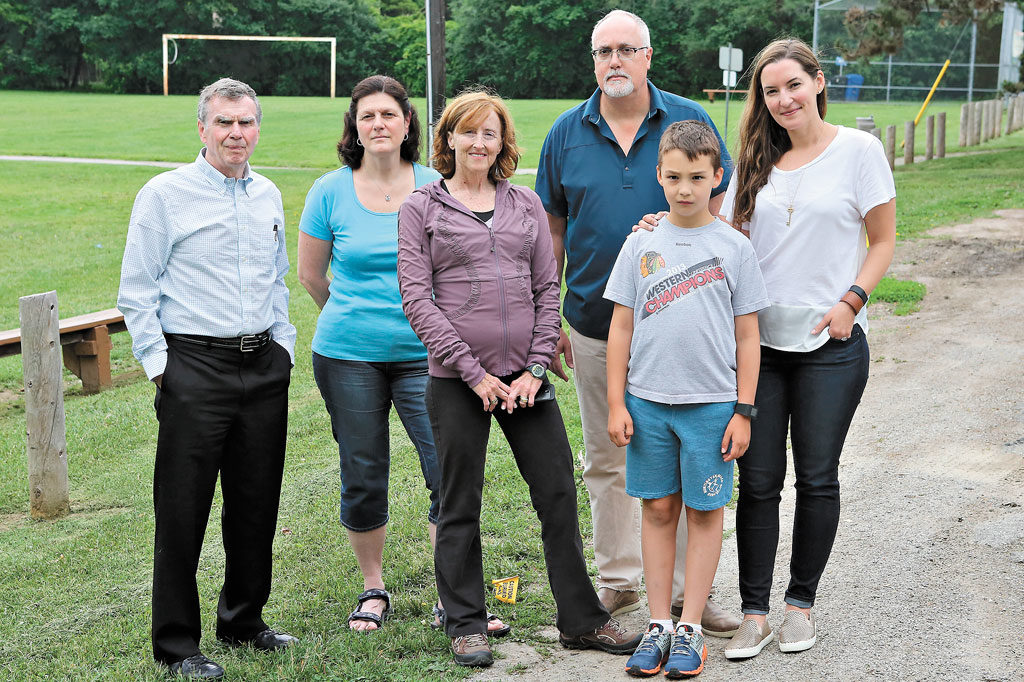
John Gill, chair of the traffic committee with the Lawrence Park Ratepayers’ Association (LPRA), has literally had people yell at him: “No sidewalks!”
In light of a recent study in Lawrence Park that proposes to mitigate storm water and basement flooding, the opportunity to reconstruct local streets has landed residents on one of two sides of a debate that has become a fight over whether or not to add sidewalks to a neighbourhood that has gone without for a hundred years.
Although some residents aim to push for improved pedestrian safety — groups like the LPRA, Toronto Centre for Active Transportation and Walk Toronto among them — others are more focused on preserving the parklike atmosphere of the neighbourhood in its current form, as it was originally designed a century ago.
The need for upgraded infrastructure, however, seems beyond dispute. John Gill lives in the study area and has had his basement flooded twice in the past seven years.
“If you look at Dawlish Avenue when there is a major rainfall, it looks like there is a river outside,” he said.
The environmental assessment currently calls for the removal of 349 trees and recommends sidewalks on five of 22 streets in the neighbourhood. The area is bordered by Mildenhall Road to the north, Bayview Avenue to the east (including Valleyanna Drive), Blyth Hill Road to the south and Mount Pleasant Road to the west.
After four community consultation meetings in May, Michael D’Andrea, the city’s executive director of engineering and construction services, heard from both sides of the debate.
“I can tell you that the community is quite split,” he said.
“Primarily for us, this is about creating a safe, accessible and walkable community,” said Gill. “We want to get away from the children walking down the middle of the street, parents and nannies pushing strollers down icy roads in the winter, and really get that separation between the pedestrian and the traffic.”
Residents on both sides of the debate, however, seem to share a concern for the number of trees that could be impacted by the project. As Coun. Jaye Robinson pointed out, it is the internal construction on the sewer and drainage systems that will cause the most damage to the root systems and trees in the area, not the sidewalks. But Robinson and D’Andrea both said the city is looking at alternate construction techniques, like hand-digging around trunks and pruning trees rather than removing them.
The study team will conduct a street-by-street analysis concerning pedestrian safety and tree preservation this summer, and will present their revised recommendation to the community in September before submitting their final report to city council.

