
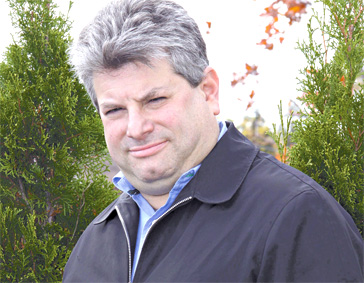
DAVID ROSENBERG begins each free speaking engagement he’s given the same way. “I’m a son, I’m a brother, I’m a cousin, I’m a friend, my father’s a Holocaust survivor, and I’m a crack addict.”
Rosenberg, who grew up near Bathurst Street and Steeles Avenue, is now clean. He speaks at schools, summer camps and businesses as part of his job as the director of operations at Jewish Addiction Community Services (JACS), a North York centre for those of all denominations who are seeking help for addiction.
Rosenberg felt it was his duty to help out where he could at the centre after he had to rely on their programs when he realized he had to treat his own addiction.
A CEO of a multi-million dollar company by the time he was 26, Rosenberg was married with three children when he started abusing crack cocaine. The habit increased to the point where he was spending as much as $1,600 every two days on drugs.
“I was dying, and I had checked myself into rehab,”Rosenberg says. “I had done three-quarters of a million dollars of crack in three years. I had a couple holes in my lung.”
Doctors treated him and told him that addiction was a disease. There was no cure, they said, and it had to be looked after daily. Rosenberg came home from the hospital to an empty house, separation papers and next to no money.
He had alienated his entire family, and he knew he would have to enrol in a program where he could find support and guidance on a daily basis.
“I was raised in a conservative Jewish home, and 80 per cent of the programs I was supposed to utilize took place in the basement of churches,” Rosenberg says. “I’m a very well-rounded guy socially, and I have friends across the board, but to ask me to take my medicine in a church, when I was raised a conservative Jew, wasn’t going to continue.”
A friend at one of the church programs told him that he should check out JACS and gave him the address. He was thrilled to see there were people like him using the programs, all paid for through fundraising campaigns.
“More importantly, there were people who were five, 10, 20 and 25 years clean,” he says.
“I remember walking in and saying, “I’m home. I can recover here.’”
Rosenberg and his parents took part in a variety of programs, all facilitated by drug counsellors and a highly trained staff. Eventually, he was able to rebuild his relationship with his parents and children, his self-esteem improved vastly, and his health returned.
Contributing to the group himself was another positive.
“The opposite to helplessness is to be helpful,” he says. “One of the things that I’m taught is that I can’t keep my health unless I give it away. I’m doing it on behalf of the charity, but it also keeps me well, or I can be a light at the end of the tunnel.”
The organization doesn’t have a sign outside indicating what it is, so that participants can avoid being identified as addicts by people in the community.
Rosenberg decided that he would share his story as much as he could with others to try to get the message out about JACS and its resources, so that addicts or their family and friends would be aware that there was a place to get help.
“I went to nine funerals last year,” Rosenberg says. “Three of them were people under 18, and all three never found JACS.”
Thirty per cent of those addicted to drugs get to the first year of being clean, he says. Half of those get to the second year. Most people die, according to Rosenberg.
The organization offers 22 programs in total, not all of them about addiction.
They have groups especially for teenagers, for women and for men and for those who are concerned for someone they suspect could be struggling with addiction. There are religious and non-religious programs, and although it is a Jewish centre, all denominations are welcome.
“I’m a father, I’m a brother, I’m a son, I’m a friend,” Rosenberg says. “And I wouldn’t be any of these things without JACS.”
Post City Magazines salutes David Rosenberg and the JACS organization for fighting drug addiction in the city and beyond.

