
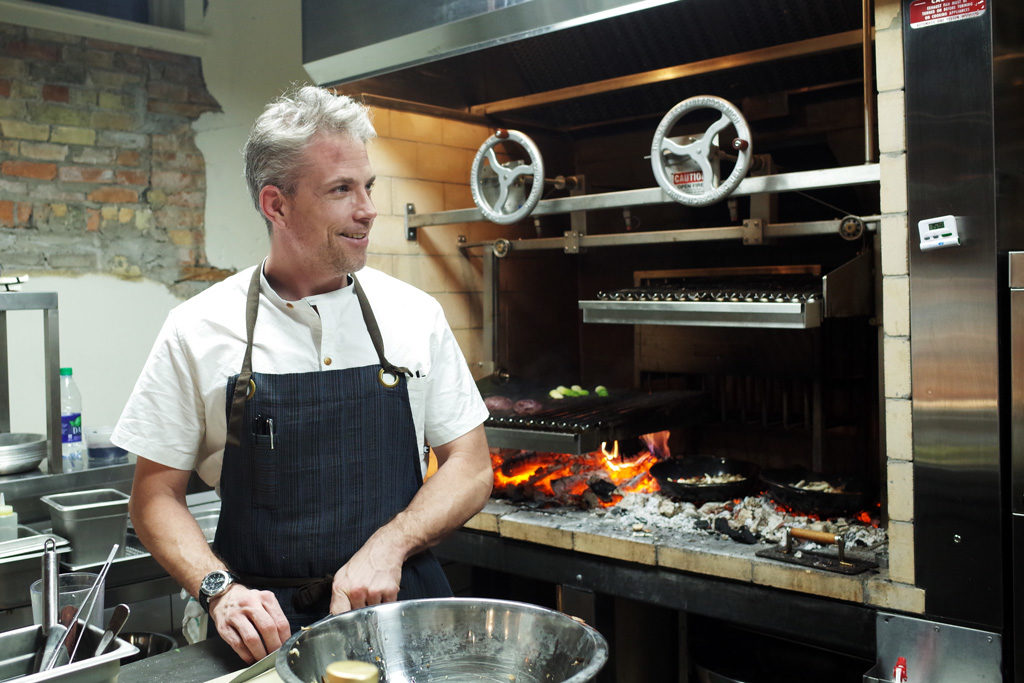
If there’s one Canadian chef who understands the manic spectrum of the culinary life, with its hallowed highs and bleak lows, it’s Jonathan Gushue. Formerly the driving force behind the restaurant at Langdon Hall, Gushue is esteemed internationally, but he has also faced existential crises — the kind that made headlines across the country when he dramatically disappeared from work, friends and family three years ago.
Now the 44-year-old chef is ready to tackle life again. But one thing he’ll never admit is that he was a victim of the industry.
“I had this disposition and these issues before I started cooking,” he says. “Stress is what you make of it.”
His renaissance project is The Berlin, a new restaurant in downtown Kitchener where he is chef and co-owner. There, he butchers whole animals, cooks over a wood-fired grill and serves ingredient-driven cuisine such as Canadian rib-eye with coal-roasted mushrooms or Cornish hen with black radish. It’s almost certain to become one of the best restaurants in Kitchener and maybe even the country. But he very nearly didn’t live long enough to open it.
More hot Tri-City eats

The Grand Trunk Saloon
Spinning out low country soul food and high-quality libations, this newbie is a must-visit and is a stone’s throw from the Berlin. Tuck into chicken ’n’ waffles and sip on a Humidor ’tail, a take on the manhattan made with house-made tobacco bitters.
30 Ontario St. S., Kitchener
Settlement Co.
With coffees roasted locally, this is where bean snobs can get a proper espresso. Pair with a straight-out-of-Portlandia toast: the Outsider matches prosciutto and brie with a balsamic drizzle.
23 King St. N., Waterloo
B@themuseum
Head here for 10 rotating taps of Ontario craft beer plus eats like cubanos and wild boar
bacon gnocchi.
10 King St. W., Kitchener
Born in St. John’s, N.L., Gushue developed an appreciation for cooking at an early age. His father, an Oxford-educated lawyer, was the type of guy to make a two-hour drive for a bowl of pea soup, a guy who cooked like he meant it.
Gushue didn’t want to be a chef, not at first. To him, working in a kitchen was something people did when they couldn’t do anything else. So he enrolled in Georgian College’s hotel management program. He wanted his father to approve of him.
It only took a small taste of professional cooking to hook him. As part of a work placement, he became a breakfast cook’s assistant. He loved it, loved the strange, unpredictable nature of restaurant culture.
“It was the most amazing experience I ever had in my life,” he says. “Every single day was different.”
So began a wild journey through restaurants across the world. He cooked in Tokyo, he cooked in Bristol, he cooked in London. It was the Michelin-starred places that really impressed him, like the Berkeley Hotel, where literally everything was made in-house: terrine, butter, charcuterie, mayonnaise. The hours were long, and you either thrived or smouldered out.
“People either like that environment or not,” he says. “I loved the high energy.”
Back in Canada, Gushue worked through high-end hotel restaurants in Vancouver and Toronto before getting hired as executive chef at Langdon Hall, a luxury hotel and spa in Cambridge, Ont., a getaway for well-to-do Torontonians.
This was where he established himself as an international culinary heavyweight. Under his guidance, Langdon Hall was named the 77th best restaurant in the world on the S. Pellegrino list (which to date has contained only five Canadian restaurants). Langdon Hall got busy, fast, after that.
The key to Gushue’s success, says food journalist and close friend Mark Schatzker, is a respect for simplicity and an intuitive understanding of ingredients.
“His cooking is not needlessly complicated, and I think that’s a problem with chefs today. Chefs are always layering on too much,” Schatzker says. “He’s one of those chefs who’s really in it to cook.”
But underneath the rave reviews and the top-tier cooking was turmoil. Gushue started drinking heavily when he was young, he says, around age 14, downing anything he could get his hands on. As he got older, he moved on to wine. He drank to hide from problems, to find an escape that even success couldn’t provide.
“With success you reach a high, but the second you reach a high, you reach a major low,” he says. “You think, ‘Oh shit, I’m the same guy.’ ”
The despair often became unbearable, most notably in late December of 2012, when he spontaneously left his job and his wife and two kids for more than a week. He didn’t contact his friends or family the entire time.
Later, he revealed to the Globe and Mail that he had been busted for intoxicated driving. Then, dejected, he hopped on a train to Montreal to booze and to contemplate suicide. The days were a blur. Eventually he was located by police, but he didn’t snap out of it until an old friend drove up to see him.
“I needed to hit rock bottom,” he says. “I needed to make a decision as to whether I’d actually take my life or not. And I knew I couldn’t or didn’t want to.”
Afrim Pristine, owner of the Cheese Boutique in Toronto and a longtime friend, says the low points have only made Gushue stronger.
“He’s been through a lot in life, but I’ve never seen him more focused and more hungry than he is now,” he says. “You grow from that and you become bigger and better.”
A few months after his episode, Gushue left Langdon Hall for good.
“I couldn’t bullshit myself any more,” he says. “I wanted to sort of be myself.”
He briefly linked up with the Queen Margherita Pizza team as a consulting chef and considered opening his own downtown Toronto restaurant with them, but it wasn’t a good fit. The empire-building thing just wasn’t for him.
Today, Gushue has been sober for three years. At The Berlin, he’s focused not on making money or expanding, but on furthering his craft, nailing down his consistency. He’s in a good place, and he cooks at a homeless shelter twice a month. Happiness, he says, is a matter of looking outside of himself.
“I thought the whole answer to life was helping myself,” he says. “You need to become a part of life. And having the faith to let that happen is not easy for someone like me. But in time it makes sense.”

