
The Jean-Michel Basquiat: Now’s the Time exhibit opening Feb. 7 and running until May 10 at the Art Gallery of Ontario is a big deal for many reasons. It’s a first for Canada. It’s a world-class show. And as a result of certain events south of the border where a number of unarmed African Americans were killed by white police officers resulting in an increase in racial tension, the themes in his work may have even more relevance and power today. It's a beautiful, shocking and utterly unforgettable collection. We toured the exhibit during a members’ preview with Austrian guest curator Dieter Buchhart as our guide.
Buchhart, after curating Basquiat shows in Paris and Basal, has worked a long time on this particular exhibit. It’s been put together largely from private collections throughout North America including a significant contribution from the Basquiat family’s own estate. For the first time, Basquiat’s two sisters will be a part of the events surrounding the exhibition.
The artist, born in Brooklyn to Haitian and Puerto Rican parents, came of age during the beginnings of hip hop culture. His roots are in street art using the pseudonym SAMO. He was also a musician (listen to a song from his band Gray here), and an actor, but art was his passion and he was a sensation before he was 20, and sold out his first solo show when he was just 21. He died tragically of a drug overdose in 1988 at the age of 27.
Buchhart thinks Toronto and its multicultural makeup is the perfect city to hold the first exhibit of this calibre in Canada.
The images are jarring to behold. And what is so striking is the raw energy and emotion and power that comes through in the works. The political nature, the knowledge of anatomy that was a lifelong passion of the artist after his mother gave him a copy of Gray’s Anatomy while he was stuck in the hospital recuperating from injuries suffered during a car accident, the historical insight and the sheer audacity of how it puts it all together. But, it’s not just that. As Buchhart notes time and time again, it’s all of this combined with a breathtaking level of skill.
The 85 paintings in the show are organized into eight thematic rooms, although there is quite obviously a lot of cross-pollination because each work is just jam-packed with ideas and meaning and depth. But the works showcased in each particular area, according to Buchhart, represent a particular theme very well.

Untitled (head) by Jean-Michel Basquiat
The exhibit opens with one of many untitled works, the well-known painting of a head showing the inner machinations in Basquiat’s characteristic style. It’s a bold and beautiful opening to the show.
“He was so contemporary,” says Buchhart, marvelling at the stunning and provocative work Dark Race Horse – Jesse Owens (1983) in the first room at the beginning of the exhibit. The work, essentially a large painting of a right foot, has never been shown publicly. “Ninety per cent of his work is about anger, but it is about how he turns that anger into energy.”
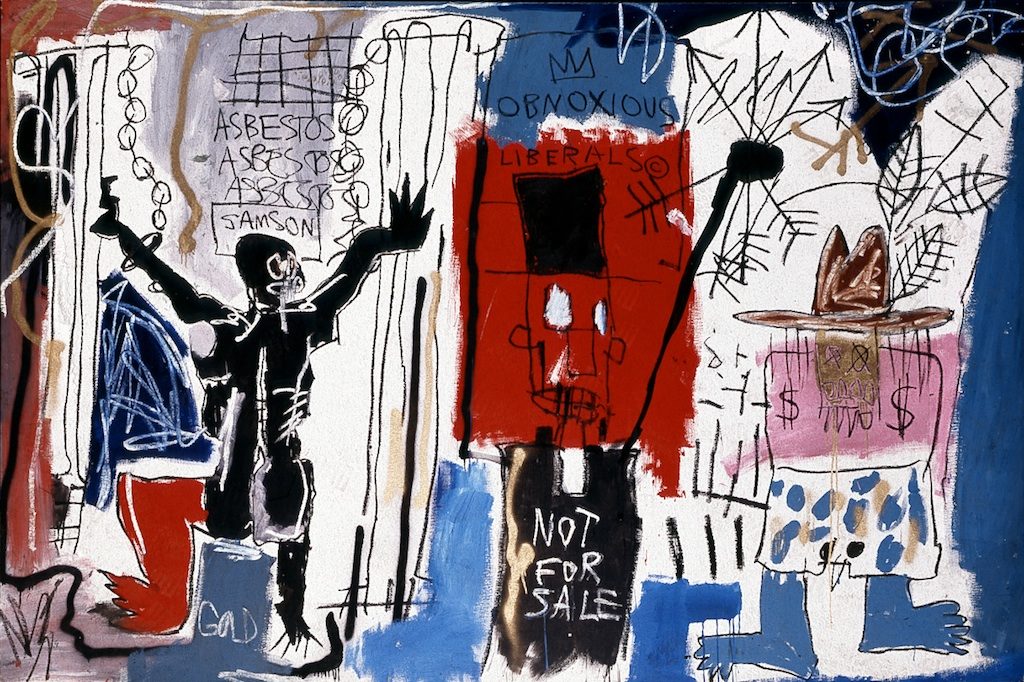
As we move through the rooms, Buchhart highlights many key works. One of those, in the Reclaiming History section, is the 1982 work Obnoxious Liberals depicting a slave auction with three figures: a slave, an auctioneer and a capitalist. This work, according to Buchhart, really demonstrates not only Basquiat’s powerful ideas on race, politics and slavery but also shows his incredible skill as a visionary artist.
“It is also a very balanced composition,” he explains. “By themselves, as artworks they are amongst the greatest.”
Before entering the adjoining room, a Martin Luther King Jr. speech is played in the short entranceway and Buchhart is quick to show one of the exhibition’s most powerful works: The Death of Michael Stewart featuring a cartoonish depiction of two police officers hovering over a silhouette of Stewart. Buchhart explains that the figure is a silhouette because Basquiat thought it could have easily been him murdered by police. He was on the streets, he experience the same kind of racism and brutality. It’s an incredible piece and demonstrates how Basquiat uses duality in his work.
One thing to remember when checking out the exhibit, according to Buchhart, is that there is so much going on with each piece and what is crossed out, or painted over, or tagged with some sort of abstract swirl is often more important than what is not. There is also an element of chance, says Buchhart, or randomness, similar to hip hop scratching and sampling, which emerged at the same time. Basquiat worked with a number of hip hop artists.

Horn Players by Jean-Michel Basquiat
Throughout the exhibition there are also examples of Basquiat’s sense of humour and his appreciation for jazz greats such as Charlie Parker. There is also a sizeable collection of collaborative works with Andy Warhol including another highlight for Buchhart, although its size and placement make it easy to skip over. Don’t Tread on Me is a 1985 work depicting a dollar sign of Warhol’s overlaid with Basquiat’s contribution of a snake and the words “don't tread on me.”
“Warhol prepped the canvass and then, I think, basically Basquiat vandalized it,” says Buchhart, explaining that the artist also physically stepped on it, as he does with many works. The snake, he explains, is an “anarchic symbol” used historically as part of the Gadsden Flag. “There are so many sides to look at,” he continues.
Buchhart says, Basquiat’s work reminds him of the early paintings from another great he’s studied: Edvard Munch of The Scream fame. “They are both very physically affecting,” he says. “With unbelievable energy.”
There are many special events surrounding the opening, most notably the AGO’s First Thursdays party on Feb. 5 featuring hip hop pioneer Grandmaster Flash.

