
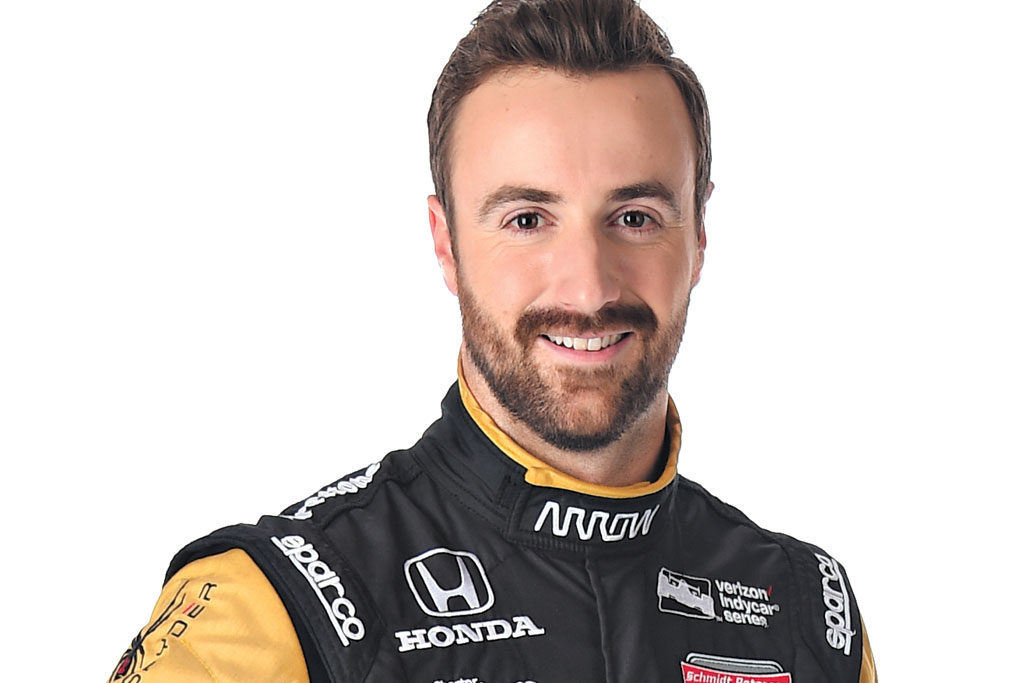
Last month, Toronto area native James Hinchcliffe was in the lead group and ended up finishing seventh at the 100th running of the Indy 500. That he was even in the race is a small miracle given that one year earlier, at the same track, Hinchcliffe was turned into a human kebab when the suspension broke on his car and pierced his leg. The accident nearly cost the IndyCar driver his life. The hometown favourite grew up watching the Toronto Indy, which instilled in the youngster a love of motor sports. Hinch returns to Toronto July 15 to 17 to compete in the 30th running of the Honda Indy Toronto.
What has the Toronto Indy meant to you?
Well, I mean, probably it’s the most important in terms of the fact that, for me, I wouldn’t have necessarily gotten into motor sports if I didn’t have that race in Toronto. We were brought to the race as kids by my dad, and I have a lot of early memories from sitting out there and watching the Mario Andrettis of the world on the racetrack. It’s not just my hometown, but really what made me fall in love with motor sports.
How hard was it to watch your fellow competitors last season?
You know what? At the time, it wasn’t. Until probably the last race, I was still recovering. I obviously wanted to be in a race car, but if someone had said, “OK, you can get in the race car tomorrow,” it really wouldn’t have been fun for me.
What do you recall of the accident?
I don’t actually recall anything of the accident itself. I suffered a fairly massive concussion, so my memory of the day is pretty patchy, luckily. One minute I was driving the car, and the next I was waking up in the ICU.
And what were you thinking when you realized the severity of what you had just gone through?
I was surprisingly calm, to be honest. I always thought if I found myself in that position I’d be a bit more panicked. But I knew where I was, and I understood it was a pretty serious accident. I relied on the fact that I was in great hands with the doctors at Methodist [Hospital in Indianapolis], so I could focus on what I needed to do to get better.
One of the first questions you asked when you woke up was how fast you could get back in the car. What was the reaction to that?
The doctors were shaking their heads, and the other drivers in the room were not surprised at all and kind of had a bit of a laugh. And my family were probably somewhere in between.
How long did it take to recover, and what helped you stay focused during that process?
Well, recovery was obviously long and kind of a slow process, but in the grand scheme of things, it went pretty quickly. I was told I wouldn’t walk for two weeks, would be in the hospital a month and wouldn’t drive a car for six months. But I walked on day four, was out of the hospital day 10 and drove a car four months later. If you take a motivated person and put them in that position, it is crazy what you can accomplish.
How did the experience change you, especially following the death of friend and fellow driver Justin Wilson?
Well, for sure, personally, something like that has a big effect. You take less things for granted and appreciate the little things in life and appreciate the people around you. As a professional, I like to think it hasn’t changed me at all. I’m still as dedicated, hungry and motivated to win and be successful. It’s funny how something that happened in my professional life affected my personal life a ton but not my professional life at all.
What do you like to do when you get back to town?
For me, it’s more about the people. The city is so cool and always changing. And there seems to be five more buildings up every time I come and new restaurants to try. But I always like coming back and just reconnecting with people.
What’s your favourite driving music?
Oh man, probably some AC/DC.

