
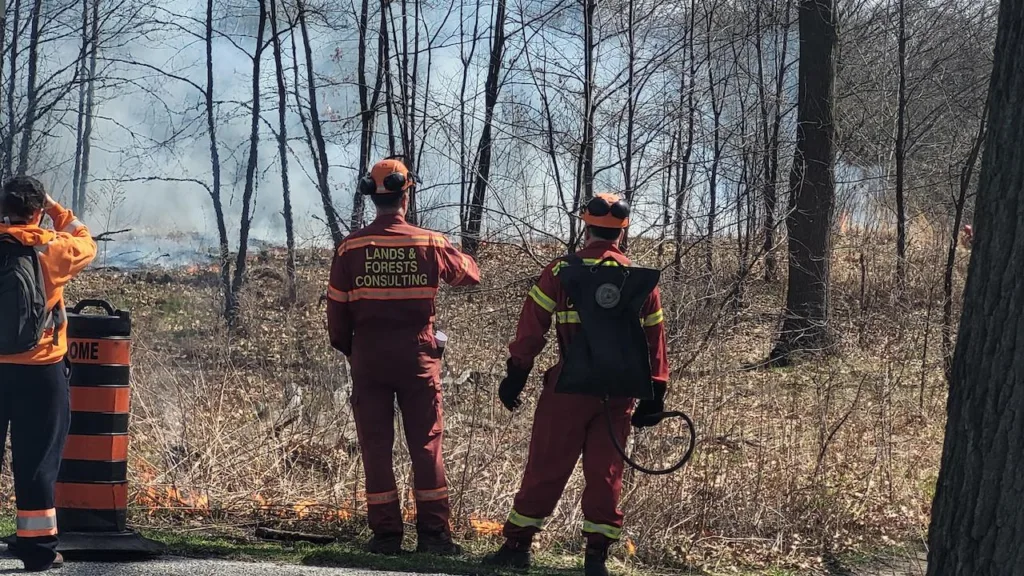
The City of Toronto is conducting its annual traditional and prescribed ‘burn’ at High Park on Tuesday as part of the City’s long-term management plan to restore and protect Toronto’s rare Black Oak woodlands and savannahs.
A burn is a deliberately set and carefully controlled fire that burns low to the ground and consumes dried leaves, small twigs, and grass stems—it doesn’t harm larger trees. Today, it’s taking place in five areas of High Park, near Bloor and Parkside Drive, between 11 a.m. and 6 p.m.
Our CEO, Jess Kaknevicius, attended today’s prescribed burn at High Park. Organized by @cityoftoronto, Indigenous Land Stewardship Circle & @landsandforests, it beautifully weaved Indigenous cultural ceremony & western science to support regeneration & connect with the earth. pic.twitter.com/bcHloQ9aXb
— Forests Ontario (@Forests_Ontario) April 9, 2024
“Fire-dependent ecosystems, such as Toronto’s rare Black Oak savannah, contain prairie plants that respond positively to burning, and that grow more vigorously than they would in the absence of fire,” the city noted on its website. “Species that are not adapted to these ecosystems can be reduced with repeated use of fire.”
In Toronto, Black Oak savannah remnants can be found in South Humber Park, Lambton Park, and High Park. High Park contains about 29 hectares of fragmented savannah and oak woodland, so it’s the most significant area of remnant prairie and savannah plant communities in the region.
“Savannahs are fire-dependent ecosystems, which rely on burning the landscape in order to maintain them. Fire benefits native plants and helps to sustain a unique habitat for the wildlife that depend on this ecosystem,” the city added.
After the burn, City staff will continue to monitor the sites, as invasive species may attempt to grow into them before the native plants in the seed bank have a chance to grow and fill the space.
City staff is currently onsite to ensure the safety of the public and wildlife, but park users are being warned to prepare for restricted access to areas near burn sites, including temporary road and trail closures. People are also advised to close windows or consider leaving the area to avoid potential sensitivity to smoke.
The “traditional and prescribed” burn was previously referred to as a “prescribed” burn—the change occurred to use more welcoming wording that honours the traditional practice of Indigenous people on Turtle Island.

