
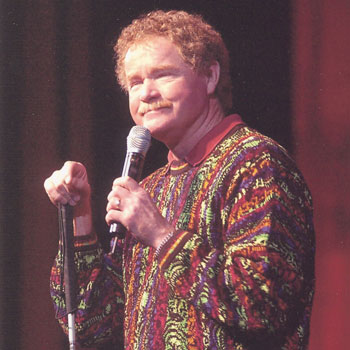
The comedy world was shocked and saddened at the sudden passing last month of Brantford’s Gord Paynter, at the age of 57.
Paynter was a legally blind comic who had type 1 diabetes. He’d been doing headlining for decades and in the last few years had developed as a motivational speaker.
If anyone ever had the right to talk about overcoming adversity, it was certainly Gord. Blind since his early 20s, he could have been an angry, bitter man. But instead, he channeled his issues into comedy.
I remember the first time I saw Gord perform. I thought, “Great potential, unique act, but how can I send him on tour?”
As it happens, you could book Gord anywhere. Send him to a small town in the middle of Alberta, and he’d find it. And arrive early. He was amazing. His first line always cracked me up. “Well, Mark, at least you have me facing the right way this time!”
Gord made worldwide news a number of years ago. An avid golfer, he shot a hole in one, which is hard enough for a sighted player, let alone one who is blind.
Gord’s passing made me think about the issue of disabilities among comedians. I remember fondly a comic from the ’70s, Ed Rice, who had been left crippled by childhood polio, and how hard he had to work just to get up onstage with his two metal crutches.
These days, I’m enjoying working with Andre Arruda, a graduate of the Humber School of Comedy, who has Morquio’s syndrome, which means his 3’ 4” body needs a motorized scooter for locomotion.
Arruda is frank about the difficulties he faces as a “differently abled” comic. The most obvious one is wheelchair accessibility. Many comedy clubs are in older buildings without proper ramping and have no way of getting his scooter onstage without the help of some strong colleagues. It’s not the most dignified entrance, but he makes the best of it, as the blues classic “Bad to the Bone” plays him on.
There’s also the transportation issue. But what really bugs Arruda is his lack of respect from parts of the comedy community, treating his disability as a gimmick. He even finds some politically correct audiences the hardest to win over, as they often think that it would be mean of them to laugh.
He’s not the only comedian with disability issues. D. J. Demers is a Toronto comic who deals with his deafness one great joke at a time. He was a finalist in NBC’s Stand-Up for Diversity and a nominee for Best Stand-up Newcomer at the last Canadian Comedy Awards.
But it’s a tough road. There isn’t much work beyond the clubs, and TV is, quite bluntly, hostile toward placing a disabled comic in a lead role. Maybe what’s necessary is for that one comic to come along to act as a game changer, the way the great actor Peter Dinklage (Game of Thrones) has changed the perception of little people.
Is that person Josh Blue?
Perhaps best known as the comic who “puts the cerebral in cerebral palsy,” Blue was the winner of NBC’s Last Comic Standing in 2006. He’s since parlayed that into a string of hit appearances on Mind of Mencia, The Ellen Degeneres Show and Live with Regis and Kelly. Some say that a sitcom is inevitable. One thing’s for sure: at least it would be different, and isn’t that what comedy is all about?
Post City Magazines’ humour columnist, Mark Breslin, is the founder of Yuk Yuk’s comedy clubs and the author of several books, including Control Freaked.

