
If there’s one clue, one physical item that sums up the overarching philosophy of Yonge and Eglinton’s Little Sister, it’s a hand-written note on display in the kitchen. Scrawled in green marker, it’s an urgent reminder to staff members: when the green sambal — a spicy Indonesian condiment — runs out, the chef must be notified at once.
“So you are aware,” the note reads, “this sambal takes 48 hours start to finish.”
Little Sister is, according to its owners, the only authentic Indonesian restaurant in Toronto. This might be because Indonesian food is superlatively difficult to make, so difficult that Michael van den Winkel, the restaurant’s chef and co-owner, was hesitant to open an Indonesian restaurant in the first place, even though he knew there was a market for it.
“I was reluctant to do an Indonesian restaurant because I know how much labour it takes,” he says. “It’s a total different way of cooking than we’re accustomed to.”
Yes, there’s green sambal, a single condiment that takes two days to create. But there’s also the slow-braised beef in the semur Java; the stewed pork shoulder in the babi kecap; the house-made pickles; and other hand-made ingredients. The big sticking point, though, is bumbu, a traditional spice mixture that can take 12 hours or more to cook properly.
Bumbu is the foundation of Indonesian cuisine, similar to Indian curry. It requires grinding down whole spices — such as clove, cumin, ginger or star anise — and cooking them in oil. Done properly, bumbu has a flavour that’s deeper and brighter than most food substances on this planet.
Little Sister uses 15 varieties of bumbu to cover its ambitious range of Indonesian styles, which includes Javanese, Sumatran and Balinese. This necessitates two full-time prep cooks, as well as three large freezers, each stuffed with vacuum packed bumbus, sambals and purées of ginger and galangal. Whenever a cook needs a flavour, he or she pulls one out from the freezer, like a document from a deep filing cabinet. It’s a fascinating system, if tedious.
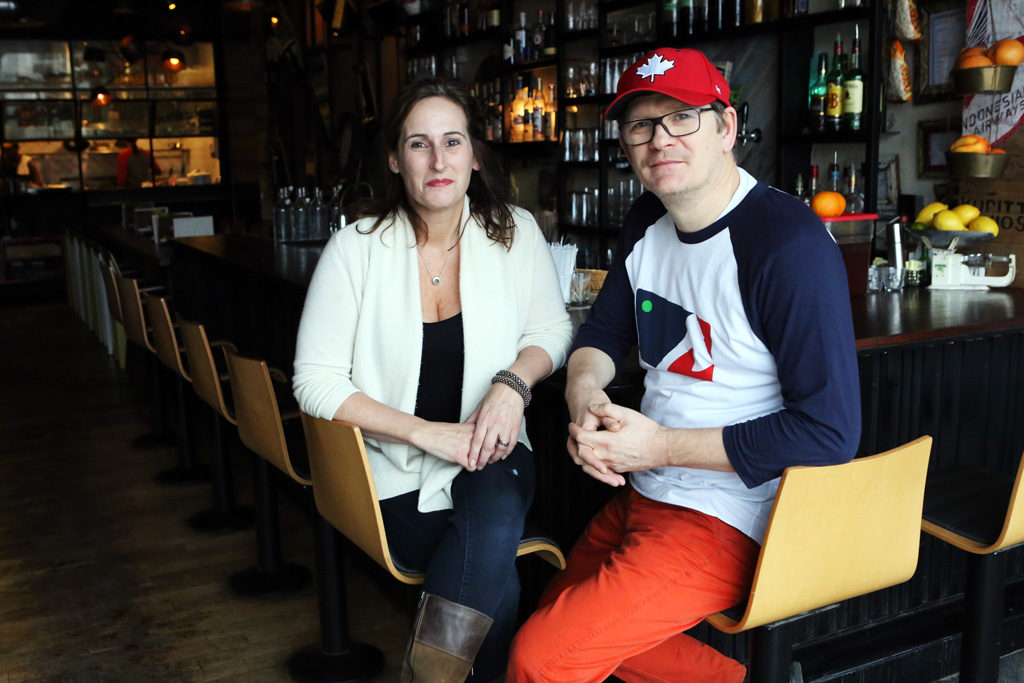
Van den Winkel — bespectacled, soft-spoken, with traces of a Dutch accent — is the one to thank for that system, and the one to thank for bringing these flavours to the city.
He grew up in Amsterdam, where Indonesian cuisine is ubiquitous. It’s a colonial thing. He started cooking at a young age, going to trade school to become a chef when he was 12.
Later, as part of his training, he was required to complete a work placement. He could have done it at a top-tier hotel or at a Michelin starred restaurant; instead, he chose to do it with the navy. He took the easy way out, he says, because he was nervous to work in high-end kitchens.
“I gave all that up to go into the navy because, I guess, of anxiety,” he says. “But if I hadn’t done that, I probably wouldn’t be here.”
Stationed at a naval airport as a budding chef in the ’80s, van den Winkel made an interesting discovery. Most of the chefs were Indonesian. And every Wednesday, everyone in the Dutch navy would indulge in rijsttafel (“rice table”), a Dutch spin on Indonesian cuisine featuring a huge quantity small-portion dishes (as in 25 or more). This too, is a remnant of colonialism: back in the heyday of the Dutch empire, a gigantic rijsttafel spread was a good way of showing off one’s wealth.
Under the guidance of his Indonesian co-workers, van den Winkel learned how to make bumbu and how to build flavours their way, with shrimp paste, lemon grass, lime leaves and chilies.
After the navy, he toured Europe, cooking in restaurants as he went. While working in Bath, England, he met his soulmate, Toronto-born Jennifer Gittins. She was also a travelling chef, having also cooked in Italy for a year, and the two of them instantly connected.
Together, they landed a gig cooking on the yacht of an Indian businessman, an owner of the massive brewery group that makes Kingfisher beer. Van den Winkel was the chef, and Gittins was his sous. They sailed the world, buying ingredients from markets in far-flung locales, such as Phuket and Dubai, and they kept the beer magnate (and his friends) fed.
“From that moment on,” Gittins says, “we’ve been together 24/7, working, living, playing, everything.”
Their time on the yacht enabled them to build a sizable savings. When they had their fill of travelling, they moved back to Canada to open their own restaurant. First, it was the now-defunct Stork on the Roof; next, it was Quince, a Mediterranean bistro. Once Quince had established itself as a solid neighbourhood spot, the couple decided to offer real-deal rijsttafel four times a year.
“They became extremely popular,” Gittins says.
Soon came the inevitable: the opening of Little Sister, an Indonesian restaurant proper, in 2014.
These days, van den Winkel and Gittins are looking to expand. They started with a cocktail bar on the floor above Little Sister late last year: Bar Batavia. Their next step is a new Little Sister south of Bloor (currently, they’re location hunting). Van den Winkel says, if he were to do it all over again, he’d have opened the original Little Sister with a walk-in freezer. After all, if they take on the downtown crowd, he won’t want to be scrambling for green sambal.

