
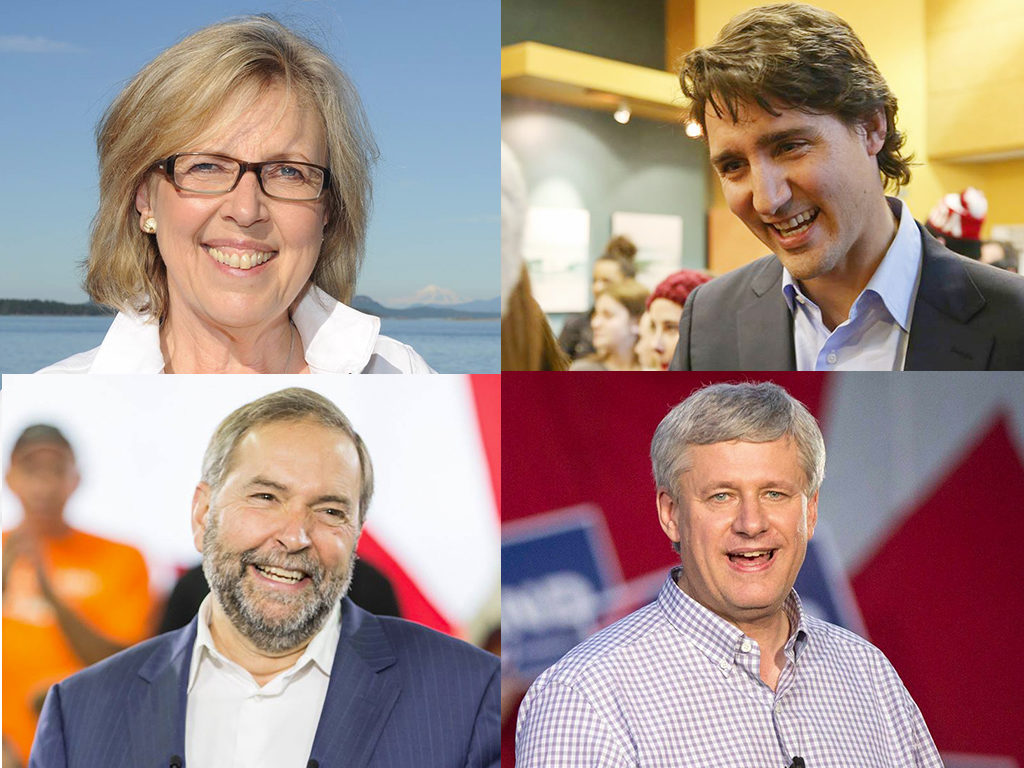
We decided to take a more subtle approach to scrutinizing the four party leaders who want to be prime minister. To that end, we had three experts — Elaine Charal (handwriting), Garth Riley (facial recognition) and Marcel Danesi (body language) — comment on Harper, Trudeau, Mulcair and May based on their professional specialties.

Stephen Harper, Conservative Party
Handwriting analysis: “The high capital letters indicate confidence, strong ego and self-image. The high t-stem in the first name indicates a go-getting tendency to bite off more than can be chewed. The long, firm t-bar indicates enthusiasm, charisma and immense willpower. The ‘threading’ at the end of the first name and in the family name is the mark of a true politician who can adapt to situations without compromising himself. (Pierre Elliott Trudeau and Barack Obama have this type of threading in their signatures.)”
Facial recognition: Stephen’s hairstyle indicates that he can appear to be a bit ‘hard-headed’ but very contemplative. The set of his eyes shows that he has a strong ability to focus in on projects but at times may miss what is happening on the peripheral. The tip of his nose indicates that he prefers to be approached in a calm manner and can be offended or defensive with a direct and pointed approach. Stephen’s chin shows that he will not shy away from taking a risk and also indicates firmness in his decision making process, and steadiness in his resolve once a decision is made.
Body language: Harper has always kept the movements of his body and his expressions as controlled and as still as possible. Under difficult questioning or debate, his posture has started to become more “slouched”, indicating a bit of apprehension. His eyes give out a sharp, almost fierce look, when questioned about things that he obviously would like to avoid. Although we may not be conscious of it while we look at him, that fierceness transfixes the rest of his body and makes him look overly-defensive.

Justin Trudeau, Liberal Party
Handwriting analysis: Justin’s signature indicates he is sharp and focused, seen in the sharpness of his letters. This indicates Justin sees five steps ahead of everyone. The stroke above his signature is his very long t-bar, indicating his enthusiasm; the star shape of his t-bar indicates his tenacity. The bold underscore beneath his signature indicates his self reliance. Both these bold strokes move strongly to the right, denoting movement toward the ‘future’.
Facial recognition: Justin’s hair indicates that he likes to challenge rules and regulations and has a bit of a ‘rebel’ attitude toward such things. His forehead profile indicates that he likes to take in information in bullet point manner. His nose, in profile, shows that he has a propensity to inspect things and be curious. His chin indicates that he can shift his thinking and consider other options, however is prone to shifting once a decision is made.
Body language: Trudeau’s posture is a solid one as he rarely moves around on stage. His pupils seem to be more dilated than others in close-ups, conveying a sense of attractive friendliness. He rarely shakes his head, thus conveying a sense of control and a wise, intelligent mind. Combined with his youthful face which smiles when asked a question, Trudeau’s body is communicating strength, youthfulness and decisiveness. Basically, it says “you can trust me, I am strong-minded, but I have a kind heart.”

Thomas Mulcair, New Democatric Party
Handwriting analysis: This signature is legible, indicating he projects genuineness. The umbrella-shaped T-bar on his first name indicates self-discipline and self-control. The v-wedge at the base of the ‘M’ in the family name indicates analytical ability; the upper wedges represent investigating ability -together they represent a desire to control his destiny, decisions and life. The entire signature moves up on the page, indicating optimism.
Facial recognition: His hair indicates an open mind that can “over think” or deeply ponder on issues. The shape of his forehead shows he likes to gather information and prefers details. His eyes show he is an empathetic listener. Thomas’ nose septum indicates his ability to be a good manager of people, projects and events. His ears show that he is a very active listener and picks up on the details that many may miss.
Body language: Mulcair’s body language is the most subdued of the three. Once he takes an upright posture, he doesn’t change it. His eyes light up when he is obviously passionate about something. This has a strange effect, though. We expect his body to become more energetic, but it does not. This makes it very hard to really grasp his message, since most of the face-to-face form of communication is guided by little cues that are generally expected to be coordinated.

Elizabeth May, Green Party
Handwriting analysis: Elizabeth has a quick script, indicating an equally quick mind. The deep v-wedges and corresponding upper v-wedges in her family name indicate a good capacity to solve problems. Her open bottom ‘b’ in her first name indicates Elizabeth wants to do things her own way and, when tradition doesn’t cut it, will blaze a new trail. The final strokes of both her first and family name shoot upward, indicating her optimism as well as her ambition. Her high capital letters indicate her confidence.
Facial recognition: Her high forehead shows that she celebrates intellectual thinking. Her right eye set indicates that she measures what is being presented and is careful as to what she allows. Elizabeth’s cheeks tell us that she is nurturing in nature. Her overall face shape, including her chin, indicates that she is a natural mediator, can consider options and ideas, and is willing to shift a position on issues even after a decision is made.
Body language: May’s body language seems to be a female counterpart to that of Mulcair. It is restrained and highly unemotional. She rarely uses hand gestures, indicating an intellectual, rather than emotional, mindset. She sometimes sways from side-to-side, which might show that she is unsure or that she is becoming impatient. Self-composure comes through by the fact that she never raises her voice or moves forward with her body to listen to a speaker.

