
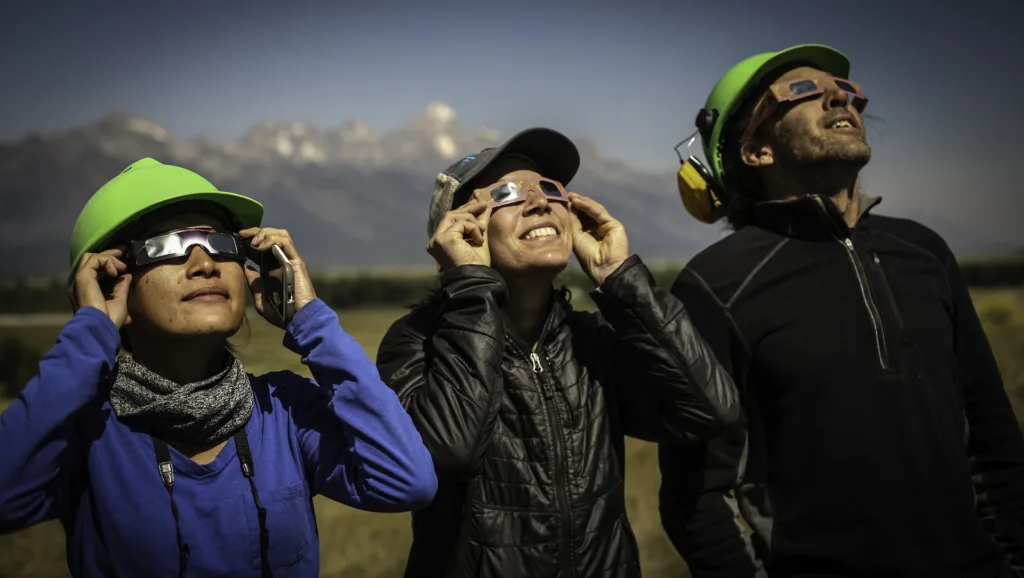
Solar eclipse glasses have been selling out at major retailers across North America in recent weeks as millions prepare to take in the once-in-a-lifetime total (or near-total) eclipse on April 8.
And while many may think they are being cautious by purchasing ISO-certified eclipse glasses, reports show that there are a lot of counterfeits on the market. This is a major problem, as eye damage can occur when watching an eclipse without proper protection. The sun’s bright rays can burn cells in the retina. Since the retina doesn’t have pain receptors, there’s no way to feel the damage as it happens, so people might not experience problems until hours later.
In recent days, Amazon has reached out and provided refunds to customers who purchased solar eclipse glasses identified as potentially not sourced from a supplier included in the American Astronomical Society’s approved list. Consumers across social media have also been sharing their concerns about glasses purchased from major Canadian retailers.
“Please double check the glasses you have for light transparency before using them during the eclipse tomorrow. It would be awful if anyone was blinded by cheap crap passing as protective lenses,” one Reddit user stated in a post on Sunday.
PSA: some eclipse glasses purchased from Canadian Tire and Home Hardware are not safe!
byu/lih9 intoronto
Another Redditor shared a video comparing eclipse glasses purchased at Canadian Tire and Amazon. The Redditor waved both pairs of glasses over their phone flashlight—the light appeared stronger through the Canadian Tire glasses.
“I wanted to add an example of why these glasses are probably not great for viewing the solar eclipse tomorrow,” the Redditor wrote. “The blue pair I got from Canadian Tire. The grey pair I ordered from Amazon from an American Astronomical Society approved seller. Notice the difference in protection from a simple phone camera flash. Now imagine the brightness of the sun. Please don’t risk your sight!”
Other users tested their glasses and confirmed that they were able to see faint outlines of other objects around them, which is a major sign that their glasses aren’t strong enough to view an eclipse. But one Redditor who bought their glasses from Canadian Tire said customer service provided them with a Certificate of Compliance and a Declaration of Compliance.
“Given similar posts I messaged Canadian Tire on FB today and within 30 minutes received the following reply “We can confirm that the solar eclipse glasses sold in our stores have been independently tested by a third-party laboratory and conform to the requirements of ISO 12312-2:2015. Thank you.””
How to tell if your eclipse glasses are fake
According to the American Astronomical Society, there’s no way to tell if your glasses are counterfeits by just looking at them—but it’s easy to tell if they are not safe:
-
- Put them on indoors and look around. You shouldn’t be able to see anything through them, except very bright lights (which should appear very faint through the glasses). If you can see anything else, like household furnishings, pictures, etc., your glasses aren’t safe enough for eclipse viewing.
- Wear your glasses outside on a sunny day. You still shouldn’t see anything through them, except for the Sun’s reflection off a shiny surface or a puddle (this should appear very faint).
- Prior to the eclipse, glance at the Sun through them for less than a second. You should see a sharp-edged, round disk (this is the Sun’s visible “face”). It should be comfortably bright. Depending on the type of filter, the Sun may appear white, bluish-white, yellow, or orange.
A real pair of solar eclipse glasses should also be labeled with ISO 12312-2, which is an international safety standard that indicates that the glasses reduce sunlight to safe levels. During the eclipse, look at the Sun through the glasses for no more than 2 or 3 seconds every 5 minutes or so. Or if you’re uncomfortable, you can simply view it online.

