
It’s the middle of polar vortex–inflicted January, and I’m at a new restaurant in Parkdale thinking about how it’s 2014 outside but not inside. The setting is unusual for the neighbourhood. The volume of the music (jazz, ragtime) is actually soft enough for conversation, and the place is elegant in a really, really old school kind of way: white marble bar top, 19th century–styled light fixtures, antique Limoges dishware and dapper servers clad in suspenders and bow ties.
My tablemate and I are eating cioppino, a tomatoey seafood stew invented in turn-of-the-century San Francisco, brimming with octopus, mussels, crab and fish. We are seated near a made-in-Toronto piano that’s around 100 years old, and we’re sipping absinthe served in the traditional way, slowly diluted with sugar and ice water from a fountain that any grandfather worth his salt would want chilling on his mantel. (The anise-tinged absinthe used to mess up the likes of Van Gogh and Toulouse-Lautrec something fierce back in the art nouveau heyday of Paris).
The venue is Geraldine, and the year might as well be 1890. For owners Alexandra Albert and Peter Ramsay, this old-timey grandeur is a direct revolt against the cookie-cutter west end restaurant aesthetic that’s defined, pretty much, by reclaimed barn wood and salvaged detritus.
“We wanted to get away from the same thing you see everywhere,” Albert says. “It’s becoming a formula.”
The interesting thing is that relics from Victorian-era dining are showing up in restaurants across the city. You can time-travel without a flux capacitor. That’s how neat Toronto is.
A few blocks east of Geraldine, Chantecler now serves lobster thermidor as a special on Fridays and weekends. It’s a throwback to 1894 when the dish was first served in Paris as a tribute to Thermidor, a play by Victorien Sardou. Nobody really remembers the play any more — or Sardou for that matter — but lots of people remember the dish he inspired, including chef Jonathan Poon.
At Chantecler, Poon steams lobster, then carefully removes and chops up the meat. He folds the chunks into a sauce made from lobster stock, white wine, bacon, cream, brandy and mustard powder (the latter two crucial for an authentic recipe), then stuffs the meat back into the lobster shell. He adds a bit of Parmesan before browning the whole thing under the broiler, and serves Ritz crackers as a totally non-traditional side.
“I figured it would be fun,” says Poon of bringing this classic food to Queen West. “It looks very extravagant.”
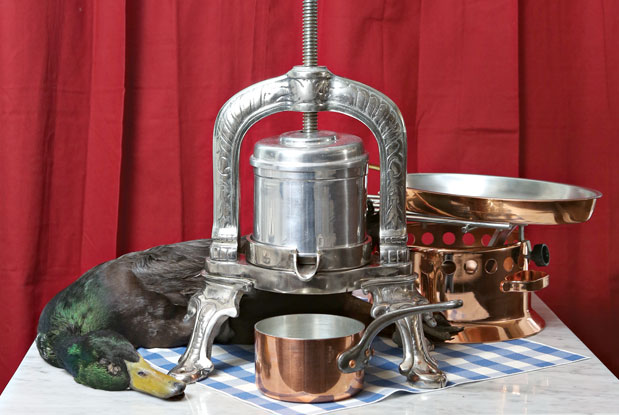
Niagara Street’s Edulis has also gone way, way back by reviving one of the great French dishes of the 19th century: canard à la presse, which translates to “pressed duck.” This is a delicacy that seems barbaric — and it is — but it is also delicious, and it was nearly impossible to find in Canada (outside of Quebec, at least) before Edulis starting doing it late last year.
The key to canard à la presse is using a duck that has been strangled, instead of killed in some other gruesome way, so that the blood is retained. This blood will be necessary when duck parts are stuffed into the press and squished to make one of the planet’s best possible sauces.
Edulis serves the duck as part of a six-course meal for four people, and it’s an experience that should be sought out with urgency. Chef Michael Caballo needs three weeks notice so he can procure a top-notch duck and also so he can age the carcass for two weeks (this intensifies the bird’s flavours).
He serves lighter fare for the first few courses — seafood, usually — before getting into duck leg in course four. The height of the experience is course five, wherein the vintage press (secured from an auction, which in this case means eBay) is brought tableside, and the duck’s bones and offal are juiced for everyone’s viewing pleasure. A sauce is then prepared — also tableside — with shallots, La Fine Bretagne (an apple liquor), duck jus, foie gras and the fresh duck extraction, and it’s all drizzled over medium-rare duck breast.
Over in Little Italy, Frank’s Kitchen does a take on oysters Rockefeller, est. 1899. The original recipe for this dish was conceived at Antoine’s, a New Orleans restaurant that has been around since the beginning of time, and it is often emulated but never duplicated (the original recipe has been kept under the strictest of wraps). For this version, chef Frank Parhizgar sautées spinach and bacon, adds poached oysters, bread crumbs and hollandaise sauce and then bakes them. The restaurant sells hundreds of these little guys every week — not bad for a snack invented over a century ago.
Yorkville hasn’t escaped this little trend thingy either. Set in a Victorian townhouse, the Oxley is one of the prettiest pubs in the city (I’ve heard good things about the women’s powder room). Chef Andrew Carter does lots of old British favourites, including Scotch eggs, suet pudding and Welsh rabbit (also known as Welsh rarebit). This latter snack, as flavourful as it is old, has no rabbit in it — it’s essentially cheese on toast but more composed. Carter makes a cheese sauce with aged cheddar, Worcestershire sauce, mustard and stout, then douses a piece of house-made sourdough with it.
When I was a kid, I always thought the future of dining would be a little different. Grey sludge, maybe, with the perfect balance of vitamins and nutrients. I also thought we’d have flying cars by now.
The lack of sludge I’m fine with.

