
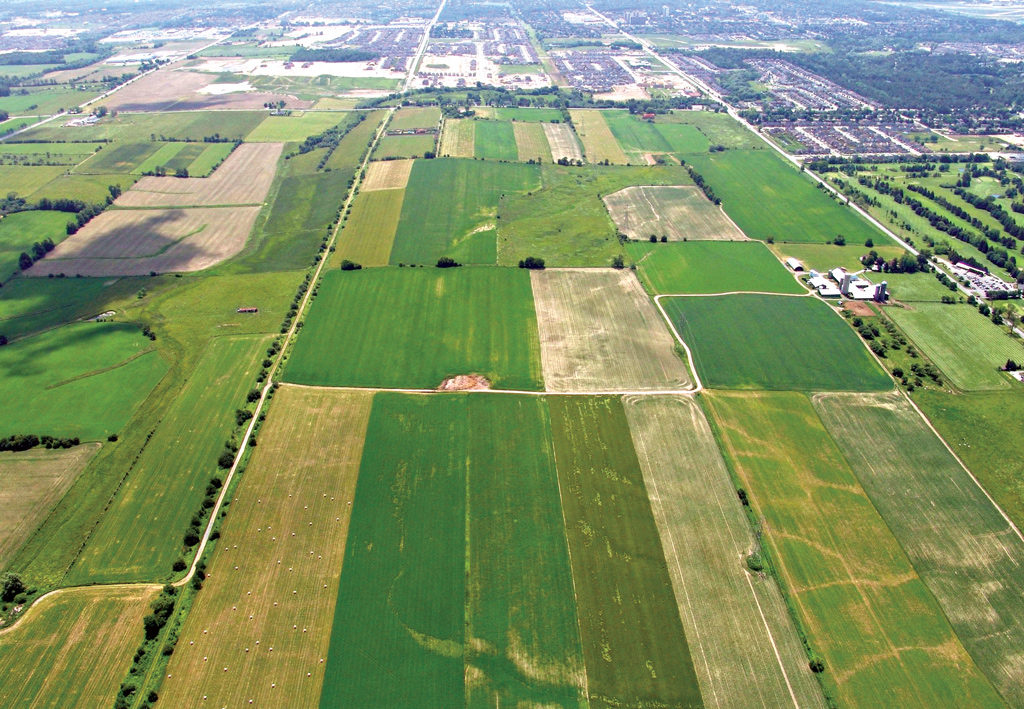
Almost half of Canada’s urban base is on land that only a few generations ago was being farmed. The need to supply food, shelter, fresh water and energy to billions of urban residents is resulting in loss of farmland, forests, wetlands and other ecosystems, as well as the critical ecological services they support, like providing food, clean air and drinking water.
According to Statistics Canada, nearly four million hectares of farmland were lost from 1971 to 2011, mostly due to urbanization.
Ontario has enacted the growth plan for the Greater Golden Horseshoe to encourage towns and cities to grow upwards through densification rather than outwards through car-dependent urban sprawl. Ontario has also established a two-million-acre Greenbelt of protected farmland and green space, which wraps around cities such as Toronto, Hamilton, Markham and Burlington.
A major outcome of the growth plan and the Greenbelt has been in protecting farmland from development and revitalizing southern Ontario’s agricultural industry. The Greenbelt alone, comprising just over 20 per cent of the region, generates more than $9 billion in annual revenue to local economies, producing a bounty of fruits and vegetables, beef, pork, dairy, honey and award-winning wines.
David Suzuki Foundation research shows the Greenbelt’s farmland and green spaces also provide an estimated $2.6 billion annually in non-market benefits, such as water filtration by watersheds. This saves local municipalities hundreds of millions of dollars they would otherwise have to spend on water infrastructure and treatment facilities.
The growth plan and Greenbelt also encourage smarter urban growth in the region through more efficient use of available land — which in turn reduces the cost of infrastructure and supports public transit.
A recent report by urban planning group the Neptis Foundation found urban expansion has slowed since plans were implemented. From 1991 to 2001, the footprint of Toronto and surrounding suburbs grew by 26 per cent to accommodate about 1.1 million new residents. Between 2001 and 2011 it expanded by just 10 per cent to accommodate roughly the same number of newcomers.
Although the Greenbelt is curbing sprawl and protecting farmland and green space, it’s far from secure — and the remaining 80 per cent of the region’s farmland and natural systems remain unprotected. Proposed highways, pipelines, hydro corridors and sprawling subdivisions could fragment natural and agricultural systems. Environmentalists have joined farmers and local food advocates to urge Ontario’s government to strengthen regulatory protection for the Greenbelt and to expand it.
Canada’s towns and cities are at a crossroads. One path leads to sprawling urban expansion, and the other creates higher density communities surrounded by farmland and green spaces.
What kind of cities do you want?

