
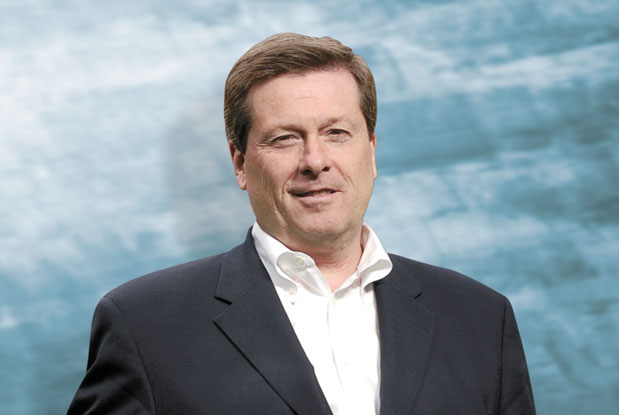
As a former commissioner of the Canadian Football League, John Tory presumably knows the sporting axiom that the wisest teams win before they set foot on the field. Gathering the right players, studying the opposition and developing the right game plan are crucial steps that take place behind the scenes. Since Tory first floated the idea of a run for mayor in June, the city’s politicians and pundits have been closely watching the radio host for signs that he, too, is working on a game plan of his own.
With his frequent appearances on television and at events and a willingness to comment on everything from Rob Ford’s troubles to the GTA’s traffic woes, crime to unemployment, Tory certainly gives the impression of a politician with his eye on a prize. Tory’s official line is that he hasn’t decided whether to run yet, and it’s one he repeated in an interview with Post City Magazines.
“I said in June that I am considering it. I don’t really have anything to add to that right now,” he said, pointing out that his duties hosting his Live Drive talk show on Newstalk 1010 and as chair of the CivicAction pressure group take up most of his time.
But that hasn’t stopped others from campaigning on his behalf. Draft John Tory, an online petition, appeared last year calling on his supporters to sign up and push for “real, honest leadership when we need it most.”
In November, a number of newspapers reported that several dozen influential backers of a Tory bid had held at least one meeting to discuss how that might unfold. Bob Richardson, a Liberal organizer, is quoted in the National Post as saying there is a “hunger for an adult in charge at city hall.”
Tory, however, is publicly maintaining a distance.
“There are quite a lot of people who would like to see me run and who want to help,” he said. “They are in touch with me in the sense that they are communicating their desire to see me run. I gather from what I mostly read in the newspapers that they are having meetings, but they are not meetings I have organized or have asked to have organized.”
On paper, Tory appears well placed to present himself as a sober and sensible face of the centre right. Despite his somewhat indifferent electoral record — he came second to David Miller when he ran for mayor in 2003 before becoming leader of the provincial Progressive Conservatives only to lose his seat in 2007 — his radio show gives him a public profile, and he is well connected and well placed to raise the $1.3 million needed to run a competitive campaign.
A few polls presenting hypothetical election situations suggest Tory enjoys solid, if not spectacular, support. Depending on the other candidates, he could come in second place behind Olivia Chow or a re-elected Rob Ford.
At present, Tory’s strategy seems to be to present himself as the mature statesman, saying soothing words to a city not at all sure it likes being known on the international stage for having a crack-smoking mayor. Tory’s talk is of building consensus and “stability of leadership.” While Ford is preparing for bloodbaths and war at the next election, Tory speaks of having a solid debate about issues, not personalities.
“The problem today is that, when people make it all about themselves as opposed to all about the city or the office of the mayor, you end up with a campaign that isn’t necessarily very constructive in terms of building a stronger, fairer city,” he said.
Though he calls himself a fiscal conservative and claims to be a fan of Ford’s work to cut costs at city hall, as chair of CivicAction, Tory has been vocal in demanding investments in the GTA’s creaking transit infrastructure.
CivicAction is the group behind the Your32 advertising campaign, which is trying to persuade the public to support extra taxes or charges to fund improvements to cut commute times.
Tory believes a downtown relief line should be among the city’s priorities and also has called for improvements to transit around United Way–identified priority neighbourhoods to help unemployed people find and commute to work.
He has also urged a shakeup in the way infrastructure projects are handled by the various levels of government to make it clear who runs the show.
Citing the numerous plans that have been floated for Toronto’s transit system in recent years, he said, “It seems almost like nobody has that last word so there never is a last word. And if there’s never a last word then the shovel never goes in the ground.”
He added, “I believe that one of the mistakes we’ve made is to allow the selection of projects and the prioritization of projects to become a political football.”
Whether Tory will take a kick at that football himself is likely to become clear in the new year.

