
There was once a time not so long ago when nobody — nobody — would have paid more than $2 for a Vietnamese banh mi sandwich in Toronto. The crazy cheapness of banh mi has always been a draw, aside from the delicious taste, but somehow, banh mi got gentrified.
These days, Torontonians are lining up for tricked out versions of it, filled with marinated short ribs, spice-rubbed pork belly or even duck confit. And they’re paying upwards of $7 a pop. How did this happen?
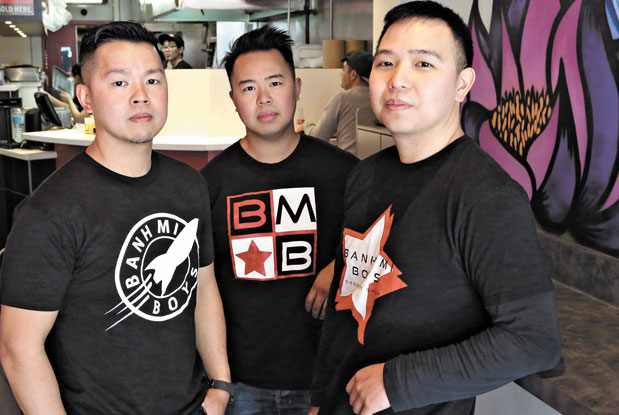
New York superchef David Chang is, of course, partially responsible. When he started serving banh mi at Ssäm Bar a few years ago, the sandwich was guaranteed at least a few moments in the global spotlight. But here in Toronto, we have a few banh mi pioneers of our own. Meet David, Philip and Peter Chau, three brothers in their early to mid 30s. If their names don’t ring a bell, perhaps their collective moniker will: they’re the Banh Mi Boys.
The Chau brothers have banh mi in their blood. Years ago, before they had their own restaurant mini-chain in Toronto, their father, Toha, was a baguette-slinging street food vendor in Saigon. Toha supported his sizable family (three sons, a daughter and a wife) by selling banh mi, and he eventually dedicated his life to it, like his sons later would.
In the ’80s, he moved the family to Canada, and he took up factory work. He saved up enough money to open his first shop at Dundas and Bathurst: Nguyen Huong, now a Toronto stalwart serving banh mi and other Vietnamese goods. There, Toha made sandwiches that were as close as possible to the ones he served in Vietnam, featuring cold cuts, pâté, carrot-and-daikon slaw, cilantro and, most importantly, a baguette so crispy that it almost hurt to bite into it. He even imported equipment from his homeland. There were lots of banh mi shops around Toronto back then, but Nguyen Huong managed to thrive. It now has multiple locations around the GTA. “In the beginning, my dad didn’t have much help,” David recalls over lunch at New Sky restaurant. “He had one employee. She’s still with us now.”
People loved the sandwiches. To keep up with demand, the family helped out. The young Chau brothers chopped vegetables, peeled garlic, prepared meat for storage and dealt with cash. As they got older, they operated machines and ground meat. In the beginning, the family worked downstairs and lived upstairs, together in one room (their grandmother lived with them, too, in a room of her own).
Eventually, Toha opened a factory to produce meat and later bread for the burgeoning business. He put his sons in charge of the factory’s operations. This would prove significant for the future of Toronto’s dining scene, because the factory gave the Chau brothers a chance to experiment. Once they had operations down, they started making their own food, modifying recipes and getting creative with flavours.
“Any time we wanted to try something, we’d go to the fridge, grab a hunk of meat and try it,” David says.
The brothers toyed with their own creations for years. They started ordering cuts of meat that their father didn’t use, and they came up with their own style of bread, similar to a traditional banh mi baguette but better suited to hold hot meat, easier to toast and less dogmatically crispy (“nobody wants the roof of their mouth getting cut,” says the eldest brother, Philip). David found a Korean girlfriend, whose family taught him how to make kimchi — and that opened a whole new door of flavours.
Then, in 2011, armed with a repertoire of new school banh mi and other Asian-inspired foodstuffs, the boys took over a shawarma joint near Queen and Spadina and opened up the first location of Banh Mi Boys.
They knew that playing around with banh mi was risky, but their flavours were right on trend: in pork-crazy Toronto, who could disagree with pork belly slow cooked with veal stock and cola, then seared? They also served steamed buns (another Momofuku hit) and their own take on tacos. Still, the first day was atrocious. They sold $30 worth of product. But things picked up after about a week thanks to office workers and other people in area. A month later, with zero advertising — through word of mouth and social media alone — they were officially busy.
“We just found the right crowd right off the bat,” David says. “We didn’t eat, we didn’t sleep, we just worked.”
In 2013, they opened a second location at Yonge and Gerrard, and this year could be their most significant yet. They plan to open another Banh Mi Boys branch — the location has yet to be decided — and they’re also venturing into Chinatown with a new concept called Lucky Red. The environment will be similar to Banh Mi Boys, but the focus will be steamed buns, and it will also serve other sandwiches and the traditional Vietnamese dessert known as chè.
Lucky Red’s upcoming location at Dundas and Spadina is interesting for a number of reasons: for one, it’s right next to Nguyen Huong, their parents’ business, and for another, it signals further gentrification in Chinatown (across the street, the founders of 416 Snack Bar are opening their new restaurant, People’s Eatery).
The Chau brothers may have helped elevate banh mi from a niche Asian food into something now craved citywide, but can they hack it in the jungle of Chinatown? The boys appear confident.
“Even if the area isn’t ready now,” says David, “it will be.”

