
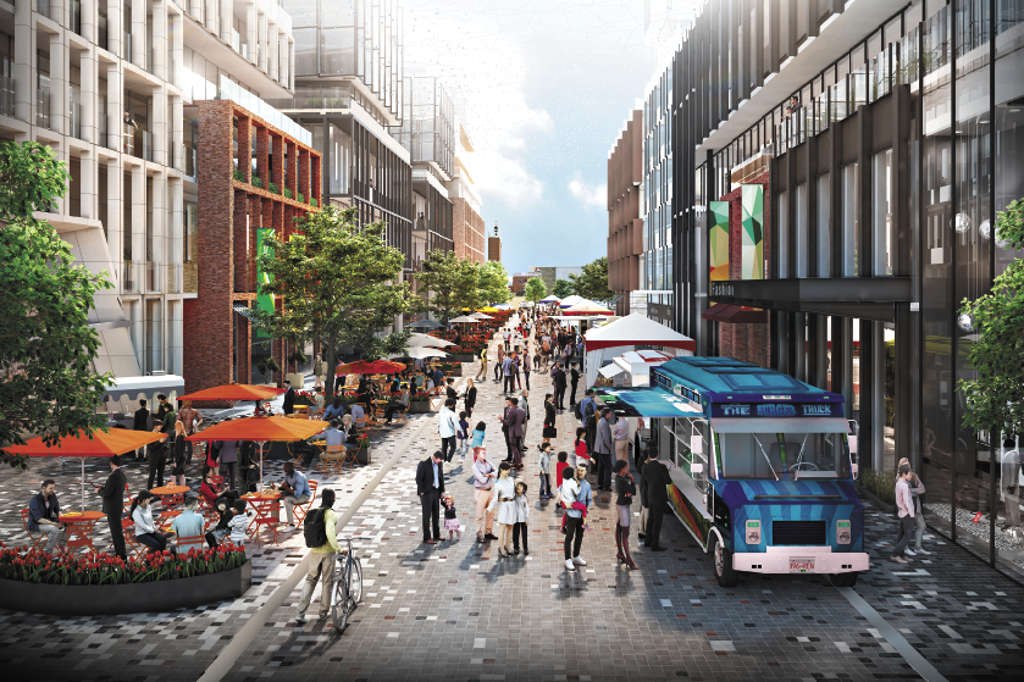
The City of Toronto is reviewing an application to transform the southwest corner of Bloor Street and Dufferin Street into a mixed-use development that will include six new buildings ranging in height from six to 47 storeys, 2,219 residential units and a community hub. Despite provincial funding and intergovernmental planning for the hub, its future remains uncertain.
The Province of Ontario pledged $20 million dollars, meant to support both a new school’s construction and the community hub, with $7 million allocated to the hub. One clear requirement the province has for the hub is that it must include child care services. However, as of a city community consultation meeting on Feb. 7, no specific hub plans exist.
Maggie Hutcheson, a longtime area resident, attended the consultation at which residents, including Community Hub Visioning Group members, learned the funding details of the hub.
“There is, in fact, no guaranteed space for a community hub but, rather, $7 million that the City can use to pay back the developer for a small portion of the buildings to serve as a community hub,” she posted on Facebook. “Given that the developer may make close to a billion dollars selling these units, it’s pathetic.”
The land was declared surplus by the Toronto District School Board (TDSB) in 2013, and later its real estate division, Toronto Lands Corporation (TLC), prepared to accept developer bids. But when the province launched a community hub creation initiative, the TLC deferred the sale to consider taking part. A committee was formed, comprising the TLC, TDSB, province and city, “to look at opportunities that might be available as part of the disposition process,” said TLC CEO Daryl Sage.
After research and community consultations, the committee recommended that 30,000 square feet should be set aside for the hub. Yet TLC selected a developer for the site without including construction of the hub as a mandatory condition of purchase.
“We engaged the development community saying, ‘We want a placeholder of up to 30,000 square feet of community space, and you will build it provided there’s a funding source,’” said Sage, adding, “If it comes at the expense of the developer, it comes at the expense of the school board.”
In December 2016, Capital Developments and Metropia were selected as purchasers in a conditional $121.5 million sale, pending city planning approval. At the same time, the province announced its financial pledge.
Historic Kent Senior Public School, one of two schools on site, will be incorporated into the development, with its main floor and basement now being considered for community hub use. Bloor Collegiate Institute will be demolished and replaced with a new 125,000-square-foot school on adjacent land that will remain in TDSB possession.
The developers will be required to provide money for community benefits under Planning Act, Section 37. Yet the $7 million in provincial funding is an added, separate contribution, which, according to the developer, is “to ensure a day care is built within the hub.”
Councillor Ana Bailão of Ward 18, Davenport, emphasizes the divisions between city involvement and provincial involvement.
“The money that comes from the province is not part of [the city’s] planning [process] but is part of the sale process,” she said. “We have Section 37 benefits and as a community will decide how to spend those. I have concerns about how we’re going to put a good community hub together given the limited resources we have.”
Daryl Sage, too, highlights the distinct responsibilities of those involved.
“There’s a great opportunity for the hub since we established the placeholder space, but the school board has no jurisdiction over city planning. The province is making a contribution, and if only that money goes into the hub, if that builds them 5,000 square feet then that’s what will occur on site.”

