
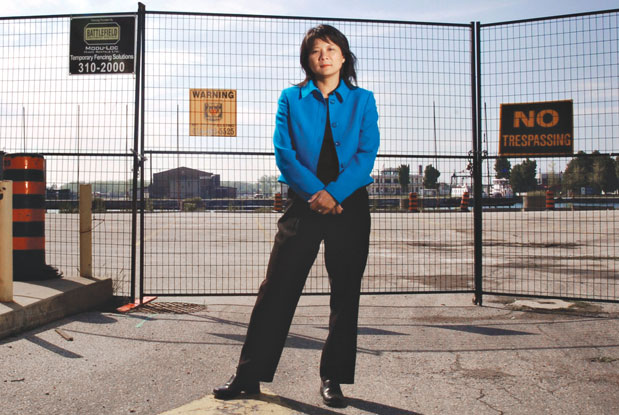
When we spoke on Valentine’s Day, like many who have lost love, Olivia Chow admitted to feeling some dread about the holiday. She’d been running around since morning promoting her new memoir, My Journey, but as soon as the Trinity-Spadina MP settled on her couch in the downtown home she once shared with former NDP leader Jack Layton, there was time for a moment of reflection on the day.
Two and a half years after losing Layton to cancer, Chow doesn’t hesitate to recall the (potentially painful) memory of their Valentine’s tradition.
“Tonight will be a bit difficult. Jack was a complete romantic, and I would get flowers,” she says, before quickly shifting back to the present: she’ll purchase flowers for her mother and run some errands for her father before spending the evening with a friend.
Although Chow says she likes to orient herself to the future and not dwell on the past, circumstance dictates otherwise. Layton’s very public death initiated a public grieving process. After years of fielding questions about loss and being asked to look back on her decades-long relationship and political partnership, Chow realized she had a story to tell — and a book to write.
“Immediately after Jack passed away, I’d have all these people asking me, ‘Olivia how are you doing, how are you managing?’” Chow says. “Many would have lost a husband or a father, and they’d say, ‘How you deal with grief might be helpful for me.’”
Through these conversations with friends and strangers, and regular formal speaking engagements with bereavement groups, Chow began to piece together the larger narrative of her life. “I started writing all these things down, and I cast back to where my strength came from. How did I manage it?” she asks.
Her answer, laid out in her memoir, is simple: experiences of adversity early in her life steeled her for pain.
Chow writes of her family’s tough transition from an easy upper-middle-class lifestyle in Hong Kong (“I had a dog and I had housekeepers”) to a financially and emotionally precarious position as immigrants in Toronto. “It’s a very typical immigrant story,” Chow says. “My mom and dad were teachers — my father was a school superintendent — but he wasn’t able to find the kind of job he was trained in, so he was really frustrated, and he just took it out on my mom.”
The family struggled as her father became physically abusive toward Chow’s mother before he eventually suffered a nervous breakdown and had to be treated in a psychiatric ward.
This dark time, which she considers one of the defining periods of her life, is just one of several very personal chapters that Chow has chosen to share. She describes her teenage years of waiting tables and studying sculpture at OCAD when she would frequent Gwartzman’s for art supplies and hang out in pubs near College and Spadina.
She also covers in detail her relationship with Layton, even including his handwritten love letters (which she excitedly flips to, praising his “amazing writing”). And she doesn’t shy away from the loss she suffered. In the mould set down by authors like Joyce Carol Oates and Joan Didion, both of whom Chow read after Layton’s death, she recounts her own grieving process.
“That was the hardest part to write,” says Chow. “It was hardest to relive the really difficult period of Jack being sick and dying, then the funeral and what I experienced immediately after.”
What the memoir makes clear, however, is that Chow’s personal experiences are not the experiences of your average private citizen.
For all the intimate revelations and anecdotes in the book, My Journey is also deeply political.
The book follows Chow’s career path from school trustee to city councillor to member of Parliament, establishing the political ethos that underpins all her work — though Chow doesn’t quite frame it that way. “It’s mostly personal stuff, and in the middle it says how I got involved in politics, with little political stories, but those are really events where people came together,” she says.
“For example, there’s the story of how we worked together to get children’s nutrition programs in schools, so that if kids are poor they have a chance to have a decent meal.” Such initiatives are at the heart of Chow’s work, with its emphasis on urban community building and sustainability.
Although rumours swirled as to whether she would run for mayor in our upcoming election, there can at least be no doubt about Chow’s political platform. If her memoir mashes together the political and the personal, it’s because, for Chow, they are inseparable, and she says so explicitly. “There isn’t any line between the two,” she says.
“Not everybody lives and breathes change, but I think everybody wants to improve their situation. A lot of people want to make their neighbourhood better or make their family better, so it’s the same kind of desire — to do work that makes life better for others.”
Chow is unabashed in her love of Toronto and her dissatisfaction with the current, headline-making regime.
“I know that I wouldn’t want my grandkids to have Rob Ford as a role model, and I think other parents feel the same way,” says Chow. “What is unfortunate is that we spend so much energy dealing with that and not the positive energy of working to make our transit system better or decreasing the number of potholes, so when I ride my bike, I don’t get hurt, or how to deliver better community programs.”
Today, Chow resigned from her position as MP and is expected to launch her mayoral campaign tomorrow, while on the side, she gets accustomed to her new role of memoirist.
She is once again striking that balance between the political and the personal, and Chow is in her element.

