
In 2011, the works of Canada’s Group of Seven and Tom Thomson wowed an adoring public in London, England during a three-month exhibition at the Dulwich Picture Gallery. The crowd caused such a ruckus and one of the most oft heard refrains, according to co-curator Ian Dejardin, was the call for a follow-up exhibition of Emily Carr.
Dejardin took it to heart and after consultation with Canadian art critic Sarah Milroy, the two got together to curate From the Forest to the Sea: Emily Carr in British Columbia. Again, a massive success. And this time the exhibition, which closed in London at the end of March, has crossed the pond to the AGO in Toronto where it will open to the public on Saturday, April 11.
The show posed an interesting challenge. In England, according to Dejardin, nobody has ever heard of Emily Carr, “unless they’ve had a holiday in Vancouver.” Whereas, in Toronto and across the country Emily Carr is a national treasure. So, the question was how to introduce her in one country and show her in a new and interesting way in another.
Both Milroy and Dejardin were on hand for a media preview of the exhibition where they talked about these challenges and others. And, it looks like they’ve risen to meet them all. Carr was a hit overseas, and this exhibition does provide a great introduction to Carr in an intriguing way without getting bogged down in sentimentality. And we are also offered a look at the B.C. artist that is fresh and fascinating.
Instead of a linear progression showing Carr’s first steps to her last, the works do travel from forest to sea in subject matter, and technique. That, in and of itself, seemed new and instead of concentrating on the more well-known works in Canada, her more adventurous periods are showcased.
She’s not just an honorary member of the Group of Seven who shook off her stodgy Victoria, B.C. upbringing, or the quirky artist who lived and smoked in a caravan in the rainforest with her pet monkey.
This offers Canadians a more global perspective to Carr’s work. After all, as Dejardin notes, Carr was far from a humble painter of totem poles. She was thoroughly trained in San Francisco, London and Paris and her works should rightly be seen alongside the true masters of the time.
The exhibition is divided into five main rooms beginning with darker, moody works of the forest including well-known paintings such as “Indian Church” and “Totem and Forest,” continuing on through her watercolour period, her encounters with the Group of Seven and especially Lawren Harris and her departure in the 1930s followed by her experimental period including her iconic work “Scorned as Timber, Beloved of the Sky” that speaks so beautifully to her love of the natural environment and her concern over its fate.
The “A New Freedom” section of the exhibition is really positioned as the centre and highlight, and best speaks to the bigger picture. These works are from the early 1930s and, for our co-curators, show Carr at the height of her talents, basically putting it all together in one series of breathtaking works using Carr’s own recipe of oil paint mixed with gasoline. They are gorgeous, full of light and radiating a warmth and energy that are well and truly unlike anything else. If there are paintings that best represent Carr to the world, they will be found on this wall.
One particular work from this period, “Windswept Trees,” made the list of a noted London art critic Laura Cumming’s top 10 works of the season. A season that included names such as Rembrandt and Van Gogh.
Secondly, the curators had to deal with the nagging question of Carr’s appropriation of First Nations imagery and ideas. This was done in a couple of ways. One, Carr is presented as something of an imperfect scientist who, when faced with what she saw as the possible extinction of First Nations in British Columbia at the time (thanks to us and our diseases) worked feverishly to document the culture. In addition, this exhibition features art and cultural artefacts from these very First Nations of coastal British Columbia in a way that speaks to endurance, to survival, to beauty and to the relationship these people have to their land. And, of course, what this means for us because we never want to be in a position where our follies could again jeopardize their way of life.
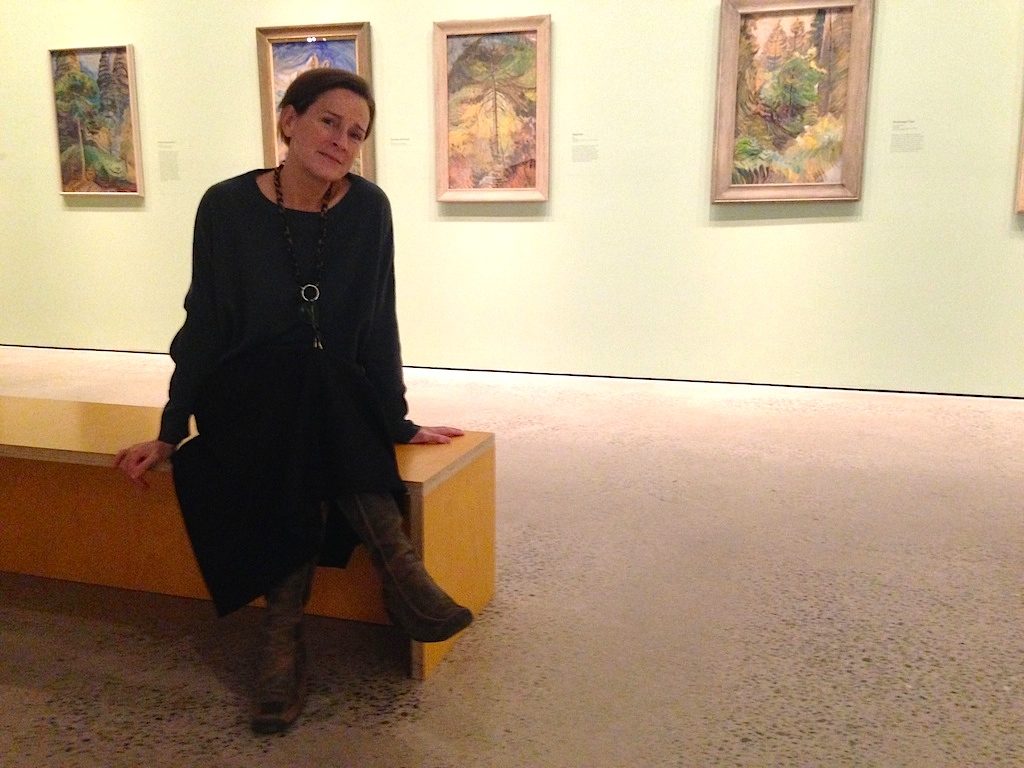
On hand for the media preview, Nika Collison, curator at Haida Gwaii Museum at Kay Llnagaay, who helped arrange several loans for the exhibition.
Dulwich Picture Gallery is the world’s first purpose-built public art gallery, founded in 1811.
From the Forest to the Sea: Emily Carr in British Columbia, included in the AGO general admission, runs until Aug. 9.

