
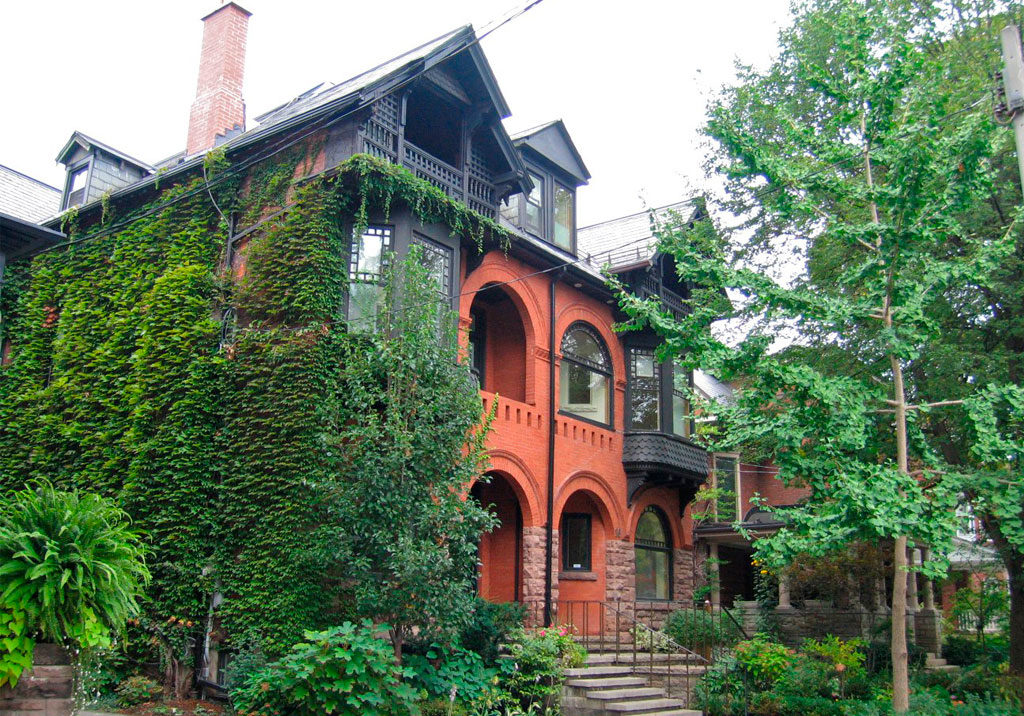
Renowned urban theorist Jane Jacobs once called it home. It’s lively at night. There are many more bookstores than in any other neighbourhood in Toronto. It is, arguably, the most successful, walkable, livable community in Toronto. As a new wave of gentrification washes through the area, can the artsy, academic Annex maintain its unique essence?
With the impending redevelopment of Honest Ed’s — the wonderfully absurd temple to kitsch — about to usher in futher gentrification, along with a new building on Dupont Street on the area’s northern border, the question of the area’s transformation is heating up again. As real estate prices continue to rise in an area that has long maintained a hippie-ish vibe, many worry about the future of an area that has long been the traditional preserve of artists and academics.
Elise Kalles is one of the city’s leading carriage trade realtors and specializes in luxury properties. She reports that the neigbourhood is changing, as former rooming houses are being converted back to single-family homes, and prices are on the way up.
“The Annex has become Toronto’s most heterogenous community. Yes there are artists and academics, but it is a very in-demand area for successful business people and well-known socialites,” she said. The vibrancy draws on the energy from the University of Toronto, she said, but also from the proximity to Bloor Street and Yorkville’s Mink Mile.
“This reflects a return to prominence of this historic Toronto neighbourhood,” she said. “A perfect example is a converted four-plex on Lowther that sold earlier this month. Asking price was $4,495,000. It sold in two weeks for $5,300,000.” According to Realosophy Realty, the average price in the Annex is more than $1.2 million.
Vancouver-based developer Westbank Corp. has unveiled its plans for a new rental development that includes a 29-storey tower on the corner of Bathurst and Bloor. But a potential tussle over the maintenance of century-old residential facades and storefronts on Bathurst and Markham has continued.
Most recently, Toronto and East York Community Council approved a motion to add 35 properties along those two streets to the City of Toronto’s Inventory of Heritage Properties. The original Westbank plan preserves some of the properties but not all.
Mike Layton is the city councillor for the ward. He said the newly listed buildings represent a more “robust” plan in terms of preserving existing heritage buildings than the proposed Westbank project.
“They had planned to address some of these listings but not all. So that’s what we’re going to have to work out,” said Layton.
There is a meeting scheduled with the developers later this year. But Layton noted that, “If a developer wants to, they can ignore properties on the heritage list.”
When asked how the negotiations with Westbank have played out so far, Layton said, “They’ve been pretty attentive.”
The Annex Residents’ Association (ARA), would like to see the facades preserved. In a submission to the city, ARA executives wrote that, “We encourage Westbank to embrace the approved Bathurst study and to be as innovative as Ed Mirvish was when he couldn’t tear down a block of Markham Street to put up a parking lot.”
The ARA had success preserving the old character of the Annex with a long-term project to have Madison Avenue declared a heritage conservation district. It was a long time coming.
In 2004, the ARA encouraged City Council to create a district on Madison similar to the East Annex Heritage Conservation District for the area between Bedford and Avenue Road.
In the case of Madison Avenue, members of the ARA worked with respected Toronto heritage architect Cathy Naismith to carry out the study to preserve what the ARA describes as the “best preserved examples of late 19th and early 20th century tree-lined streetscape in the city.” Renowned architects such as E. J. Lennox, designer of Old City Hall, worked in the area. A Lennox design at 37 Madison Ave. was the first of many houses in the neighbourhood built in a unique architechtural style that would eventually be called the “Annex style.”
On Sept. 30, 2015, city council passed a motion to have Madison Avenue officially designated a heritage conservation district. So there are wins for the preservationists, even as development goes ahead.
David Harrison, chair of the ARA, said the increases in home prices continue to change the nature of the region. “The development pressure is on the edges of the Annex — Bloor Street, Dupont, Avenue Road, Davenport and Bathurst. The character of the Annex is evolving. But this is the case with all neighbourhoods in Toronto.” said Harrison.
On Dupont, the developer that delivered us the thriving King West strip, Freed Developments, is said to have bought up the old and fraying Galleria mall. That company is also rumoured to haves scooped up the old Mono Lino Typesetting building on the north side of the street, along with several other properties. These developments will join several development projects already underway, such as the Fuse condo at Dupont and Lansdowne.
Loblaws recently announced it is opening a store in the long-shuttered industrial building on the northwest corner of that intersection. The Sobeys down the street could be joined by two 14-storey condos built on top of the grocery store.
Critics suggest the idea that the area is rapidly going to become the next King West are a bit overwrought. They point out the street suffers from a lack of quality public transit. But surely, this empty land so close to downtown could benefit from some densification. To this end, there are some important developments.
The north side of Dupont has been zoned for employment-based developments, with reason. Dupont is just south of a major Canadian Pacific rail line that hosts up to 40 trains a day. But the city has changed those designations to allow residential (as long as it is built more than 30 metres from the rail line). Also important for the future of the area is the forthcoming Dupont Visioning Study, which the city is currently working on. That is expected to lay out development objectives for the area that can only be called “auto-brutalist.”
In addition to new residents, the changing face of Dupont is also bringing in new restaurants and shops to the once-beleaguered strip, spearheaded by restaurateur Anthony Rose who has opened a series of food establishments there including Fat Pasha.
Layton remains upbeat: “Yes, the real estate is getting more expensive. But there are still a lot of renters in the Annex, and there are still lots of students,” he said.
His advice for those hoping to preserve the neighbourhood is simple — shop local. “The way to keep those businesses there is to use your shopping dollar. Don’t drive to a big box store. Go to the local store,” he said.
“Encourage other people to do that.… That’s how we keep it.”

