
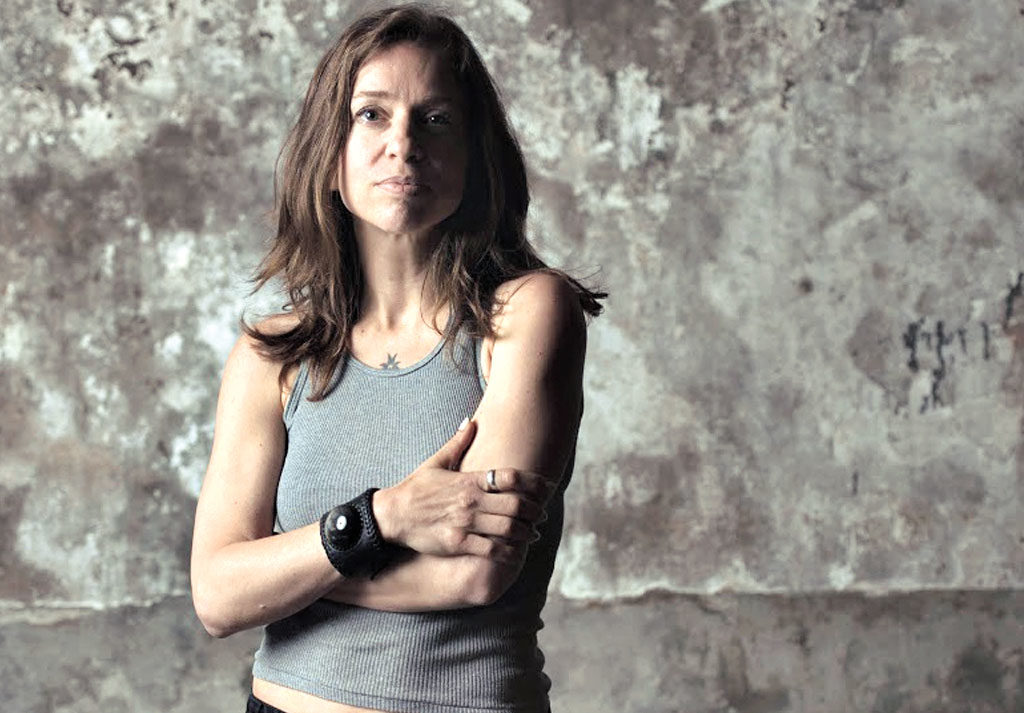
Folk singer Ani DiFranco has been entertaining and enlightening listeners since she started playing coffee houses when she was 14. At 18, she started her own, now booming record label, Righteous Babe Records. She’s put out 20 albums, won a slew of awards, moved to New Orleans, had a couple of kids and continues to amaze. She’s in town on September 14 for a rare concert appearance at the Great Hall. Go.
What has changed the most for you now, as both an artist and a mom dealing with playdates and chores as much as songwriting and touring?
Boy, I can sure relate to the chores and playdates! I feel so dizzy these days when I first step out onstage, surfacing as I am from the deep depths of mothering. It is hard for me to slip back into the boots I once lived in: the reading, writing, researching, picking, grinning, marauding revolutionary. I feel so far from it all sometimes. But children are nothing if not grounding (as in airplanes) so what I have in exchange is balance.
How has being a mother influenced your music?
Because my kids pull me away from my work incessantly and constantly I can’t get anything done. But because I can’t get anything done, when I finally do, the process has been infused with so much more time and perspective than it would have been otherwise. In essence, my kids have taught me patience. Mixing the ingredient of patience into my writing process has made me a better writer and has opened up whole new galaxies of possibilities within me.
When you first started out, you were so fiery and passionate and in-your-face. If you could go back and visit that youngster, what advice would you give her?
I am mostly mortified by that girl and steer very clear of her memory myself! But then … that has always been my problem: self-loathing. The older me would say to the younger me: “Do not seek validation outside yourself. You are beautiful. You are worthy, and if you don’t learn to love yourself first you will never get good at loving to others!” Of course, the younger me would not understand.
You’re playing a smaller venue where people stand up. It will be nice to revisit the intimacy of a club. Do you get a rise out of playing for a crowd like that these days?
Oh geebus, a standing venue! They are a challenge for this old bag of bones too! As you say, you gotta play a more amped-up show in a standing venue, so I’ll be sweating for sure.
You are doing your part to shine a light on the race issues that are so prominent in the United States and also here in Toronto. What message do you want to get out?
I really love the organization called Color of Change. They do great actions via the Internet that people everywhere can get involved in and support. I know you experience your own racism problems in Canada, but just thank goddess you never had slavery there. In America, the entrenched poverty of African-Americans, the broken homes and single momming, the mass incarceration of black men, the existence and unfair use of the death penalty … all are legacies of slavery. I am just glad that white America (largely through the cameras on cellphones) is waking up to the reality of race in America.
Who were your early musical inspirations?
My guitar teacher Michael Meldrum, Suzanne Vega and Joan Armatrading, John Fahey and Betty Carter. Sekou. Utah. Maceo.
Who are you listening to these days? Who is the next great protest singer in the United States?
The sound of my two-year-old kvetching. I wish I knew! I want their phone number!

