
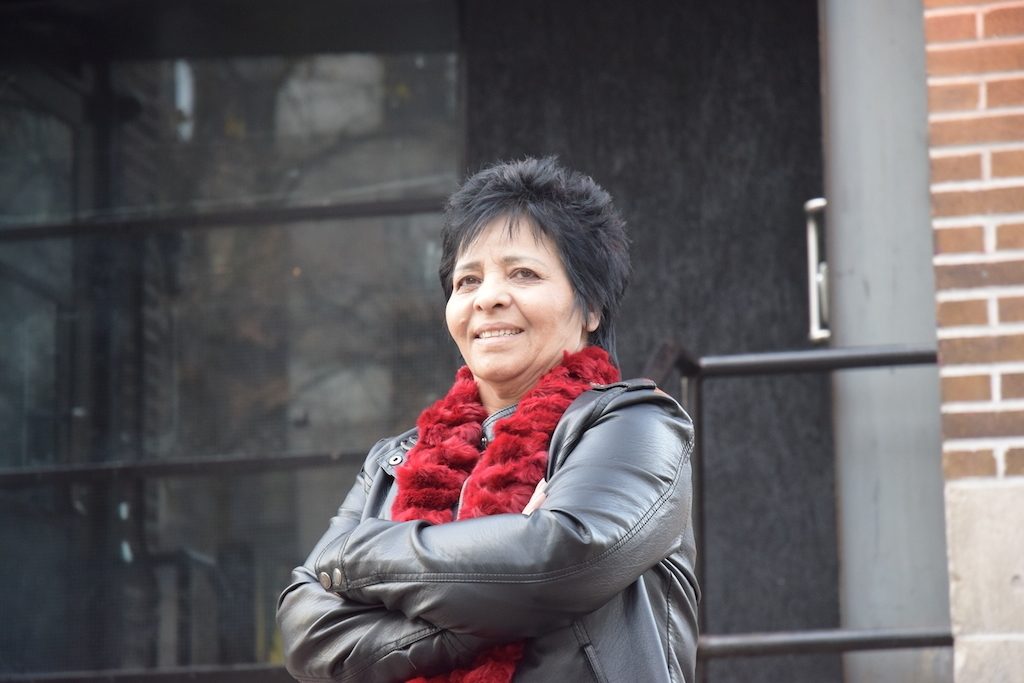
In 2008, Christopher Morris of Human Cargo Theatre in Toronto travelled to Afghanistan to collect stories of the families impacted by war to be part of a new theatrical project dubbed The Road to Paradise. Afghani actress Parwin Mushtael auditioned and won a role in the production, but then everything changed. The Taliban reared its ugly, misogynistic head once more and the impact couldn’t have been more devastating. Her life was threatened, then Mushtael’s husband was killed throwing her life in disarray. Somehow, after Mushtael was in hiding for four months, Morris helped the actress make her way to Pakistan and then onto Canada with her two children in 2010. Her story became the spine of a new version of The Road to Paradise and the production with Crow’s Theatre is finally ready to hit the stage at Toronto’s Buddies in Bad Times theatre. Post City spoke with Mushtael through an interpreter.
Why did you decide to become an actress?
Every human being has their own capacity. It started from childhood, six years old. I was very interested in theatre. In the house, I used to be in the middle and people would ask me how to do other people’s acting. And also from school on special occasions like Teacher’s Day and Independence Day and other occasions I used to perform. So, it was always something I’ve wanted to do. And due to some circumstances, I was not able to perform at an actual theatre at that time, but I’d always wanted to do it.
What circumstances?
During the Taliban, we all had to wear a burka. We were very restricted, all our movements. So, there was this feeling that was restrictive and limited inside me. One day during the Taliban, I got out of the house wearing clothing of a man. For four hours wearing men’s clothes, I walked around the city. It was hot, too. I was passing by the Taliban and they didn’t know. In case I was caught, they would pull out my nails and maybe kill me. During the Taliban time, all my feelings were kept inside me and I was looking for a way out. We were very restricted, there were no escorts, no activities of the women. My feelings were all kept inside and I wanted to express that. After the Taliban were defeated, I told my husband i wanted to be an actress.
And how did you manage that?
After the Taliban, there was a post for jobs for women to come and be an actress, work in theatre, be a journalist, but there were no women to come on the TV after the Taliban.
Why?
Everyone wanted to, but they were scared and also they didn’t have the courage to come on the stage or be on the TV. So, when I heard about the jobs, I told my husband I want to go there and start working as an actress. I went to the Afghanistan National Television and became an actress, and this gave courage to other Afghan women, so they followed me.
And how did your career begin?
They took my audition and I was selected and they asked me to have a play to be recorded. The show was called The Dark Night of the Taliban. So, I went to the stage and I had my burka and my shoes under my arm on the stage during the production. And then, the other guy, a famous actor, played my husband. So, the show was about the harsh times and experience that women have during the Taliban.
Your first role was a show criticizing the Taliban? Why take that risk?
Of course, because all during Taliban I was so restricted, after that with freedom I wanted to do whatever it takes even if they want my death. I would have done anything. Throughout history many people have died for freedom. That was my path for freedom; that was the reason I came to the stage.
And how long were you an actress in Afghanistan?
For 16 years, my job was for national TV. When I started working, I became famous very rapidly.
Tell me about the death threats.
There was a time after Taliban defeated they were gone, but after some years they emerged again, and then When they reappeared in society, Taliban against woman, I got threats and everything started.
Were they from people you knew, or just random?
I was threatened by other people I didn’t know, but also I was threatened by my in-laws. they were conservative. My brother also had six brothers, and they were conservative. They would threaten me and my husband and asking him why he would let his wife go and become and actress because this was a very bad thing to do. And my husband, he always supported me and defended me against all these threats from the family or outside the family. That’s why I think the Taliban or someone from his family, his brothers, killed him.
How did you learn of his death, what happened?
At that time, the night my husband was killed, he was outside and I even heard the shooting. but, I was sure it was my husband. When I called him, there was no answer on his phone, but I thought something was wrong. Usually, when he goes out he would tell me where. That night, he just said he had to go outside and I’ll be back. Then he went out and he never came back.
And what happened to you, after that?
For four months, I lived in Kabul, I was in hiding and lived in a place where we slept on the rock and brick. And even during the four months, I would still get threatening messages saying I was in that place and wearing that thing. I was amazed how they kept track of me and followed me, although I was wearing burka again. And then, I had to get out of the country, so I called Christopher Morris and he helped me a lot and we went to Pakistan.
Tell me why you think this play, your story, is important?
There are two things important in my play. One thing, we worked on this play from 2008 until now, and Christopher wanted me to be a part of this play. From 2008 until now, he was very patient for me to work in this theatre. The most important thing, is that this play is about my life an important part of my life, expressing my deep feelings and my experience which I had back home. And, it’s not just my experience and pain, but the pain and experience of thousands of other women around the world that I wanted to share with Canadian people and Canadian artists.
What do you hope people will take with them after seeing it?
So, the message I want for the audience is the pain and the bad experience that I had as an actress, and the bad things that happened because of me being an actress and then the pain and the experience of women who go through tragic experiences.
The Road To Paradise is written by Jonathan Garfinkel and Christopher Morris and is directed by Morris. The play stars Parwin Mushtael, Pakisani actress Samiya Mumtaz and Christine Horne. It runs at Buddies in Bad Times until Nov. 28. Following the Buddies in Bad Times production the show will play at Toronto’s Aga Khan Museum on Dec. 2, CFB Petawawa and then Pakistan.

