
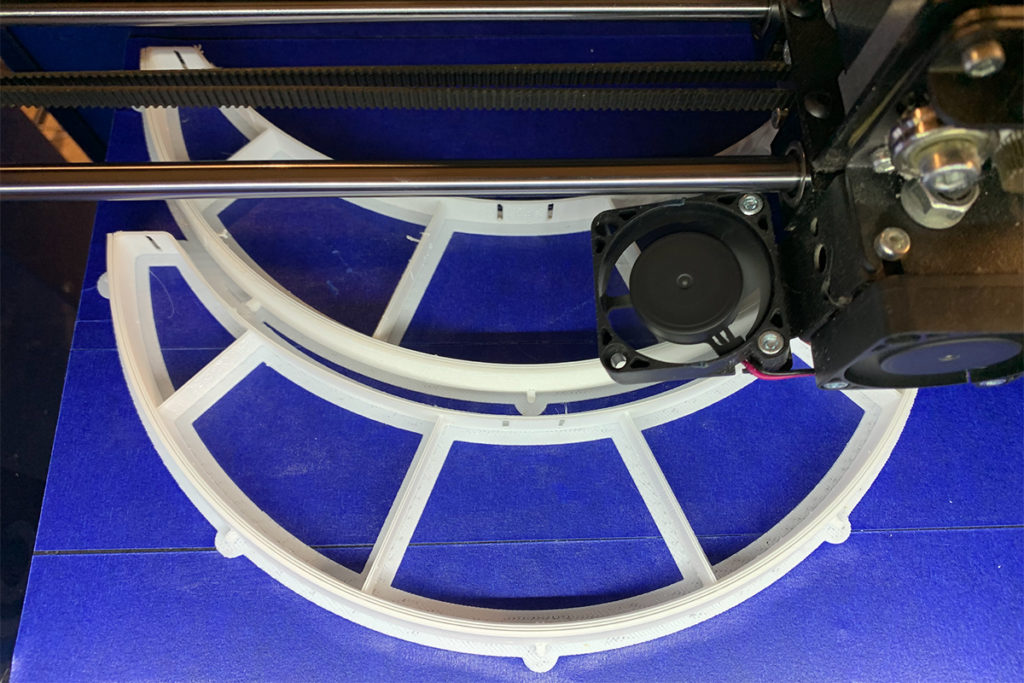
The shortage of medical supplies and personal protective equipment (PPE) for healthcare workers has been a major problem during the COVID-19 pandemic, but some of Toronto’s 3D printing labs have stepped up to help fill the gap in supplies.
One of the most significant efforts is taking place at Ryerson University, where the Creative Technology Lab has engaged its array of 3D printers and laser cutters to create face shields for doctors and nurses on the frontlines. Prototypes for the designs are already in testing at Toronto General Hospital, and the lab ultimately expects to be able to create 75 3D headpieces, 350 casted headpieces, and 425 laser cut plastic shields each day.
Perhaps more importantly, the lab is also investigating ways to reduce production times for face shield printing. “Currently, the lab can produce a single 3D-printed face shield unit in three hours, but we’ve prototyped a silicon mold for fabricating non-porous urethane resin face shields to increase potential output to one face shield unit in five minutes,” explains the director of the Creative Technology Lab, Jonathon Anderson.
This prototype will be tested and refined with the Unity Health Toronto, which includes St. Michael’s Hospital and St. Joseph’s Hospital and Providence Health Care. Two different types of face masks and two different types of face shields will be created with four laser cutters. Additional strategic partnerships could be in the works, but Anderson notes that “Health Canada has placed strict regulations on all PPE production.”
Other institutions have also taken up the charge to help fabricate essential healthcare equipment. The Toronto Public Library is loaning 10 of their 3D printers to the APIL project which is part of a larger initiative being spearheaded by the Glia Project at Toronto General Hospital. The Ultimaker 2+ 3D printers will be used to create face shields.
TPL is providing 10 of the library’s Ultimaker 2+ 3D printers for loan to a team at Toronto General Hospital to support their efforts to produce personal protective equipment (PPE) for frontline healthcare workers fighting the COVID-19 pandemic. https://t.co/vudG5mmRyq pic.twitter.com/400IZXdwSU
— Toronto Public Library (@torontolibrary) March 27, 2020
In addition to TPL and Ryerson, Objex Unlimited, Mosaic Manufacturing and Autodesk, have all provided PPE or 3D printers to the project.
Beyond producing PPE, other colleges are doing what they can to support the battle against COVID-19. Seneca College, for instance, has donated over 2000 pounds of medical supplies to three hospitals in the GTA: Southlake Regional Health Centre, North York General and Markham-Stouffville Hospital. The supplies included 2 ventilators, 30 cases of surgical masks including N95 and O2 masks, hand sanitizer, 100 cases of gloves and 40 canisters of cleaning wipes.
#SenecaProud to answer PM @JustinTrudeau‘s call with our recent medical supplies donation to @Southlake_News
The ~2,000 lbs of supplies included:
– 2 ventilators
– 30 cases of surgical masks
– 40 canisters of cleaning wipes
– 100 cases of gloves
– N95 & O2 masks#PlanktheCurve https://t.co/BraT5runLl pic.twitter.com/QaQvN7mRb4— Seneca College (@SenecaCollege) March 25, 2020
These supplies are typically used by students in nursing, animal health, biological sciences and applied chemistry, fire protection engineering technology and environmental and civil engineering technology.
Health workers can use all the support they can get right now, and the ongoing collaboration and innovation taking place in Toronto in response to COVID-19 is a bright spot during this crisis.

