
Hundreds of age-old trees in Lawrence Park will be spared the axe when the City of Toronto begins its overhaul of the area’s sewer system in the next few years. While some residents have expressed their relief, others argue the plan prioritizes the neighbourhood’s tree canopy over pedestrian safety.
On May 25, Toronto City Council approved a plan to mitigate storm water and basement flooding in the area and reconstruct 26 local streets. The plan will impact approximately 99 of 1,201 local trees, instead of the 350 originally proposed in 2013. Sidewalks will be installed on five streets.
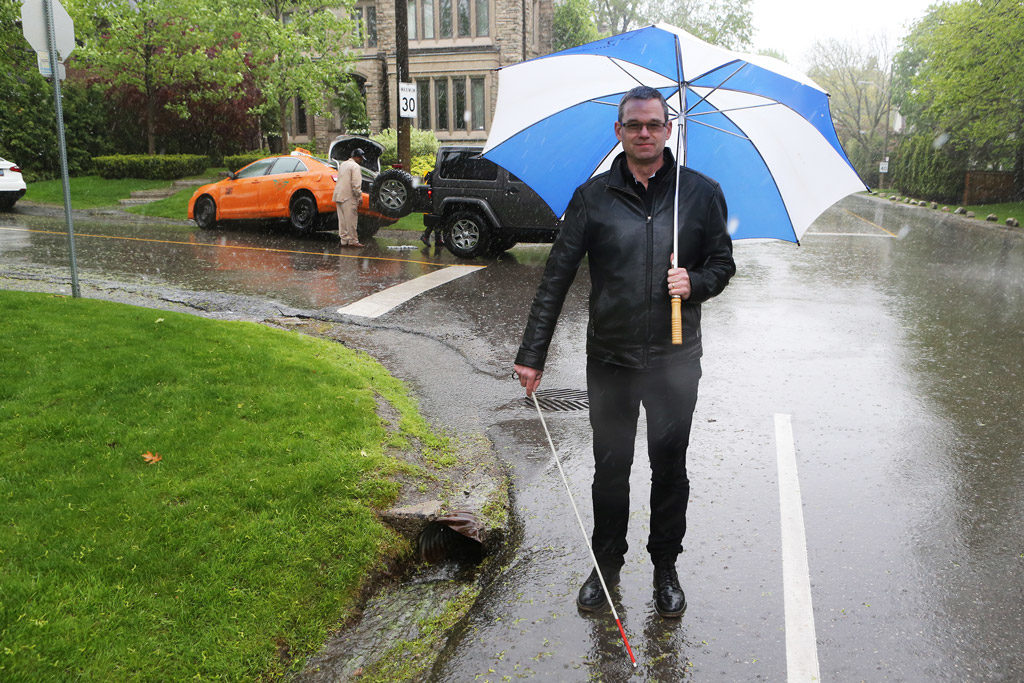
Brian McLean lives in Lawrence Park and knows first-hand how important navigational tools such as sidewalks and curbs are for the visually impaired. McLean, a client of the CNIB who uses a white cane, said he regularly avoids streets in the area without sidewalks.
“I do have some vision, but even on the roads without a curb, I could wander too close into the middle of the road and then that becomes very dangerous for me,” he said.
To illustrate McLean’s point, the cab he was travelling in to meet Post City on a rainy day in May, actually veered off the road into a ditch on Mildenhall Road.
Angela Bonfanti, executive director of CNIB, said staff didn’t get wind of the city’s plans until recently.
Bonfanti said installing sidewalks on only five out of 26 local streets is unacceptable in any neighbourhood, but is particularly problematic in Lawrence Park, which borders CNIB’s head office at 1929 Bayview Ave. and is frequented by people with sight loss.
The Lawrence Park Ratepayers’ Association (LPRA) was the driving force behind an appeal urging the city to scale back on the loss of trees.
Phillip Crawley, a member of the LPRA and publisher and CEO of the Globe and Mail, said the LPRA is pleased with the overall outcome.
“The overwhelming view was the destruction of trees was not something the residents wanted to see,” he said. “They’ve gotten used to not having sidewalks.”
McLean said he hopes the city will install more than five sidewalks over the next few years to enhance the lifestyle of locals living with a disability.
According to Bonfanti, CNIB will continue to advocate for more sidewalks in the future. “A tree can be replaced. The life of a person with sight loss cannot,” she said.
Construction in the area is not expected to begin until 2021.

