
In 1952, at the corner of Bayview Avenue and Eglinton Avenue East, Sunnybrook plaza became the first suburban strip mall, or plaza, to be built in Toronto. Since then dozens have popped up, adding character and convenience to local neighbourhoods as they grow.
Historically, these were mom-and-pop shops built around essential services from dry cleaning to convenience stores and food outlets. Now, if the current trend is any indication, the days of the plaza are all but over as real estate companies eye these primo sites for development.
Yes, it happens. But what does it really mean for those neighbourhoods in the long run? We are about to find out.
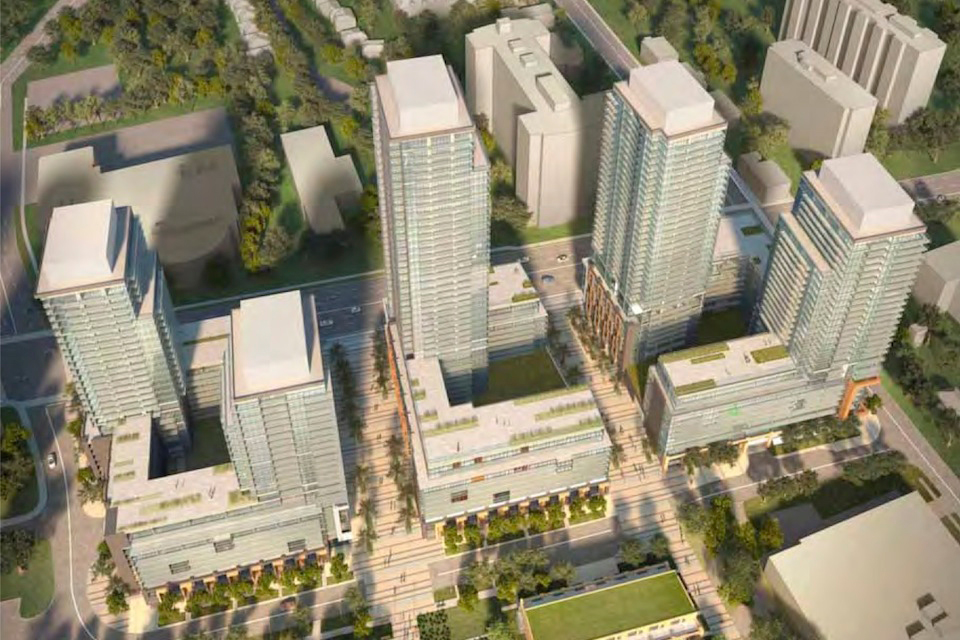
In the early part of 2015 it was announced that RioCan will have plans to develop the Sunnybrook space, plans that are now being dealt with at the Ontario Municipal Board before getting underway.
In the new development, there will be nearly 25,000 square feet of available commercial space, but the worry is that the rents will be so high no current retailers will be able to afford to come back.
Malcolm Firkser is the owner of Home Hardware in Sunnybrook plaza — a staple in the area.
“My feelings are this has been a long time coming, the development. For the sake of the community, I certainly hope the developer scales back to what I would call a more reasonable size development that fits community needs,” he said.
Residents say they are going to lose the community feel that these low-key shops offer.
“We have always enjoyed shopping at Sunnybrook plaza. Generally easy to park and just five minutes from any point in the Leaside neighbourhood. Stores like the longtime tenants Home Hardware and Pharma Plus are wonderful,” local resident Richard Byford said.
But it’s not only Firkser and Byford who are concerned by what happens next.
“At least a dozen times a day I’m stopped and asked — people want to know what’s going to happen to me and to us,” Firkser said.
He also said he is quite certain he will need to relocate. When is the bigger question. The Home Hardware lease is in place until 2019, so he is unable to do anything pre-emptive. The new development is likely still a couple years away. But a new location brings entirely new risks of its own.
“Here we all feed off each other … the businesses. People go do their dry cleaning, hairdresser, pop in and get what they need from the hardware store. Parents drop their kids off at Kumon [for tutoring], then they wander around our shop for an hour,” Firkser said.
Just this year, the city lost a strip mall at Eglinton Avenue East and Laird Drive, another on Yonge Street just south of Eglinton soon to go and several more on the chopping block. Bathurst Manor plaza in North York near Bathurst Street and Sheppard Avenue West is another example. As well as a massive development coming to the site of Newtonbrook Plaza.
For 20 years Sam Cossidente operated his Man About Town clothing shop inside the historic Bathurst Manor strip mall, a little nook where everyone knew each other and being served on a first name basis was common.
Cossidente knows more than 200 families and says he has watched them age and grow. For at least four of these families he has tailored the suits of two generations of bar mitzvahs — something he recalls with great pride.
Then last year he was forced to move as developers came in, levelled the land and began to build condos.
Cossidente said he got lucky. Last August he reopened at a new location nearby on Rimrock Road, and most of his faithful customers have followed. But what happened to rest of the retailers? “They scattered. A barber went here. A dry cleaner went there. No one ended up back together,” he said. Several others closed down and are not likely to reopen.
This is far too common a story for small retailers located within the neighbourhood plazas spread across Toronto and the GTA as the developers continue to seize the land. The neighbourhood plaza, or strip mall, is facing a slow but imminent death, and it may be easy to see why: they often sit on large lots of land just ripe for condos.
But what are we really losing? The strip mall is often an eclectic mishmash of stores: Chinese food, launderer, haircutter. Some would say that is not at all the point.
“Neighbourhoods lose their individuality,” said Carol Fripp, of the Leaside Property Owners’ Association. “And a lot of it has to do with the price of real estate. The rents for these stores go up and up and up, and the retailers can’t return — especially in smaller shopping districts. Smaller retailers can’t sell enough in order to cover those rents and still have a living wage for themselves,” she added.
Once a developer moves in on the lot, retailers are notified they must leave. Some are given the option to return, but the new rents are usually so high they could never survive.
Another concern is really the loss of Toronto’s history. The ’50s strip mall is as much a part of Canada’s culture as Tim Hortons, whether we like it or not.
That was acknowledged earlier this year when the Parkway plaza — located at the southeast corner of Victoria Park Avenue and Ellesmere Road — earned protection as a heritage site. But most other plazas of course won’t be so lucky. When asked about what he likes about being in the neighbourhood, Firkser needs no time to respond: “The people.”
“They’ve become my friends. I’ve seen literally infants grow up and buy homes in the neighbourhood,” he said.
“I’ve been very fortunate to have been part of a community that you would normally see in a small town, within the Leaside community. I’ve been very fortunate, you don’t see that in most parts of Toronto,” he added.
Neighbourhood plazas by the numbers
- 12.7 The percentage increase in large-format “power centres” as part of the retail landscape in the GTA between 1996 and 2006. Strip malls shrank three per cent.
- 2 The number of enclosed malls built in Canada since 1989: Vaughan Mills and Iron Mills in Calgary.
- 100 The approximate percentage of GTA residents who now live within a 20-minute drive of a power centre. Up from 40 in 1996.
- 1852 The year Canada’s first indoor shopping mall opened in Hamilton, dubbed the Lister Block.
- 1952 The year York Mills plaza opened at the corner of York Mills and Bayview, one year after Sunnybrook plaza opened.
- 1,660 The number of residential units slated for the redevelopment of the old Newtonbrook plaza site in North York.

