
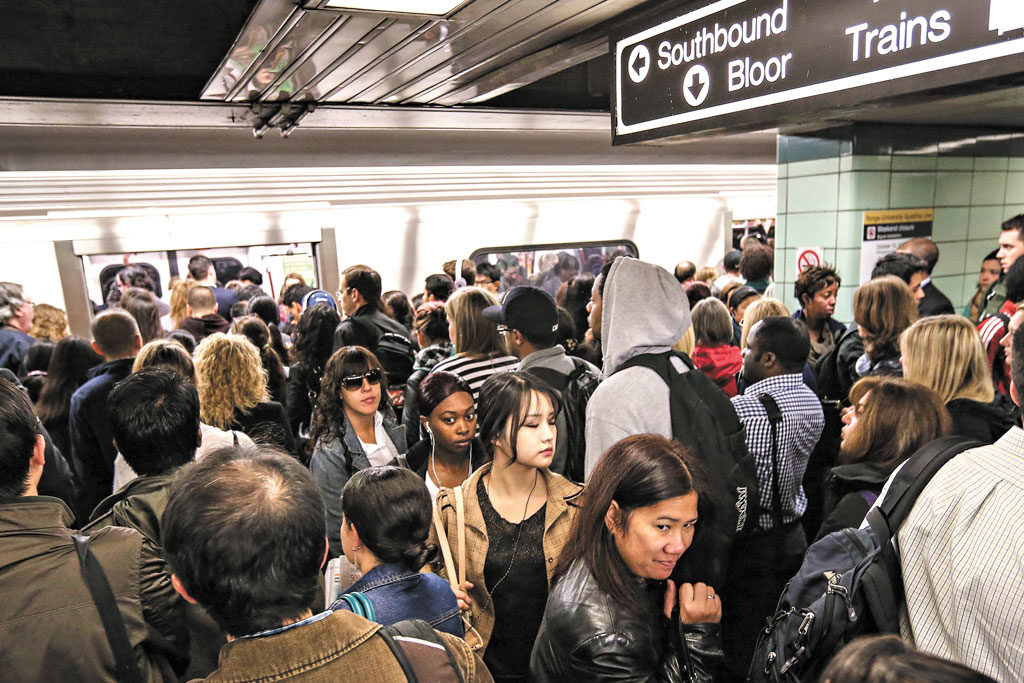
The Yonge-University subway line north of Bloor Street along Yonge Street is facing a capacity crisis. Reports and studies conducted by Metrolinx and the City of Toronto tell Midtown residents what they already know all too well: that the Yonge line is full.
The Yonge line is currently operating at 96 per cent capacity — around 34,700 passengers per hour in peak direction. It goes without saying that this is unsustainable at current city population growth rates, let alone along one of Canada’s busiest thoroughfares.
The question some are asking is a simple one: why is the City of Toronto approving condominium developments that will bring thousands of new residents to transit nodes at stations such as St. Clair, Eglinton, Lawrence and Sheppard when indications are that there isn’t anywhere near the transit capacity available for new residents?
Many people have suggested ways to alleviate the congestion. None, however, have been as popular as the construction of a downtown relief line (DRL).
John Bossons is an emeritus professor of economics at the University of Toronto. He, along with Geoff Kettel, co-chair of the Federation of North Toronto Residents’ Associations, recently penned an editorial for the Toronto Star in which they argue that “it is irresponsible to approve development without providing the infrastructure to support it.”
Bossons said the city must be realistic about the number of new developments approved along Yonge Street, even suggesting that the city could impose a moratorium on all official plan amendments and rezoning along Yonge Street.
Josh Colle, Toronto city councillor and chair of the Toronto Transit Commission (TTC), said that the city needs to do a better job of tying approvals of new residential developments to transit capacity.
Steven Munro, a Toronto transit advocate who has spent the last 40 years writing about transit and politics in Toronto, has heard this before. He said that “the horse has left the barn” on this suggestion, referring to the fact that it’s inaccurate to link density at stations with the source of demand.
“Look at Kennedy station,” Munro said. “There are no big developments nearby, but try telling that to folks heading westbound during the morning rush.”
Curtailing developments along the Yonge corridor will do nothing to curtail ridership since a large percentage of density comes from feeder buses and, in the case of Sheppard station, feeder subway lines, explained Munro.
So how did the city get into the current transit mess? According to Bossons, a line can be drawn from today’s overcrowded subway system to the 1995 Russell Hill subway accident that left three people dead.
“At that point, the city stopped spending money on new items [subway trains, expansions, etc.] to focus instead on maintenance, repair and improvements — particularly on fail-safe mechanisms, which were, in addition to human error, the leading cause of the tragedy.”
Colle agreed with Bosson’s assessment, but said that while maintenance work gets less glory it can provide much needed relief in the near future.
“The work we’re doing now, redoing the track and signalling system, is essential,” he said. “The sad thing about that is that it has been neglected for about 50 years.”
According to Colle, significant portions of this work should be completed in 2019, which will help alleviate some congestion along the Yonge line north of Bloor at a fraction of the cost of the DRL. The downtown relief line is generally considered to be a two-phase project that will connect downtown Toronto with the Bloor-Danforth subway east of the Don River first, followed by a further extension north to the Sheppard Avenue East and Don Mills Road area.
The cost for the project ranges between $6 and $8 billion, with Phase 1 opening in 2031 and Phase 2 opening in 2041.
Colle is supportive of the project that Toronto City Council voted to advance to the planning, environmental assessment and initial design study stage earlier this year. He said the TTC currently has an $8 billion backlog of capital projects — not including current and proposed expansions like the Eglinton Crosstown or SmartTrack.
To address this concern, Bossons said that the TTC, City of Toronto and Province of Ontario should borrow more money.
“Interest rates are as low as at any point in the last hundred years. It makes sense to borrow at these rates and invest in infrastructure,” said Bossons.
Colle explained that the city simply isn’t in a position to borrow any more money. “The city has around a $30 billion backlog when you include infrastructure, housing and transit projects. The city literally can’t borrow that much money.”
As a result, Torontonians are likely going to have to wait until 2041 for relief. Another option to ease congestion along the Yonge line is to install more north-south priority rush hour bus lanes. But Colle said the issue is the amount of buses needed for the job.
“The TTC recently ordered 100 new buses, with another 200 on their way thanks to federal funding,” he said. “This will allow the TTC to retire a number of older buses, and to potentially incorporate more express bus routes.”
The addition of two trains per hour along the Yonge-University line is expected in 2019 as a result of ongoing signal improvement work and automatic train control. This will constitute about a 10 per cent increase in capacity, which may seem like a drop in the bucket to commuters waiting in line to get to work.

