
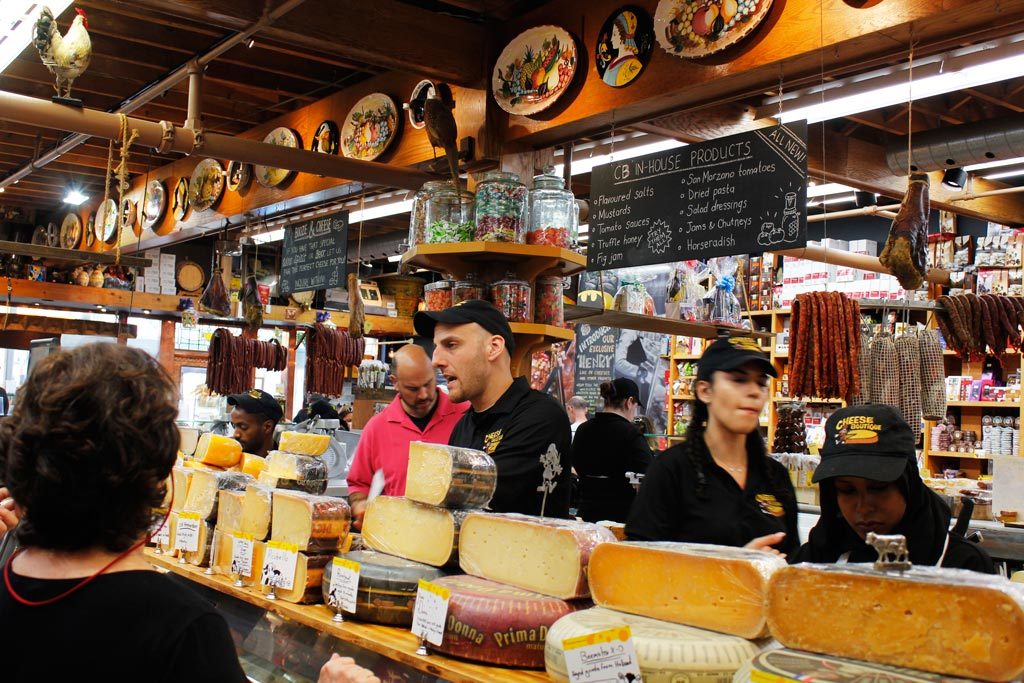
Tucked away on an unassuming side street in east Etobicoke lives the Cheese Boutique. With 16,000 products, three aging rooms and 46 years of history in the Pristine family, The Cheese Boutique is a living, breathing and continually evolving piece of Toronto’s culinary culture.
On a sunny Saturday in late June, members of the Italian Chamber of Commerce of Ontario (ICCO) gathered to showcase some of the quintessential Italian products sold by the shop.
Note: If you’re buying balsamico, the first two ingredients must always be cooked grape must (grape juice) and wine vinegar – any less than 20% of the two and it’s not authentic. Parmesan cheese can only come from Parma. And true Italian olive oil must always have bitterness.
From fresh and local to fancy and foreign, you’re bound to find it at The Cheese Boutique, but it’s the rare and exotic finds that we were hunting for, and who better to pick out a few of his favourites than owner Afrim Pristine.
Here are 5 particular Italian products that can (almost) only be found at The Cheese Boutique.
With around 500 cheeses in circulation at any given time, Afrim selects two complementary but contrasting cheeses from the Il Forteto dairy in Tuscany where he spent time working. Interestingly, both are made from the exact same ingredients, but are transformed into entirely unlike products during the production process.

One producer, using the same ingredients to make two very different cheeses (IMAGE: JASON FINESTONE)
Cacio di Fossa
The name means “cheese of the pit” because this sheep’s milk cheese is encased in burlap and buried two feet under the nutrient-rich Tuscan soil and left to age for two years.
“When the bag is pulled up, it’s literally covered in blue-green mould,” Afrim explains. “There’s an ammonia blue funk to the rind, almost like a dry-aged steak, but when you break it open it’s completely different.”
Nutty, semi-soft, robust but not overpowering – melt this right in the pan with a short pasta and some good butter and you’ve got Afrim’s dream dish, perfect with a bold red wine like Amarone.

The inside of the sheep’s milk cheese (IMAGE: JASON FINESTONE)
Pecorino Affienato
“We often talk about local products in the context of a whole country, but regionality is so important in Italy,” Afrim contends. “This pecorino, also from the same Il Forteto dairy is a truly local product – the entire process from the rearing to milking of the sheep, the curding and the ageing of this cheese are done on the same property.”
A light summery cheese, this pecorino is aged in wildflower honey, made on premises, and then rolled in the same hay the sheep eat. It’s a beautiful circular approach to cheesemaking and is a great table cheese, though too mild for pasta.

B;ottarge, salt-cured fish roe, is one of the priciest items on the pescetarian diet (IMAGE: JASON FINESTONE)
Bottarga di Muggine
Bottarga (cured fish roe) has become a trendy ingredient at many contemporary restaurants – Rob Gentile uses uni bottarga at Buca Yorkville, for example – but traditional bottarga comes from North Africa and Sardinia, and is made by salt curing mullet or tuna roe.
Afrim finds the flavour of the mullet roe more pleasant and approachable, likening its counterpart to “cat food”. Salty, a bit fishy, but more complex than anything, true bottarga should contain nothing more than salt and fish roe on the ingredient list, like this this one from Sardinia. It’s often coated with beeswax for further preservation, which is no cause for alarm. Test its purity by holding it up to a light source – there should be a pronounced glow through the semi-translucent orange-hued sample.
At $44 for two pieces, it’s not a cheap way to liven up your bucatini, however wrapped in tin foil and stored in the fridge, bottarga will almost never spoil.

A highly regarded brand of carnaroli risotto rice (IMAGE: JASON FINESTONE)
Acquerello
There are thousands of rice varieties throughout the world, and somehow arborio has become synonymous with risotto. Afrim, however suggests you swap the standard for the carnaroli variety. Acquerello, a carnaroli producer, is from Piedmont and is used strictly for risotto, hand harvested and aged 1-3 years.
“As soon as it’s aged, the starch content shoots up and the creaminess is crazy!”
Far less butter and cream is needed when cooking with this particular type, and each morsel will retain it’s shape, making it Afrim’s choice for this historically northern-Italian dish that’s now been widely appropriated throughout Italy, including his mother’s native Naples.

Cheese Boutique’s own house brand San Marzano tomatoes (IMAGE: JASON FINESTONE)
San Marzano Tomatoes
You’ve likely heard of San Marzano tomatoes, but what really makes them special?
“The soil in San Marzano is some of the richest in the world,” says Afrim. “At the end of the day the most important thing with San Marzano tomatoes is the terroir. They are extremely sweet, but with low acidity.”
“The DOP seal recognizes specific region of origin, but also shows that a product has to be made the same way 50 years from now, and it’s the same way it was made 50 years ago.”
The Cheese Boutique brands and imports their own DOP Certified San Marzano tomatoes. Simply heat these tomatoes in a sauté pan with a bit of salt, add some fresh basil if you like and toss in your favourite pasta – dinner is served.
“There’s the new school wave of Italian cooking where you take tradition and put your own spin on it,” Pristine explains, “but there’s also something to be said for letting simple, high quality ingredients speak for themselves.”
Cheese Boutique, 45 Ripley Ave., 416-762-6292

