
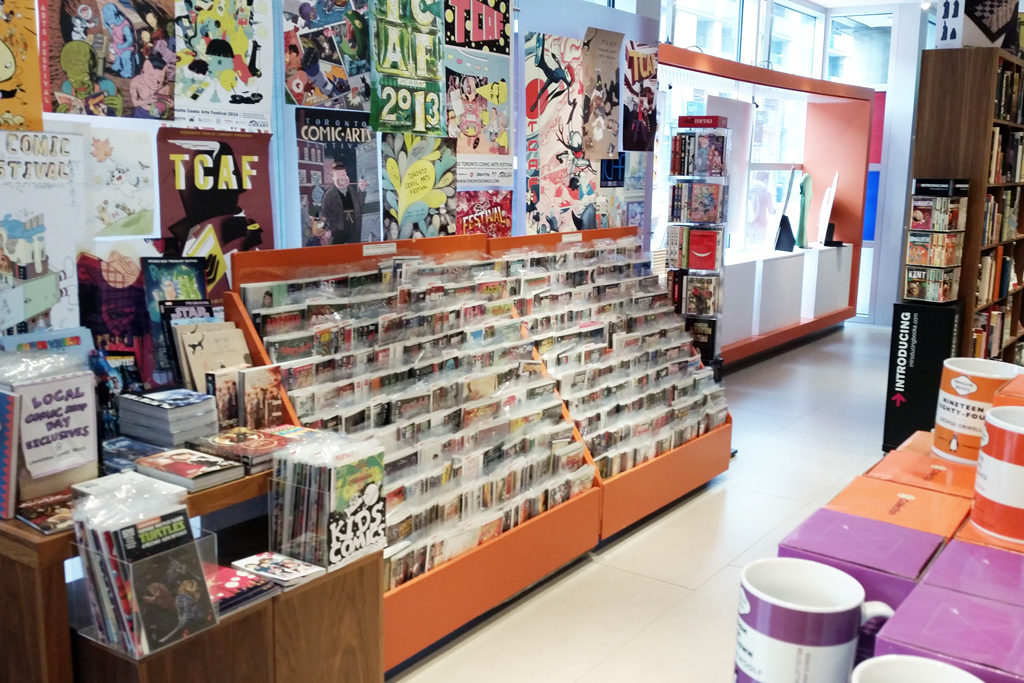
Just off the main entrance at the Toronto Reference Library is a 2,000-square-foot comic lover’s paradise. Page & Panel, as it’s called, began as a pop-up comic book shop and became a permanent library fixture in March of 2015.
For Miles Baker, the shop’s manager, the fact that the city’s literature hub has embraced the venue is one sign of many that people are seeing comic books in a new, more sophisticated light.
“Libraries are seeing the literary merits of comics,” Baker says. “A lot of educators and librarians have identified comics as a great way to get reluctant readers on board.”
Comics and graphic novels are increasingly shedding their lowbrow reputation and are being taken seriously as works of literature. Cerebus, an epic graphic novel series from Hamilton-born Dave Sim, is philosophically charged and intellectually ambitious. In 2011, Toronto resident Jeff Lemire’s Essex County beat out highly regarded novels to win the People’s Choice Award during CBC’s Canada Reads.
Creative types known for their work in other media are also latching onto the graphic novel as a legitimate art form. Earlier this year, Toronto playwright Ins Choi published a graphic novel inspired by his performance piece Subway Stations of the Cross. In 2010, journalist Richard Poplak chose the comic book format for Kenk, his thoroughly researched portrait of notorious Toronto bike thief Igor Kenk. And in early December, Margaret Atwood — Canada’s literary queen — announced that she was at work on an upcoming graphic novel series, first of which will be called Angel Catbird.
Even comic conventions are growing up. The Toronto Comic Arts Festival (TCAF), an annual celebration of graphic novels and comics, is a world apart from a traditional convention. Costumes and other forms of fandom are discouraged in favour of readings, discussions and gallery shows. In short, it’s classy, which certainly can’t hurt a medium often pegged as the opposite.
“Most of the comic shows in Toronto were really focused on the superhero end of the spectrum,” says Christopher Butcher, co-founder of TCAF.
Baker, who grew up reading comics, sees none of this newfound respect as a surprise, even if the popular perception of comic books has been tainted by campy superhero pulp from Marvel and DC.
“It’s a medium that frequently gets painted as a genre,” he says. “But there’s been such sophisticated work in the medium for so long.”

