
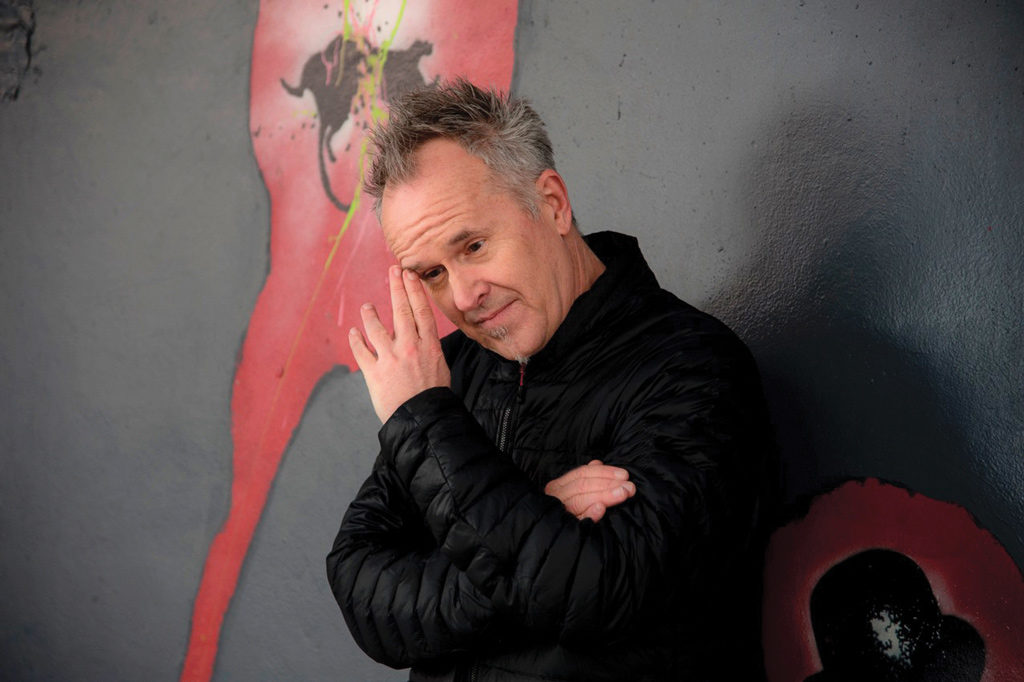
British songwriter and musician Howard Jones was one of the top recording artists on the planet for a short time in the ’80s. His chart-topping album, Dream Into Action, produced a slew of top 10 hits including “Things Can Only Get Better” and “Life in One Day.”
Speaking with him ahead of his appearances in Toronto at Hugh’s Room November 11 and 12, he declares he needs no further evidence of his legacy than watching the reality TV show The Voice.
“I just watched an episode on YouTube of The Voice, and they were doing ‘No One Is to Blame,’ where two people sing together in a battle. They did a really cool version of it actually. It’s proof that song has kind of survived, which is really great.”
And he’s got a Canadian connection. According to Jones, he spent some time in Ottawa during his high school years and fondly remembers playing piano in a classroom over lunch hour as kids piled in to listen. It was there that he formed his first band and, rumour has it, even played a bit of street hockey before he hopped back over the pond, when he was 14, and ended up at music college.
“That’s where all the music began, really, and I started doing loads of gigs in pubs and clubs up in London,” he says. “And I got rejected by every record company and publisher until one person finally made a go of it, and it literally took off right away.”
His debut album, Human Lib, shot to number one in Britain, and Jones solidified his place in a musical movement defined by such bands as New Order, Depeche Mode, Human League, Eurythmics and many others.
“I think it was a very interesting decade for music, and we had the chance to really do something different,” Jones explains. “New technology was bursting onto the scene, drum machines, synthesizers you could afford, new ways of working with stuff in the studio like sampling and digital delays. All that stuff suddenly became available, and we could make music in different ways and make it sound different.”
Then along came Kurt Cobain and his grunge, and Jones and company were shown the proverbial door. What seems to set Jones apart, upon reflection, is his positivity. A Buddhist, a vegetarian and someone whose mother was the president of his fan club (for real), Jones took it upon himself to be that guy.
“I felt that a lot of music at the time I was emerging was quite depressing, and I really didn’t want to give that out,” he says. “Myself, I’d struggled to get a record deal for years and to become good at what I did, and then I did get a chance. And I want to put out that, if I can do it, maybe you can too. Other artists have a different role, you know. They kind of share people’s grief and the more miserable times, and they articulate that, but I never wanted to do that. I was more like the cheerleader and said, ‘Keep going‘ and ‘Don’t give up, you’re great!’ ”
Following his most successful years, Jones concentrated more on production work and songwriting, in addition to that brief foray owning a vegetarian restaurant in New York City. He continues to tour around the world with a full band but also for intimate club shows featuring him and his piano.
“I’m motivated to continue because I think, if you’re good at something, then you should offer it up and do it, don’t just sit at home,” he says, always the cheerleader. “And I like to be out there doing what I do. I love meeting people afterwards and talking to them and finding out about their lives.”
Hugh’s Room, 2261 Dundas St. W., 416-531-6604

