
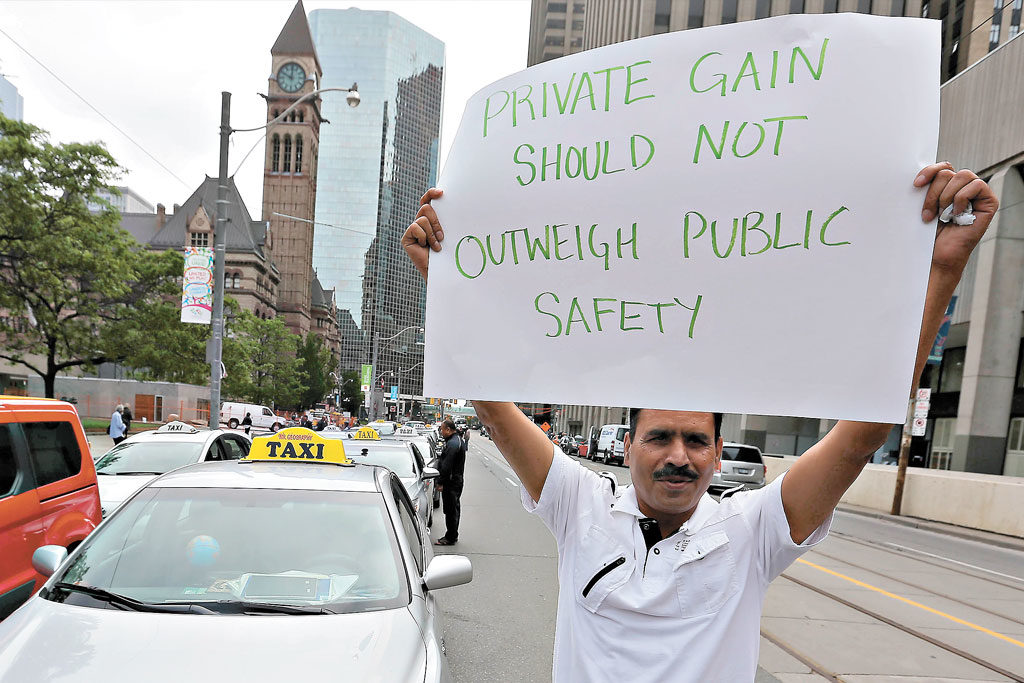
Thank your lucky stars you aren’t a member of city council trying to sort how the taxi industry and Uber will work together. Mayor John Tory says it will be done in the next two months but few believe that he’s a miracle worker.
Uber is the transportation network company that offers a ride-sharing platform, allowing others to offer services traditionally provided by taxis. It claims to be a communications company, not a taxi business, wanting to give anyone with a good driving record, a clean criminal record and a good car a system — dubbed UberX — to pick up anyone and drive them where they want to go for an agreed and reasonable price. Lots of drivers fit this profile. That means UberX has no problem offering speedy pickups.
Uber isn’t concerned with the administrative infrastructure in the taxi industry, neither the licensing system nor the fare structure. The city requires licensing and set fares to ensure the high quality of the cars and drivers and to ensure taxi drivers receive reasonable compensation for their work, thinking these controls will give Toronto residents a taxi service that arrives quickly, provides a safe ride in a clean car and is reasonably priced. But many taxis aren’t pleasant: cars often take too long to appear, and the cost is high. And the licensing and set fares haven’t given drivers a living wage.
Plates have been gobbled up by those with money and are worth more than $100,000 apiece.
This is one of the perverse results of licensing: if the government creates a shortage of something, there’s bound to be someone ready to take advantage of the situation.
In Toronto some individuals now own multiple plates. Owners cover these capital costs and more by renting the cars out to drivers. So when you pay for a taxi ride, at least half the money goes to the licence holder, not the driver. It’s very hard to make a decent living driving a taxi.
Uber doesn’t solve the income problem. Instead, with its UberX service, it offers people who own a car a chance for a second part-time job to supplement their income.
This is not the way anyone wanted the licensing system to work, but that’s the way it goes.ok.
You can pretend these wealthy licence owners don’t exist, but if you do, you’ll never find a solution to the problem. Those who hold large bundles of assets never seem to want to be meek and mild when others try to destroy that wealth. Instead, they fight back.
In early July, city council said (with Mayor Tory the only dissenter) it wanted all the rules and regulations applying to taxis to also apply to Uber. That would just spread the misery without providing good taxi service. On the other hand, getting rid of the rules and regulations throws the taxi drivers out of work and tries to ignore the licence holders.
The overarching issue here is what has been termed precarious employment: people in low paying jobs without benefits, without steady work or predictable hours. This is what UberX offers to people who already have a job and a car but need extra income to survive. The existing taxi industry offers low income and usually demands too many hours just to earn it. In Ontario last year, some 1.7 million people earned $15 an hour or less, and 40 per cent of them didn’t have predictable hours.
Precarious employment is what caused the wildcat strike that shut down Pearson Airport for a day in early July. Airlines are changing their refuelling company in October, and those who have worked for 10 or 15 years for the company losing the contract can apply to the new company for the same job but with a pay cut from about $20 per hour to less than $14 per hour with no pensions or benefits and no union.
Addressing this means we have to talk about ensuring people have living wages, predictable working arrangements and reasonable benefits.
These are big issues, and they aren’t issues city council can address on its own. We need governments to require higher minimum wages, better employment insurance, better working standards and generally predictable hours.
Uber is challenging similar taxi arrangements around the world. Finding a reasonable resolution to the situation means the issues involved in precarious employment will have to be addressed, and that will be all for the good.
Dare we wish our councillors good luck?
Post City Magazines’ columnist John Sewell is a former mayor of Toronto and the author of a number of urban planning books.

