
For almost six decades, generations of families have gathered at Forest Hill’s beloved House of Chan for plates of steak, lobster and North Americanized Chinese food. Toronto has a long-lasting love for juicy hunkin’ steaks, and House of Chan has contributed to a large part of our city’s meat culture.
My first experience at House of Chan was nearly a decade ago. I visited the restaurant with a few friends after hearing about the kitschy decor and high-rated steak program. I returned over the years, and spent one evening with long-time general manager Peter Pau. Pau can chat for hours about the menus, the food and the clientele. He is still with the restaurant. Now in his 37th year, he still takes the time to mingle with guests.
For many years, everyone of import — from politicians like Mel Lastman to dignitaries and athletes — cosied up in the red pleather booths amid ornate retro-Chinese decor.

Penny Lyons plans to keep the booths, tables, and esthetic theme for the new House of Chan.
“Many customers enjoy the soups, our back ribs, then order a Chinese dish with steak or lobster,” says Penny Lyons, current owner of the Chan.
A young Joanne Kates was an early convert, trying her best to convince her school-age chums to eschew rival Stefoff’s.
“In high school the House of Chan was my favourite place to be. It was better than my house, better than my school,” she says. “The egg soup and the egg rolls were enough to put me in heaven.” The dark, grungy decor added to the Chan’s allure. “It was really cool because you felt sort of grown-up. It was the opposite of where we came from, which was school.”
Recently Lyons made it official that the restaurant will be moving from its original location. Metrolinx is expropriating the property to build the Bathurst station of the Eglinton Crosstown. So Lyons found a new Forest Hill address, just a short walk east toward Avenue Road. She promises to maintain the old school comfort vibe that helped make HoC so popular over the years.
“We’re taking the booths with us and the tables,” she says of her plans. The lobster tank is also being moved, and she plans to maintain the dark, crimson-laden esthetics. “Red carpets, mirrors on the side,” Lyons notes, “it’s a smaller space but it will feel very much the same.”
And the steaks? They’re not going anywhere. “In my opinion, so many of our customers feel we have the best steaks in town,” Lyons says. “We only use U.S. prime; therefore, the consistency is always there.”
Another staple of the menu was the stone crabs, which were removed from the menu last year. The restaurant had a relationship with Steve Saywitz of Joe Stone Crab in Miami Beach. “I think you’ll see them again when we open at the new location — probably in October,” Lyons says. “It was a wonderful experience working with Saywitz.”
Although there may be some other additions to the menu, Lyons is staying mum — for the most part. She does admit she wants to add some new Chinese dishes to the menu to keep things fresh.
“We will add a few things, eventually, once we are settled in,” Lyons notes.
T.O.’s steak culture has gone through drastic changes over the last year. Gone are the days where certain cuts and portion sizes were signs of luxury.
“Toronto has been growing at an incredible pace, and people want to try the best that they can,” says Danny McCallum, exec chef at Jacobs and Co.
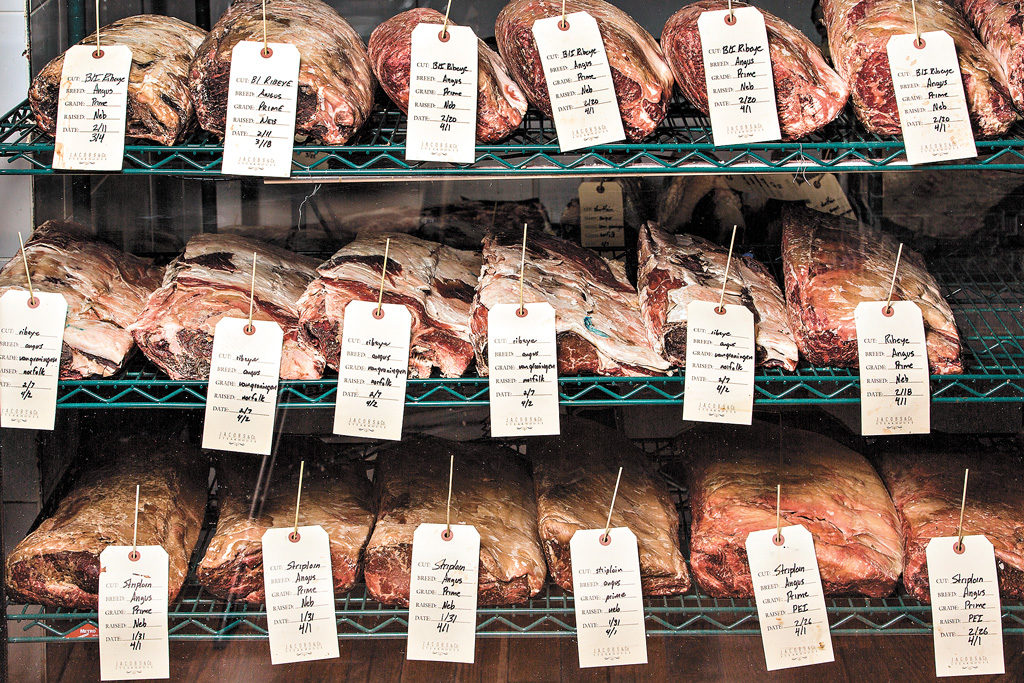
Nowadays, “dry-aged,” “terroir” and “wagyu A5” are buzzwords when it comes to what defines a great steak.
“We can have beef from 12 different distinct terroirs, with the menu featuring up to 50 different styles of steaks,” notes McCallum.
Picky consumers have become increasingly educated about their meat. “People have strayed from the traditional USDA steak a little and are trying different things, like grass-fed from Norfolk,” says McCallum.
Stuart Cameron, exec chef at Yorkville’s NAO, acknowledges that palates are evolving. “Dry-aging beef does add a higher price point to the steak menu,” he notes, “but we are still able to offer great steaks with 40 days age on them that are comparable to other steak houses.”
Cameron’s cooking process differs from that of his peers. “To distinguish ourselves, we opted to cook over fruit wood on a wood-burning grill. It gave us a steak with a thick crust and a flavour that you can’t get from a gas grill.”
Over the last year, steak prices have gone up. According to Statistics Canada, there’s been an increase of 12 to 15 per cent in steak prices due to the rising price of feed and fewer cattle going to slaughter.
McCallum isn’t too concerned. “Because we are/were already paying top prices for the top stuff, we were less affected than most people.”
At the Chan, however, they’ve never messed with the steaks, taking a straightforward approach. Lyons notes that, although they have a special meat fridge, they’ve never had the capacity to age meat in-house nor will they at their new location.
As for the rise in costs, Lyons isn’t concerned. “Our meat supplier has been with us for a very long time,” she says. “We will continue to purchase from him because the quality is there. The price hike doesn’t affect us.”
“I’m so excited,” Kates says of the new House of Chan. “I’m looking forward to it.”

