
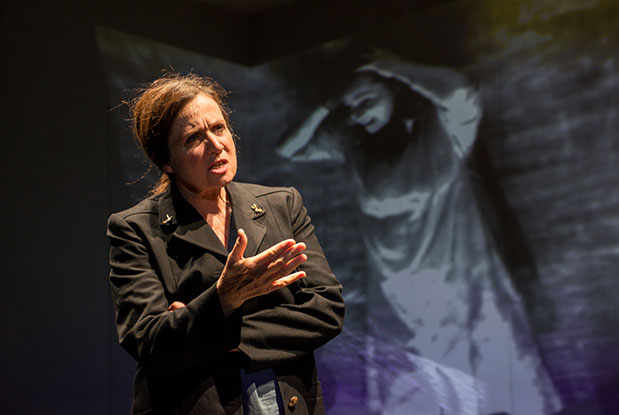
Venerable Canadian playwright Judith Thompson was so agitated by the justice system’s mishandling of juvenile delinquent Ashley Smith, whose prison cell suicide in 2007 was witnessed without intervention by corrections officers present, that she wrote Watching Glory Die, her new 70-minute drama in which Thompson was persuaded to play all three roles herself. She nails every scene, in writing and performance. This Toronto premiere, Canadian Rep Theatre’s second production of the season, directed by the company’s founder and artistic director Ken Gass, plays at Berkeley Street Theatre Upstairs until June 1.
Starting with throwing crab apples at the postman’s knees, Glory spends five years in custody. Ostensibly a fictional account of an 19-year-old prison inmate named Glory, Watching Glory Die incorporates innumerable details that parallel the tragic case of Smith, an average child who began acting out around the age of 14. One such detail is a friendship with a neighbouring inmate that echoes Smith's real relationship with so-called “dangerous offender” Renée Acoby, whose continuing imprisonment resembles Smith’s.
As an actor and writer, Thompson is entirely successful in presenting the contrasting perspectives of Glory as well as Rosellen, her doting and helpless mother, and Gail, a prison guard at Grand Valley Institution (the federal women’s prison in Kitchener) who is introduced first as a family person and second as a corrections officer who takes her professional responsibilities seriously.
While, at first Glory talks as if she is not right in the head—blathering about being the child of a crocodile—one must keep in mind she is a teenager who has spent a quarter of her life incarcerated, sometimes in solitary confinement (dubbed, with vicious euphemism, Therapeutic Quiet) for up to 23 hours per day and, she claims, under the influence of illegally administered anti-schizophrenia medication. But Glory assures us she is not crazy; she uses her imagination to keep herself sane.
Thompson’s performance renders three very distinct characters who, after initial introductions, require no costume changes. Gass, set designer Astrid Janson, and lighting designer André du Toit have created three separate realms to give each character her own stage space. Glory’s cell, with mirrored floor and white walls and ceiling which catch reflections and evocative, textural projections (projections designer, Cameron Davis), fills centre stage. Gail’s territory is the unadorned area next to the cell and Glory’s mother is far away at home in a chair off to one side.
Thompson hands us no villain, nor does she present Glory as blameless. But no one can deny the horrendous injustice of treating a mischievous teenager like she’s Hannibal Lecter. Packing more fact than fiction, Watching Glory Die shocks, clarifies and engages.
$30-42. A Canadian Rep Theatre production, Watching Glory Die is onstage at the Berkeley Street Theatre until June 1.
Evan Andrew Mackay is a Toronto playwright and humorist who writes about culture and social justice.

