
Few of the people I know are happy about the leading candidates for mayor of Toronto. The biggest complaint seems to be the candidates’ mushiness and desire to talk small. Why can’t they talk big?
One cost of the Ford family’s dominance in the media is that it makes serious talk about the city difficult, although you would think the top candidates would have devised strategies to do so.
Maybe the two cultures that the mega-city has forcibly yoked together — the suburban and city cultures — means the only issue that might appeal to both is traffic and transit, so that issue gets talked to death, which the candidates have done.
By now, a candidate should have raised the one defining issue in municipal politics over the past 50 years — development. Do you love high-rises or hate them? Should residents have a large say in development decisions or not? Has city council put reasonable plans in place or do new ones need to be made? Does the development industry have a stranglehold over councillors? Is the public being well served?
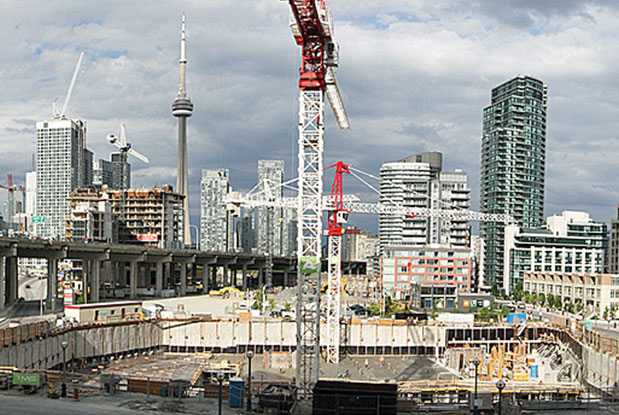
In spite of the tsunami of condo towers that has washed over central Toronto, candidates for mayor don’t seem to want to talk about this issue. Why can’t some leading candidate complain that these towers don’t offer units large enough to serve families with young children? That the units cost far more than two-thirds of the population can afford? That their height and glass exteriors result in thousands of birds a night being killed as they try to fly through Toronto? Aren’t these key issues for most voters?
My best explanation for the silence on the development issue is that the candidates aren’t saying this now because they haven’t been saying it in the past. It’s the old dogs and new tricks story. One can only assume that whoever gets elected will agree to more of the same kind of development. What a missed opportunity that would be.
Another issue is climate change. Some argue it’s such a big issue that city hall shouldn’t tackle it head-on, but instead leave it to some other level of government. That’s short-sighted. Important political issues are almost always first debated in cities, since that’s where diverse interests rub up against each other enough to provoke new ideas to emerge as well as new solutions. The national political framework is so removed from city life and so dominated by political party operatives that the important issues are usually drowned out until after the fact — the national parties don’t lead. The same can be said of the provincial political framework.
But in city hall, where parties play a negligible role, debate on something like climate change could take place if the mayoralty candidates thought it important.
As the International Panel on Climate Change reported recently to the United Nations, it is imperative that action be taken immediately if carbon emissions are to be controlled and our way of life is to be retained. There is widespread agreement among scientists that significant changes will occur within 35 years unless carbon emissions are stabilized and reduced, starting today.
That could be done through a carbon tax, which will raise the cost of emitting carbon — raising the price is the best way to limit something from occurring. Our candidates should be asking the province for the legislative ability to allow the city to impose a carbon tax, just as two decades ago we asked for and received the authority to limit smoking. Making that request forcefully will take the debate to Queen’s Park, and that’s a good thing.
In 1975 Toronto City Council decided it needed to put rent controls in place in the city. When it made that legislative request to the province, the debate was so convincing that Premier Bill Davis enacted rent controls throughout Ontario.
If city council says it wants to impose a carbon tax to counter carbon emissions, that will force others to say where they stand. Taking (or providing) leadership is never a bad thing to do. If everyone decides to do nothing, the world of our grandchildren will be a very frightening and scary place when they are our age.
We can start on the right solution by saying we want to do it even if others aren’t so sure. It’s that funny thing about leadership.
I think that’s what we are looking for in our mayoralty candidates but not finding.
Post City Magazines’ columnist John Sewell is a former mayor of Toronto and the author of a number of urban planning books.

