
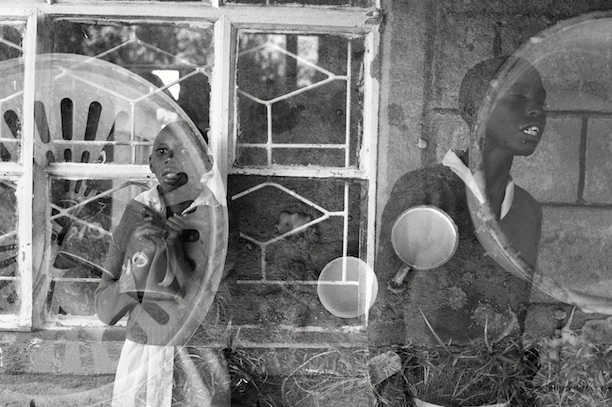
“You’re not supposed to run from grizzly bears,” says Jordan Campbell, a 31-year-old Toronto photographer participating in the Contact Photography Festival. His inquisitive way about the world once landed him in Alaska in an alarming predicament with a grizzly bear.
As he aimed his 50-millimetre lens at the 400-pound creature, all the tactics one should employ in the presence of an annoyed grizzly — avoiding eye contact, speaking in a soft but monotone voice, waving your arms — went straight out the window, and instead, Campbell ran like hell toward the beach.
If not for the sand, the crashing waves and the vast open space (a hindrance for this grizzly), Campbell may have succumbed to the fate of the Alaskan food chain.
“[I have] an overwhelming sense of curiosity and mischief,” says Campbell. But he’s quick to correct himself: “[It’s] well-intentioned mischief.”
A far cry from spying on bears in the Alaskan bush is Campbell’s latest photography exhibition on display from May 7 to 31 at Contact.
Titled SHERP, Long Wanderings in Northern Kenya, the documentary-style exhibit is about people.
Back in 2005, Campbell’s friend read a story about the Samburu Handicapped Education and Rehabilitation Program (SHERP) in the Vancouver Sun — a foster home, orphanage and community for children with disabilities in Maralal, northern Kenya.
Left behind by their families, over 100 children from three- to 18-years-old are living at SHERP and attending local schools. Their disabilities range from those as minor as cataracts and cleft palates to congenital deformities such as cerebral palsy, autism and blindness.
At the time the article was published, Campbell was a crew member on the Pacific Grace, which landed him in Alaska. He worked for the Sail and Life Training Society (SALTS) floating from country to country along the west coast.
When his friend arrived home from her first trip to SHERP in 2005, Campbell was still aboard the Grace. But his friend’s involvement with the community at SHERP had been so profound that she convinced him to join the following year.
In 2006, Campbell first landed in Maralal. He still recalls the moment he opened the doors to the children’s dormitory.
“I remember not knowing how I was going to fill the role of caring for these kids,” says Campbell, who was, at that moment, suffering from sensory overload. There was a stench of urine and feces. And floating around the room, hopping from object to object were pesky black dots — a swarm of flies.
The children were huddled in groups of three or four on each bed.
“I spent my first night crying,” he confesses.
I ask Campbell to show me a few of his favourite photographs: In one, a man ardently pushes a child in a wheelchair, and in the horizon, rays of light shaped like cylinders spill through the clouds.
In another photo, a girl sits in a classroom. She wears a thick V-neck sweater with a white collar pulled out from under her school uniform.
With her hands laid out atop her desk, she listens to her teacher intently. Her hair is in braids and her sunglasses fit snug around her eyes — they’re shaped like swimming goggles.
“I find that one of the first questions I’m asked when I show people my photos is ‘What is the disability that this individual has?’” Campbell says.
“And I think that question comes from a place of good intentions, but ultimately, in my opinion, it’s one that pulls us away from the individual and toward the disability.”
One thing we’ll take home from the exhibit, he says, is the sense of interconnectivity that exists between the children at SHERP.
“It’s not a look into the pain or the greed or the sense of loss that exists. Those things are there. I’m not intentionally trying to hide them, but [I want] to have a different conversation.”
SHERP, Long Wanderings in Northern Kenya will show at the Alliance Française Gallery starting May 7.
Held annually, the Scotiabank Contact Photography Festival opens May 2 and features over 1,500 Canadian and international artists who will show their work at 175 venues throughout Toronto in celebration of the photographic arts.
Other notable exhibitions include The Sochi Project, Faces and Phases, Pictures from Paradise and Identity Crisis.

