
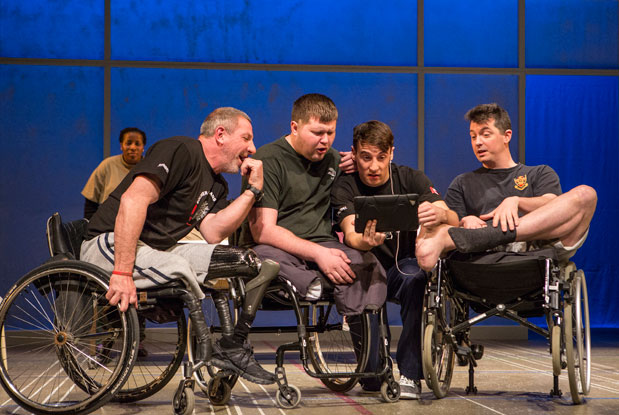
The Two Worlds of Charlie F is not Hollywood. It is a play developed by Bravo 22 Company, a theatre project for wounded, injured and sick Service personnel conceived of by producer Alice Driver. The play, based on the experiences of soldiers who served in Afghanistan, Iraq, Bosnia, Northern Ireland and elsewhere—some of which are featured in the cast—gives “a soldier’s view of service, injury and recovery.” First staged and toured in the UK in 2012, and having won the Amnesty International Freedom of Expression Award at the Edinburgh Fringe Festival, it is now playing in Toronto until Mar. 9.
The strength of the show, written by Owen Sheers, is its raw authenticity. These things happened, and they happened to some of the performers you are watching. The show delivers shock and insight, but is less emotionally engaging than you might expect. Though heartfelt, poignant and sobering throughout, there is no build up. Much dialogue is presented in monologue style, spoken to the audience rather than lived between the characters on stage. Characters, real as their experiences were, do more telling than showing, and don’t offer much context or specificity which could take us deeper into that other world of the soldier and the veteran. Of course we are moved when an actor/soldier says, “I lost my legs, but I saved my best friend’s life that day.” But we aren’t given the opportunity to know more about either of the men or a sense of their lives before or after that profoundly important moment.
Much information is presented in the style of a military debriefing, which is appropriate to a point, but the lack of theatricality gives it the feel of a pageant or a USO military camp show. The soldiers are not depicted confronting the enemy, and interactions amongst the soldiers and their families are mostly non-confrontational. One of the most effective scenes, dramatically speaking, involves the injured vets interacting with civilians in a strip club. It would be good to see more of this—characters responding to and in conflict with each other, instead of an inventory of what combat soldiers go through. Some of the vignettes are striking but they are mostly isolated incidents with no narrative connection to one another. With such a big cast, director Stephen Rayne might have done more to help the audience distinguish between characters.
With respect to the performances, one might suppose that putting soldiers on stage is like sending actors into battle – you can only expect them to get so far on raw talent and determination. Yet while some of the acting is not polished like boots on military parade, it is at least rough and ready like a field hospital. Seeing Newfoundlander Cassidy Little’s committed performance in the title role, it comes as no surprise to learn that, before joining the British Royal Marines and serving as a medic in Afghanistan, he went to a performance high school, did some stand-up comedy, and earned a university scholarship for dancing. If this play were a character study of Charlie Fowler, it might have been a showcase for Little’s acting chops. But this is by design an ensemble piece, with strong contributions from Darren Swift, Daniel Shaw, Stephen Shaw, Stewart Hill (those are his paintings for sale in the lobby) and others. Maurilla Simpson stood out amongst good singing voices in the cast.
Song and dance numbers (original music, Jason Carr; choreographer, Lily Philips) were an unexpected element in the show and although they contribute to the pageant feel, they are well executed and provide another way into the collective story, bringing forth energy which contrasts nicely with sound effects that are often as startling as they should be (Colin Pink, sound designer).
The Two Worlds of Charlie F doesn’t glorify war or take any political or philosophical position regarding the involvement of British soldiers in conflict in another country. This is not about “What are we fighting for?” Rather, it is about the two worlds of the soldier: home and away; service and civilian; before injury and after. It is not sentimental, and for those with no direct personal connection to the military or to recent or current international military conflicts, this play might not bring you to tears, but it will make you think about the nature of a soldier’s life, before and after combat, in a way that no amount of news coverage ever will. So if you want to “support our troops,” go to The Two Worlds of Charlie F and let them tell you their stories.
$19-$79. As part of Off-Mirvish, The Two Worlds of Charlie F., at the Princess of Wales Theatre, until Mar. 9
Evan Andrew Mackay is a Toronto playwright and humorist who writes about culture and social justice.

