
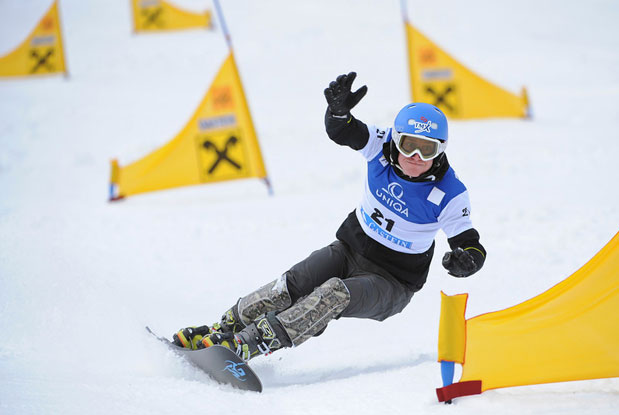
MICHAEL LAMBERT, SNOWBOARD
MEN’S SLOPESTYLE QUALIFICATION: FEB. 6, 10:00 EST
“As an athlete, I can’t even tell you the difference [between Sochi and Vancouver]. Going into these Games there’s been no hype,” says professional snowboarder Michael Lambert. Sochi marks the Toronto-born boarder’s second Olympics, but his sophomore Games will also be his last. Lambert plans to retire from racing, whether or not he gets to stand on the podium in Russia.
Pre–Vancouver Olympics newspaper profiles painted the articulate, clean-cut Lambert as one of Canada’s best hopes for gold. And of course, most of the articles touched on the young athlete’s lifelong addiction to speed. (Lambert’s dad took away his son’s skis and put him on a board — at seven years old — hoping to slow down his reckless skier of a son. Much to doting dad’s dismay, his speed-addicted son only ended up going faster.) Heading to his first Olympics, the weight of Canada sat on the then-23-year-old’s shoulders.
Lambert has had a tumultuous relationship with boarding since going pro at after high school. Before the year leading up to the Vancouver Olympics, Lambert’s victories were erratic. He was a volatile boarder ruled more by his emotions and instincts than by his skill. Daily meditation helped the Olympic hopeful gain the self-reflexivity and self-control he needed to combat his anxiety and rise to the top echelons of parallel giant slalom (PGS) racing.
While climbing the international rankings, Lambert was also starring on an MTV reality TV series, Over the Bolts. Between a demanding training schedule that kept the athlete away from his friends and family in Toronto for more than 220 days a year and commitment to MTV, the young boarder was being run ragged — but he kept winning.
After winning the World Cup in Switzerland, a month before the Vancouver Games, the homegrown boarder seemed like a sure bet for gold. So, when an unexpected crash during a final Olympic race stymied Lambert’s hopes for a podium position, he was more than crushed.
“Oh yeah, it was hard for me. I definitely lost a lot of meaning in my life,” says Lambert. His 12th-place finish pushed the athlete into a post-Olympic depression. Over the course of a year, Lambert went from being one of the top four parallel giant slalom racers in the world to ranking 30th. He was bumped down from the A to the C team on the Canadian National Team and lost his Own the Podium funding.
Lambert is highly loyal to his sponsors, friends and family, who have supported him throughout the highs and lows of his career. He’s also a proud Torontonian.
After the Olympics are over, he plans to “start working immediately,” selling commercial real estate with his childhood friend and now-fiancée Ginger Whitney.
“I’ll be honest, as an athlete, being in the city can be distracting,” exclaims Lambert. The boarder openly upbraids the stoner culture associated with snowboarding; his idea of quality downtime is going for a spin class and then unwinding with a hot yoga session at Moksha Yoga (although he’s the first to admit he’s no yogi).
“As an athlete, I just love this shift in culture [in Toronto]. People are into road biking, they’re into cross fit, cold-pressed juice. All these things are going on rather than people just wanting to go to a bar and smoke cigarettes. That’s just not cool any more. And I love that,” says Lambert.
The 27-year-old is a regular at his pal’s recently opened Rosedale juice shop, Greenhouse Juice Company, a stone’s throw from his swanky, architect roommate–designed pad with a view of the CN Tower.
“I’ve become increasingly obsessed with health and nutrition,” Lambert observes. “What I look forward to most about retiring is having 24-7 control about what I can ingest.”
“Control” is the operative word when it comes to describing Lambert because he has spent the last three years regaining control over his Olympic potential.
It took serendipitously running into his old coach Mark Ballard for Lambert to recognize that he was lost post-Vancouver.
“I didn’t have any love for snowboarding any more. I had fooled myself about what it meant, and I had filled myself with false ideals,” Lambert explained to a concerned Ballard. His old coach (now his current coach) hooked Lambert up with a sports psychologist who made the Olympian watch his crash on repeat for two hours straight until he was able to move beyond Vancouver and set his sights on Sochi.
Before this past Christmas, Lambert won two back-to-back Europa Cups in Austria, but his place on the Olympic team wasn’t guaranteed. After his last race with the other World Cup riders, he still hadn’t heard whether he’d made the team.
“I was totally at peace with that ending,” says Lambert. “I really felt like that was the day that snowboarding ended for me. I don’t want anyone to mistake that for me not caring about Sochi. To walk away from my last World Cup season, that feels like closing the book,” muses Lambert, who sees Sochi as an exciting appendix to his racing career.
“I’m going to go to Canmore next week and probably turn my phone off because I want to,” says Lambert. “I want to enjoy this for what it is. I’m not here to sell anything. I’m not here to prove anything to anyone. I’m here to go try and get a medal and race the last snowboard race of my career. I want to enjoy that for what it is in its purest form.”

