
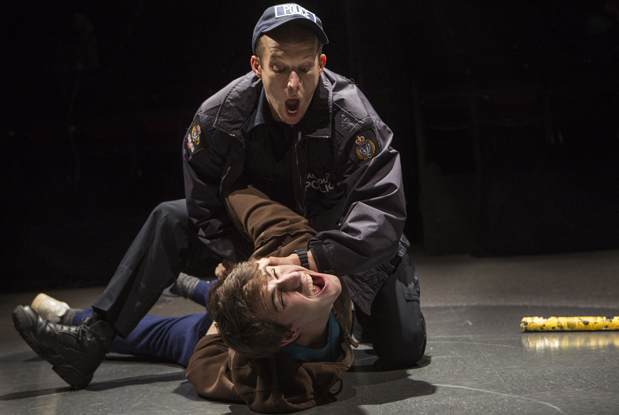
At the Toronto premiere of Joan MacLeod’s new drama The Valley, the audience is split in two, each side sloping down to the stage with opposing perspectives. The Valley depicts Sharon (Susan Coyne), a good mother trying to protect her teenage son Connor (Colin Mercer), and a good police officer, Dan, trying to protect his community. Just as Tarragon is presenting The Valley, an inquest is examining three recent cases of fatal shootings of mentally ill people by Toronto police.
From Dan’s perspective, a spoiled rich kid on drugs has stopped Vancouver’s sky train at rush hour and is waving a weapon at commuters, and then the kid’s mother wants to blame the police for her son’s problems. From Sharon’s perspective, her mentally ill son takes fright, waves a handful of rolled up paper, and gets assaulted and hospitalized by a cold-eyed cop. In the hands of multi-award-winning Victoria-based playwright MacLeod, each troubled character is portrayed realistically and seen in a sympathetic light. The cop is not uncaring, he’s just doing his job, but both at home and on the job he doesn’t know how to recognize or cope with people who have mental illness. To enhance MacLeod’s balanced depiction of the constable, Ian Lake (Dan) gained perspective by shadowing police officers on duty in Stratford while completing his sixth season at Stratford Festival.
Graeme S. Thomson’s economical set is central to this production’s effectiveness. To get to my seat, I had to walk through the set — static spaces in its four corners (kitchen, bedroom, living room, police office), a door at each end, and in the centre of all, a grey circle where characters are alternately isolated, separated, and brought together. The set combines with Richard Rose’s direction to evoke an intimacy which makes you feel as if you have been brought into the home of each character to hear his or her most personal story. The split in the audience, echoing the split in Connor’s mental state, ceases to distract as each of the four powerful actors draws you in.
During intermission you will see a wall in the lobby inviting audience members to post anecdotes of their first interactions with police, just as each of the characters relates such anecdotes in the show. On that wall and on the stage, the anecdotes are not all positive and not all negative. It is commonplace to occasionally consider police — and parents — to be a “necessary evil”. Most people will, at some point, sympathize with or even experience firsthand what their parents have had to endure. Fewer people devote much thought to what it must be like to be a police officer. In The Valley, MacLeod does not approach the problem of bad cops; she helps us look at cops as people. Dan is devoted to being a good police officer, a good father, and a good husband. No one can fill any of those roles flawlessly. In the same way, Dan doesn’t expect people he deals with on his job to be flawless. He says, “It isn’t bad people we’re dealing with; it’s regular people making bad choices.” Police are regular people, too. On the other hand, police are armed and dangerous, and when they get nervous, the only thing keeping their guns in their holsters is their training and their own personal judgment.
Dan’s wife Janie (Dora winner Michelle Monteith), who has her own checkered past, first defends her husband against Sharon’s publicized accusations of brutality, then questions whether Dan had been thinking clearly when he encountered Connor. She points out the two of them had a big fight before he went to work that day, but he denies that he carries the strife of their home life with him while he’s on the job.
After Sharon’s official complaints about police conduct get her nowhere, MacLeod’s play looks at the potential of alternative approaches to resolving unsatisfactory police interactions. Fittingly, this happens to be Corrections Canada’s Restorative Justice week.
Early in the play, frequent sprinkles of laughter are provoked first by familiar moments of family interaction and later by moments of discomfort. An exploration of the important and delicate roles of the consummate protectors — parents and police — this is not a “fun” play, but a timely, thoughtful and valuable one. It was good to be facing half the audience so I could see, as actors took their bows, a few audience members wipe away tears.
The Valley, Tarragon Theatre, runs until Dec. 15
Evan Andrew Mackay is a Toronto playwright and humorist who writes about culture and social justice. Find more of his writings at goodevaning.wordpress.com.

