
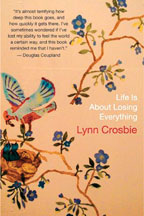
Difficult life experiences are sometimes easily ignored instead of scrutinized, but sometimes having the courage to be introspective can open the door to healing. In Life Is About Losing Everything (House of Anasi, $24.95), Toronto author and columnist Lynn Crosbie reflects on a tumultuous seven-year period in her life.
The provocative book takes readers on a trip though some of the writer’s darkest times, and though there are moments of serious darkness and sadness, the Globe and Mail columnist and author of controversial books Liar and Paul’s Case finds a way to inject humour into some of these narratives.
“Sometimes it would be emotionally exhausting and somehow I’d think of a funny way of thinking about something else and that would sort of keep bringing me back to the project,” she says of the process.
“If you can’t laugh at it, it’s just going to destroy you.”
The book works in short story form as well as poetry and prose. The mixing of styles helps to coax a thoughtful narrative from the semi-fictional memoir.
“I always had this colossal frustration with genre and how short stories should be and how a novel should look,” she says of the changing style.
“So what you’re seeing, when the narrative bends a little bit or even breaks, is that impatience.”
Though originally written chronologically, Crosbie and her editor shifted some stories around to attain a more natural flow.
Having not written for a while, the material began oozing out of Crosbie.
She started with one short story and trimmed it back, then did the same thing with another. Soon enough she was writing almost daily, sifting through that darker period of her life.
“I would go to work or be on my way to work, but always wanting to write because I had this voice and means of communicating my experience,” she says.
Very raw and honest — though situations and names were changed to protect those involved — she wrote this book free from any inhibitions that may have doomed the book. And, as she recalls, it turned out to be a very liberating experience.
Although her experiences are unique, the themes are universal.
“Everyone has lost someone they loved, everybody has been hurt, everyone has felt certain of the things that I described,” she says, “and maybe that there’s room for connection all through it.”

