
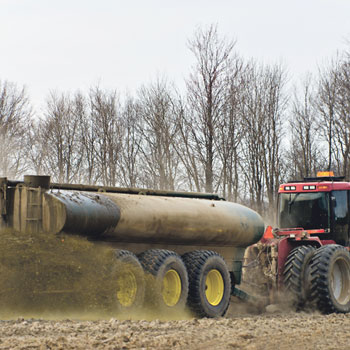
Not many Torontonians realize that the waste they’ve flushed down their toilets will likely fertilize the sweet Ontario corn they’ll enjoy this summer, but the practice of using processed sewage sludge as manure is fairly common. However, recent changes surrounding the practice have prompted criticism from those who believe there is not enough research to show that the recycled waste matter is safe for use at all.
Chef and sustainable farming advocate Brad Long pointed out that, although using municipal sewage as farm manure may sound bad, he believes the appropriateness of sludge as fertilizer is ultimately a question of due diligence.
“As a chef, I want to know everything about my food: where it came from, who did what to it and why,” Long said. “So when it comes to this waste, I have to ask whether we know what chemicals are in it and what effects they’ll have down the line. I don’t like the idea of using it without proper testing.”
Sludge is the solid material left over in the municipal sewage treatment process. The application of sludge on Ontario farmlands has been widely practised since 1996 when the Great Lakes Water Quality Agreement required Ontario cities to improve the functioning of their sewage treatment plants, resulting in the production of far more sludge. At that point, the province recommended that the sludge, which is costly to dispose of, be recycled as fertilizer and offered to farmers at no cost. Today nearly two-thirds of the 300,000 tonnes of sewage sludge generated in Ontario is spread on farm fields.
For years, the Ontario Ministry of the Environment (MOE) oversaw the practice, handling sludge according to waste management policies, but beginning in 2011, the Ontario Ministry of Agriculture, Food and Rural Affairs (OMAFRA) took primary responsibility, and sludge is being handled as a nutrient under the Nutrient Management Act. Farmers and waste management companies therefore no longer require a certificate of approval.
As far as Maureen Reilly, of the group Sludge Watch, is concerned, this change is just one more problem among many when it comes to sludge use.
“It worries me because the Ministry of Agriculture doesn’t have any great familiarity with measuring groundwater contamination or toxins,” she said.
Since documentation of the sludge spreading is no longer in the public domain, Reilly said it is more difficult to monitor its use. She’s mainly concerned about the lack of research into the actual chemical composition of the sludge and its effects on human health.
“The government wants to manage sewage sludge just like they manage manure, making it seem like what’s pertinent about sludge is nutrients,” she said. “But nutrients are the least of my concerns.”
Critics such as Reilly and the David Suzuki Foundation are uneasy with the toxins in urban waste that wind up in sludge, including toxic metals, hormones, pharmaceuticals and bacteria-resistant pathogens. The MOE claims that pharmaceuticals and other chemicals are present in the sludge in trace amounts, and guidelines only require that it test for 11 metals, nutrients and E. coli.
“There are at least 25,000 chemicals in municipal waste that we don’t test for,” said Reilly. “Why would we deliberately put those toxins in our food while we also run campaigns to lower our body burden of toxins?”
Jonah Schein, Davenport member of provincial parliament and NDP environment critic, said due diligence has not been exercised. He claimed that proper oversight of the application of sludge is lacking. “The approach the government seems to be taking is deregulation at every level, and that’s alarming,” he said, adding that the question of how to safely dispose of sludge is unanswered.
“It may be a better option to put it in the landfill in the interim,” he said. “The people I speak to in my community know that food security and safety are key for the future of the province.”
Although OMAFRA insists that it imposes strict standards for sludge application based on the latest science, Reilly disagreed. “I’m concerned that with less and less regulation, industry will find it more lucrative to provide cheap waste disposal to cities, thereby shortchanging our food, our farms and our communities.”

