
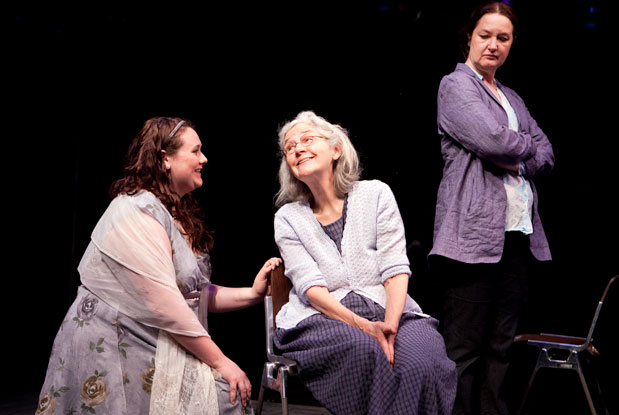
An article titled “The Top Five Regrets of the Dying” circulated on the Internet not too long ago. Besides the obvious “I wish I hadn’t worked so hard,” one of the top laments was “I wish I had let myself be happier.” That’s a notion that seems to have escaped the three female characters in Daniel MacIvor’s newest play, Was Spring, a story about guilt and regret that opened at the Tarragon Theatre last night.
The play opens with the unyielding and sassy Kitty (played to the hilt by the mesmerizing Clare Coulter) pondering her existence during her final days. We quickly learn that Kitty’s apparent heart problem is not the only ailment from which the damaged octogenarian suffers. She is, in fact, a tortured soul, and as the play unfolds it becomes obvious that Kitty is suffering from a broken heart in many senses of the term.
Kitty is joined by two other women, Kath (Caroline Gillis) and Kit (Jessica Moss). They too have experienced a tragic event in the springtime, but to say more would be to ruin MacIvor’s important plot device.
Yes, the names Kit and Kath are similar to Kitty’s, and you might be right to think that all three women are actually the same person, but as their stories unfold quite differently, it’s difficult to decipher their relationship to each other straight away.
On the surface, it’s easy to assume that Kath is intended to be seen as the jaded one juxtaposed with Kit’s naive innocence, but MacIvor has weaved such an elegant, multi-layered piece, that one should not be so quick to judge from appearances. These characters all have their moments of both darkness and light.
Gillis plays the middle-aged Kath with a perfect blend of emotional rawness and acerbic wit. Moss shines in what Kitty calls her “princess” moments, but falls flat at the more dramatic points of the play.
There is one memorable and extremely well-crafted scene that adds some much-needed levity to proceedings when all three ladies chew a piece of hard peppermint candy. It’s a simple moment that gives a nice touch of softness to these tough women.
The lighting and set, excellently designed by Kimberly Purtell, are simple and symbolic: three chairs sit on the black box stage, surrounded by a wall of concave mirrors. The stage isn’t very large, but not much room is needed when the story involves three women cataloguing their lives.
The end result isn’t entirely satisfying, but, sadly, like the above interviews with the dying prove, not many lives are ever truly fulfilling.
As one of the most brilliant lines of MacIvor’s prose says, “All that wasted time. There is no time to waste.”
Was Spring, Tarragon Theatre, 30 Bridgman Ave., 416-531-1827. To May 6.

