
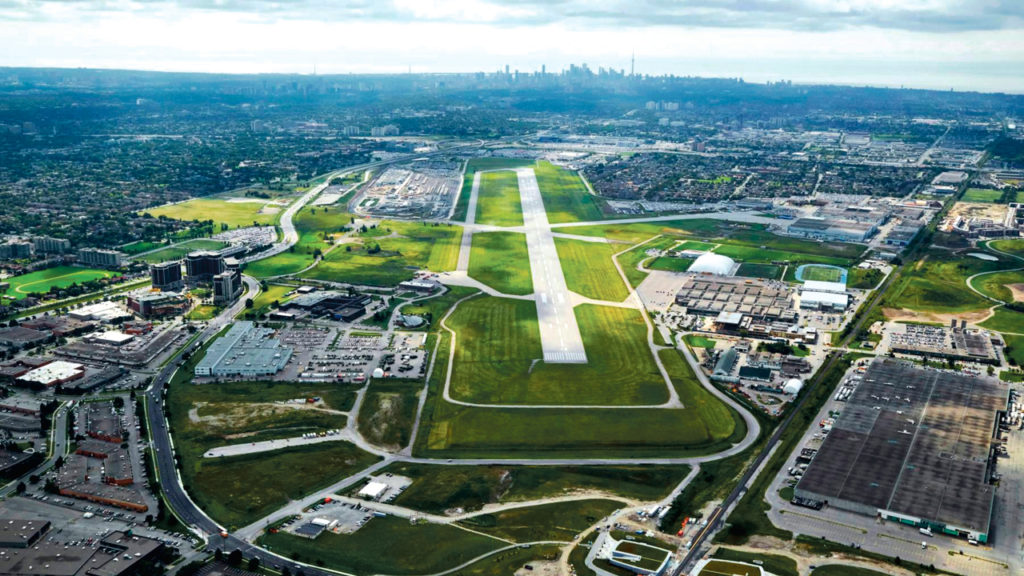
Northcrest Developments just released its first progress report on YZD, the 370-acre redevelopment of the former Downsview Airport lands.
It’s being billed as North America’s largest urban development project for a reason: the redevelopment will include a new set of neighbourhoods in the GTA, designed to add housing, jobs, parks and transit connections on a scale Toronto rarely gets to plan from scratch! The proposed mix includes more than 30,000 housing units, space for about 66,000 residents, 23,000 permanent jobs at completion, roughly 70 acres of parks and three subway stations.
Although construction hasn’t officially started, development has already begun through public programming, hiring initiatives, community funding, and early operational changes, as outlined in the Responsible Development in Action 2020 – 2025 report.
“This inaugural Progress Report shows why our work matters. It reflects the hundreds of conversations we’ve had with local communities, businesses, artists, civic leaders, our First Nation partners, and experts from Toronto and around the world. Their voices are shaping this work and guiding every step we take,” Derek Goring, CEO, Northcrest Developments, said in a statement.
“The findings reinforce a simple truth: cities grow stronger when people help shape them. With that belief at the centre of everything we do, YZD is working to set a new standard for how Toronto grows – and how community can be built with intention, care, and ambition over time.”
According to the report, since 2020, YZD has welcomed nearly one million visitors (through festivals, exhibits, major events, etc.), hosted more than 120 engagement events, supported the hiring of more than 1,200 people through the Rogers Stadium job fair, and reinvested $500,000 into community partnerships and scholarships.
Environmental Responsibility is also a huge part of the redevelopment. Northcrest says it’s achieved a 40% reduction in electricity use from baseline levels, and that it’s salvaged and repurposed more than 21.5 tonnes of material into new public spaces and installations across the site.
Future highlights have been built into the planning policy, including the preservation of more than 150,000 m² of existing buildings, as well as open space to support biodiversity and community wellbeing.
Perhaps the biggest takeaway from the report is that the next visible shift in the development is expected to begin this year! Torontonians can expect early infrastructure and servicing work in the Hangar District. From there, the timeline points to reactivation of the existing hangar buildings (2029), then a first-phase opening in 2031 (with parks, a bridge, and adaptive reuse), and eventually a “city within a city” buildout over the coming decades.
Click here to see the full report.

