
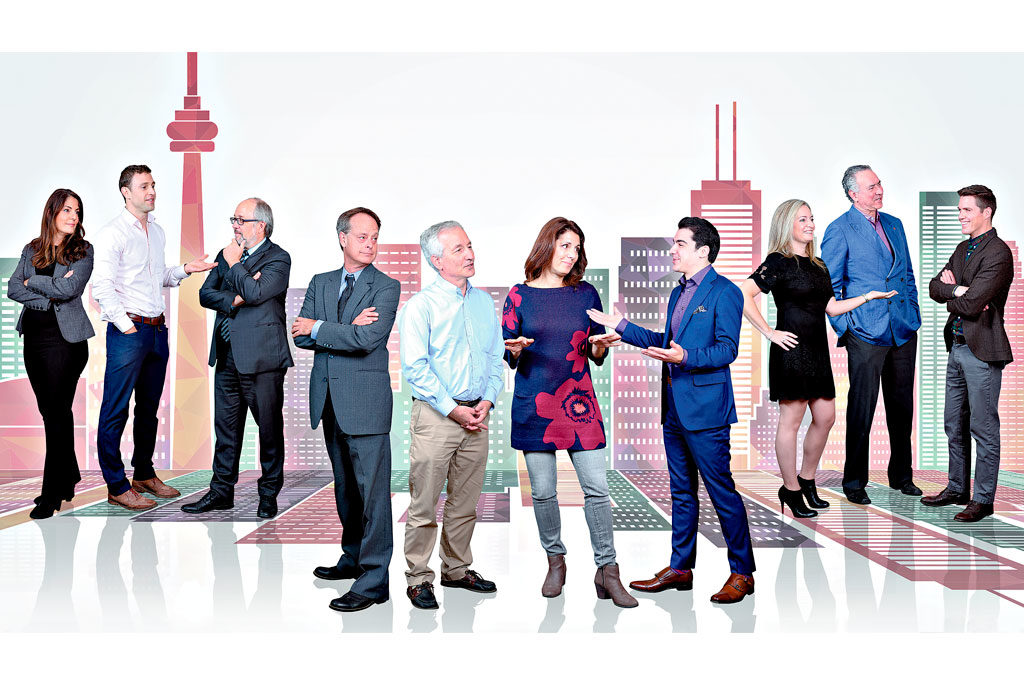
POST CITY’S ROUNDTABLE PARTICIPANTS
Sara Bleiwas
Parent and retired teacher
Barry Chaim
Founder, CEO and CCEE, EDO Group of Companies
Erica Ehm
Parent and creator of the YummyMummyClub.ca
Marc Emery
Well-known cannabis activist, founder of Cannabis Culture
Olga Fowell
Parent, North Toronto resident and realtor
Mike Hart, MD
Family physician at GreenLeaf Medical Clinic
Michael McLellan
Member of the Toronto Dispensaries Coalition
Joe Mihevc
Local councillor for Ward 21
Mark Pugash
Director of corporate communications with Toronto
Police Service
Adam Saperia
President of GrowWise Health, which educates patients and health-care providers on medical cannabis
Post City: There’s a lot of talk about legalization and how it will happen. Of particular interest to our neighbourhoods would be the proximity of this to schools. If made legal, how far away from schools should any legal marijuana seller be?
Sara Bleiwas: I think as a parent of teenagers and as well as a teacher in the public school board, I would not want to see it sold recreationally anywhere but certainly not in an area close to schools. I think teenagers have access to it already, but we don’t want to have more access. I think we will have kids all over the neighbourhood getting recreational drugs if it’s legal. Because 19-year-olds, if they set a limit of age, all you’re going to have is the younger kids getting it from their older brothers and sisters.
Michael McLellan: Sara, you said that kids already have access to it now. I think that is very true. It’s commonly understood that teenagers have greater access to marijuana than they do alcohol. I think there’s a medical debate over whether or not marijuana is in fact less or more harmful than alcohol and other drugs. I would personally come in on the side of the argument that it is no more harmful than alcohol. I wouldn’t go so far as to say that it’s less harmful, therefore we should not be encouraging them to use it. What we do know, from the experience in Portugal or in the Netherlands or in states where recreational marijuana has been legalized or decriminalized, is that, when marijuana use is decriminalized or legalized, the use of other substances decreases. You could say that having greater access to marijuana could be no more harmful and possibly less harmful to our children than not having access at all.
Mark Pugash: The law is clear. I mean, the [marijuana] industry would have you believe there’s a grey area. There is, in fact, no grey area. The industry would also have you believe there are no health risks. And I think that what the Globe and Mail has done over the last two months shows that that’s no more true than the suggestion there’s a grey area. There are no quality controls. There are no regulations. They found significant levels of pesticides and other things in the cannabis. [Ed. note: the Globe and Mail sent unregulated weed procured from nine dispensaries across the city to a lab for testing.]
Marc Emery: You’re totally wrong. The Globe and Mail didn’t find there were any hazardous or dangerous substances. And in fact, it was frequently found marijuana is safer than everything available on a given street for children. It’s safer than sugar, coffee, alcohol.
Pugash: Let me just read from the Globe and Mail…contaminants include the pesticide carbonate, which is not permitted for cannabis, and dodemorph, which is not approved for human consumption. It was 13 of 22 samples, which were found to contain either fecal matter or pesticides or other contaminants.
Joe Mihevc: At the end of the day, we’re going to move in the direction of legalizing in some form or another. But I think at the outset, I think having some controls in place and kind of loosening them in a gradual way is a better way to go than just kind of wide open right from the beginning.
Olga Fowell: So first and foremost, in my opinion, there’s two streams on this issue. One is the medicinal marijuana and the other is recreational. I find, whenever we’re in these types of forums, we lump it all together. There are 20 legal medical marijuana producers right now in Ontario. I had an illegal dispensary, Tweeder — a supposed medicinal marijuana store — on the block where I live, which was less than 100 metres from the daycare. And the day that it blew up, coincidentally, my kids walked their dog around the block that day two hours before that. It’s shocking. It’s absolutely shocking. And I will not let that be forgotten.
Post City: Do more teens now smoke marijuana than drink alcohol?
McLellan: I don’t know the statistics on that. You already have a situation where the police themselves have said that it’s easier for Toronto students to acquire marijuana than alcohol. So they’re already using it.
Erica Ehm: As a parent, it’s important to talk about it. I don’t want my son to have that additional pull to go into a groovy place where they may also sell T-shirts and other kinds of cool paraphernalia … that implies that we’re saying, “It’s safe.” It’s not safe.
Emery: That’s been debunked.
McLellan: Marijuana is absolutely safe.
Ehm: It is not safe for teenage brains. My husband, who as a teenager, smoked a lot of pot, says he is terrified of what’s out there now.
Emery: That’s a hypocrisy, though.
Ehm: It’s not hypocrisy.
Emery: He smoked a lot of pot now he’s worried.
Ehm: It’s a reality of now that it’s being produced with significantly different … all the different stuff in there, the different chemicals.
Post City: Dr. Hart, can you tell us about the impacts of THC on younger brain development?
Dr. Mike Hart: So I generally don’t prescribe THC to anyone below the age of 25.
Ehm: Because?
Dr. Hart: Because there is some evidence that it may cause harm to a developing brain. Now I do feel though that THC and CBD [cannabidiol] are completely different and completely separate. And I think that we should look at considering using CBD for patients under the age of 25.
Bleiwas: You’re saying this, sorry, as a medical…
Dr. Hart: Doctor.
Fowell: A child with epilepsy who has no other options, perhaps you would suggest, recommend, prescribe?
Dr. Hart: Yes, but on the same note, though, people are prescribing amphetamines, antidepressants, lots of medication to kids that are below the age of 25, even below the age of 16, below the age of 10.… That’s probably doing significantly more damage than the THC.
Adam Saperia: On the recreational side, the CMA (Canadian Medical Association) actually put out a physician paper to the [federal] Legalization Task Force. The initial thought was under 25 would not be allowed because 25 is when the brain, based on research, stops developing. But they actually came back and said that the age should be 21. So that was actually the CMA’s position, to make it 21 not 25.
Post City: There’s a flood of dispensaries in Vancouver, and that city decided to create a system that licensed the dispensaries as a way to control the number and the location. Toronto has a committee looking into this. Councillor Mihevc, is this something the city is taking seriously?
Mihevc: Right now, frankly, the city is not really considering doing what Vancouver did. We have the position that recreational use and recreational dispensaries are illegal, and we have asked the police to step in appropriately. Really, though, we are in this hiatus period. And the best service the federal government could do is get this through, pass the legislation. We want the new rules.
McLellan: We have a difference of opinion with the city that we think they could be taking action right now like Vancouver, Victoria and dozens of municipalities across Canada have done.
Pugash: But if the activity it’s regulating is against the law?
Mihevc: It seems like a paradox, but it is happening.
Emery: Three to five million Canadians consume marijuana regularly. Where do you think they’re all buying it now? At least a dispensary is transparent. At least you can go in and look at it.
Pugash: No, it’s not transparent. You don’t know where it comes from.
Emery: I know where it comes from. I know where my product comes from. And we test it ourselves.
Pugash: The comments that the province has made leads, I think, everyone to believe that the LCBO is the model. And there are, I think, fairly strict regulations on that. The key thing now is this period that the councillor referred to. It is presenting fundamental problems. What’s interesting is the people who are most vocal from the cannabis industry are rarely those who are in the stores when the warrants are executed, and it’s probably somebody earning a minimum wage who ends up getting charged.
Fowell: Or getting their hands burnt and face burned off.
Saperia: One of the issues with the dispensaries today is that there’s a lot of confusion right now in the patient population. And prior to the police taking action this year there was a Forum poll put out. I think it was more than 40 per cent of residents didn’t know the legal status of dispensaries. And if you have patients who aren’t fully aware of this stuff, who don’t know how to access it legally and properly, who aren’t getting the support of a doctor or health care professional, it’s problematic.
Emery: Because they just want to buy it. They don’t want to know how the system works.
Mihevc: We make rules. They [the police] enforce rules. Eventually something will be legal, and we want it to happen sooner rather than later.
Emery: If you know it’s going to be legal, what’s the morality of arresting people now?
Pugash: Because the law says what you’re doing now is illegal. You can’t say that it won’t be a year from now.
Emery: But it was illegal to get an abortion. It was illegal to be homosexual. It was illegal to distribute contraceptives. People broke laws and now we accept that.
Pugash: The number of people I’ve spoken to who say, “I’m prepared to defy the law, but I don’t want to pay the consequences” — if you’re prepared for true civil disobedience, which is to break the law because you believe you’re entitled and it’s a noble cause, then you have to accept the consequences. Very few people that we’ve run into that are prepared to defy the law, they’re not prepared to accept the consequences. That is not civil disobedience, that’s hypocrisy.
Emery: I’ve seen 34 prisons and jails for marijuana and spent five years in the United States with my country exiling me.
Barry Chaim: Where I have a problem right now with what we’re talking about is the hypocrisy of regulation and the hypocrisy of responsibility. The government allows tobacco to have all kinds of chemicals in it that are known to be carcinogens and they continue to be available. Nobody’s talking about that because the lobbies are very strong. Whether I get marijuana or not that’s irrelevant to me at this table. What I want to see is what’s good for society.
Post City: Mr. Pugash, what is the police strategy for deciding how to handle dispensaries?
Pugash: After Project Claudia [when police closed down many Toronto dispensaries], the argument came from a number of people: why don’t you go after real criminals? Which I’ve never found a very compelling argument. It’s like the person who’s stopped for speeding says: Yeah, but he’s speeding and he’s speeding and he’s speeding. They also say, if you’re doing that, you can’t do other things. At the same time we had a major gang takedown. What we can’t do because it’s an issue of prioritizing, people say: why don’t you just shut them all down? We simply don’t have the resources to do that. So we operate on a number of bases. One is public complaints. Another is public safety. Another is proximity to schools and other things. We’ve continued doing them since Project Claudia, I would say, on an average of two or three a week. That will keep going, but it’s a balance, as with anything else.
McLellan: When Vancouver came up with this new licensing regime there were about 40 dispensaries that closed down the next day. There were another 40 or 50 that didn’t. Some decide that they’re going to follow the rules, and some don’t. When the rules are viewed as legitimate by the communities and the industry itself, they will be followed. The rules as they exist or do not exist at all here in Toronto are not viewed as legitimate. Therefore it’s like Whac-A-Mole for the Toronto Police Service.
Post City: Mr. Emery, You’ve been at this longer than anyone else at this table. So I want to ask you straight up: We all know these dispensaries are breaking the law. We know they are subject to a police raid. Why do it now? Why not wait?
Emery: Because we’ve waited long enough. They’ve been rounding up our people for 50 years. Two million Canadians have got criminal records. I myself have seen 34 prisons and jails for pot in eight out of 10 provinces, in six U.S. states. The straight people of this country owe us because you’ve been persecuting us unjustifiably. This law was never valid. It should never have been illegal. It should have been regulated in the 1970s and made legal since then. So for me, I can’t even listen to this until someone apologizes to me for supporting a system that’s openly rounded up my whole social community.
Post City: Why don’t we talk about impairment a bit. Because I think that’s an interesting question especially considering we have a lot of parents who are readers.
Dr. Hart: So I always counsel patients not to drive four hours after vaporizing or smoking and then eight hours after consuming an edible or if they feel that they’re under the influence or if they feel impaired. So those are the rules that I tend to give to my patients.
Mihevc: Probably good rules. In our public health report, it’s very interesting. So there have to be, when the new regime comes in place, a lot of rules around smoking and driving. Of course there has to be. But what’s interesting — and this is why we need to do a lot more research on it — is that it is different. It is actually different being stoned versus being drunk. When you’re stoned, you actually have better control over your speed than when you’re drunk.
Emery: Hence the paranoia while driving. Because you’re overly cautious because you think everybody knows you’re stoned. So you go the speed limit for sure.
Dr. Hart: When people use alcohol, they’re more likely to be aggressive and reckless. If you use cannabis you’re more likely to get paranoid. So in that type of sense, you’re more likely to be potentially more cautious in those situations because you’re aware of yourself, you’re aware that you’re impaired. So because you know that you’re impaired, you’re going to do whatever you can to make sure that nothing happens.
Emery: The National Highway Traffic Safety Administration in the United States tested thousands of stoned drivers, straight drivers, and drunk drivers. And they concluded that the stoned drivers were as safe or better than the straight drivers. And it’s a massive study and anybody can get it. It’s been in the Washington Post. Fatal accidents by people smoking only marijuana are extremely rare.
Post City: So a question from a reader: What about medical patients who may not want to experience psychoactivity and use CBD-ribbed strains alongside THC?
Dr. Hart: I think, you know, we do need to separate THC and CBD. And for some of my patients — and I’m sure Adam can attest to this as well — I’ll write on my prescription less than one per cent THC. So that patient can only order a high CBD strain. In that instance then, for sure, that patient should be able to drive. And, in fact, I’m happy that you brought this up because I have a patient, mid-20s. She was not driving because she had seizures, had a pretty severe seizure disorder. You start her on CBD. Now she doesn’t have any seizures and she actually got her licence back. So she got her licence back from the Ministry of Transportation of Ontario with cannabis use, and that’s a fact. And there’s a lot of other cases that are similar to that. So we do need to make a very important distinction between THC and CBD.
Saperia: And this is one of the important things, when talking to patients, is that there is a stigma out there about cannabis that you just smoke it and you get high and people may have that perception of what a cannabis user looks like. But Dr. Hart is absolutely right that the medicinal benefits of CBD are incredible. That it doesn’t produce a high.
Post City: We’d love to get a comment from each of you with regard to what you’ve heard today: if you’ve learned anything and what you see as the way ahead in the next year.
Saperia: OK. I think, to sum it up, I think right now there is a legal medical system, and I think patients should be encouraged if they have any questions to try to navigate that legal medical system. I think in the long run the legalization of marijuana is going to be beneficial. I think it actually benefits patient care. Right now there still remains a stigma around marijuana use, both recreational and for medical purposes. But certainly I think when it comes to medical patients, legalizing marijuana will help reduce that stigma. It’ll help create greater access for those who are having difficulty accessing it through a doctor. But I think it is important, as Joe has said and as many of us have said, to view this through the lens of a public health approach and make sure that all the concerns that have been addressed are being properly addressed as the system comes out. But also we want to make sure that, as we move toward legalization for recreational purposes, we don’t want medical patients being left behind.
Pugash: One of the things that I always think is important is hearing those who rarely have a voice. And I think certainly one of the values of today is hearing that voice that too often we don’t hear. I don’t believe I’ve heard anything new from the producers. But I have found it very interesting to hear the voice that we often [don’t hear].
Bleiwas: I just wanted to say, you know, as a teacher and a parent of teenagers, I’m all for medical marijuana and using medical marijuana. I just want to see it used properly, through a doctor’s prescription, and tested properly. And if we’re going to go toward recreational marijuana, I hope it goes in the same way and that we go slowly and we make sure it’s tested. And we, you know, make sure of that — because I know it’s going to get into the hands of young people and into kids’ hands, and I don’t want to see them using product that’s laced with pesticides and fertilizers and all that kind of stuff. And I want to make sure that the government is concerned about that and that they test it.
McLellan: Thank you, everybody, for sharing all your points today. It’s been good to hear the different perspectives up close for once. My concern, of course, is for what regulations do come forth, I think that the current system, the ACMPR [Access to Cannabis for Medical Purposes] system, is totally inadequate to provide proper access to medical marijuana. The mail order thing is obviously a non-starter. The fact that they’re eliminating what they can sell is also a non-starter. It needs to be expanded up. Dispensaries right now are filling those gaps. So for there to be police action taken against them, I disagree with it. But moving beyond that, because this will be legal soon, we’ve talked today about how it should be distributed. When you look at what the different opportunities are, dispensaries, in my opinion, are the best way for marijuana to be distributed, and that’s because it’s safe. You can control it better as a stand-alone entity versus having it mixed in with the sale of other products, whether it be alcohol or pharmaceutical products. So you want a stand-alone dispensary doing it. You may not like any of the dispensaries today, but what you do want is a dispensary.
Fowell: What kind of numbers are you thinking?
McLellan: For what?
Fowell: Volume of this open market?
McLellan: Well, I mean, there’s third party estimates that the market’s around 10 billion per year.
Fowell: So how many shops in my neighbourhood do you want?
McLellan: I think, I mean, Marc, before, has said that there should be a thousand dispensaries in Toronto. I think that the average Torontonian would probably object to that quantity. But you’re going to see similar numbers with LCBOs. There’s LCBOs, literally, in every neighbourhood. I think you’re going to probably see a dispensary in every neighbourhood. “How do you want that essentially to look?” is the question we should ask. This is an inevitable process. Over five years, there’s going to be dispensaries throughout our province, and people aren’t going to blink when they go by them like they do now. So what do you want that dispensary to look like? First of all, it should be a dispensary, not an LCBO, in my opinion. But then you should actually have rules that govern how those dispensaries look and how they act, who works in them, who owns them, how it’s distributed, and those should be safe and sensible regulations to protect all of our communities.
Emery: Marijuana is one of the safest substances on earth. Science proves this over and over again. We don’t need to treat it like plutonium. We don’t need to be arresting people with battering rams and Kevlar and guns and ammo, just like Operation Claudia. We’re not those kind of people. We’re from a peaceful, honest lifestyle. Now that it’s going to be legal, they’re telling us how we’re going to live, how we’re going to get our marijuana, how we’re going to grow it, how we’re going to sell it, how we’re going to be. That’s never going to be acceptable to the five million Canadians who consume marijuana. So the rules that come in have to be inclusive. They have to include all things. They have to be fair. They have to be no more severe than certainly a liquor store or any of the other harmful industries that we give licences to carte blanche to poison our kids with sugar or fats or alcohol or Wellbutrin. These things kill people. Marijuana doesn’t kill anybody. So we just need to come to a safe, civilized way so everybody who wants marijuana can feel like a first-class citizen, walk into a store like any other store on earth and just say, “I want one of those, one of those and one of those,” and they’re 19 years of age. They buy it and they go home. And they feel like a real Canadian for the first time in 50 years.
Mihevc: Well, this is obviously an issue with many moving parts, and I’m sure there’ll be more moving parts in the next few years. I think the city’s interests will be, one, following the law. And if there’s a new law coming, then, of course, we will want to have input into that law and we’ll want people to follow that law. I think I quite agree with Dr. Mike around the public health piece of harm reduction. In public health, we know what harm reduction is. We just had a big community conversation around safe injection sites, which is really a harm reduction approach. Cannabis is not a morally mutual product. There are harms associated with it, and there are benefits associated with it as well, but there are harms. And I think we as a society will want to maximize the benefits and minimize the harms. And the harms will come at a public health level. It’ll come at a neighbourhood level. And what I’ve learned today is just that we’ve got to make sure that our public health officials are on their best game.
Fowell: So in summary, I think great discussion today for both sides. And again, I think I started the conversation this way, I think that it’s two different streams — there’s the medicinal marijuana stream and there’s the recreational. On the medicinal, I, you know, I concur with the doctors and go out of here understanding that there’s already a process in place. It needs betterment, absolutely, to make it accessible. And I think that’s something that there should be more energy put into to improve on.
If you have questions or comments about the Post City “Growing Pains” roundtable please send feedback to editorial@postcity.com.

