
If you fly over a forest and look down, you’ll see every green tree and plant reaching to the heavens to absorb the ultimate energy source: sunlight. What a contrast when you look down on a city or town with its naked roofs, asphalt roads and concrete sidewalks, all ignoring the sun’s beneficence! Research shows we might benefit by thinking more like a forest.
Solar roads could be a step in that direction. Roads, sidewalks and parking lots cover massive areas. Using them to generate power means less environmental disturbance, as no new land is needed to house solar operations.
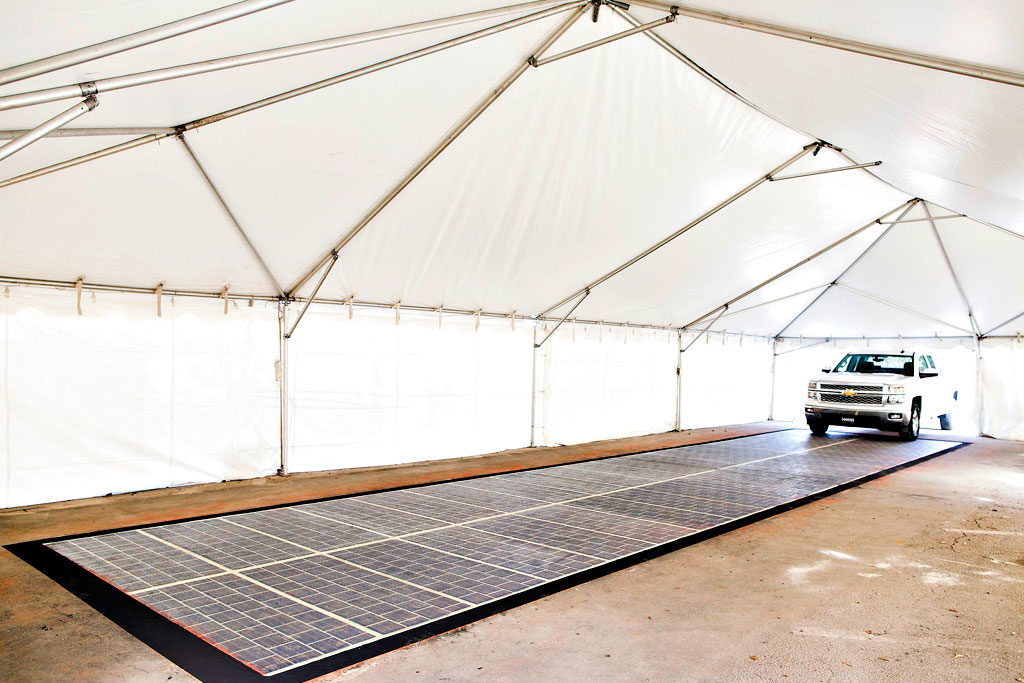
A French company, Colas, is working with the French National Institute for Solar Energy to test its Wattway technology under various conditions, with a goal of covering 1,000 kilometres of existing highway with thin, durable, skid-resistant crystalline silicon solar panel surfacing over the next four years. They estimate that could provide electricity for five million people. Although critics have raised questions about cost and feasibility, it’s not pie-in-the-sky. The technology is being tested and employed throughout the world.
Rooftops are another place to generate power using existing infrastructure. Elon Musk’s company Tesla is making shingles that double as solar panels. Although they cost more than conventional asphalt shingles, they’re comparable in price to higher-end roof tiles and can save money when you factor in the power they generate. In Toronto, many schools have installed solar panels on their rooftops in an effort to be more green.
U.S. science writer Janine Benyus coined the term “biomimicry” to describe technologies based on nature’s ability to solve problems or exploit opportunities. It’s an important concept because it requires humility and respect for natural processes rather than the imposition of our crude but powerful technological innovations.
Biomimicry has inspired applications ranging from producing energy through artificial photosynthesis to building lightweight support structures based on the properties of bamboo.
By learning how nature works and how to work within it, we can overcome many problems we’ve created by trying to jam our technologies on top of natural systems. Fossil fuels were formed when plants absorbed and converted sunlight through photosynthesis hundreds of millions of years ago, then retained that energy when they died, decayed and became compacted and buried deep in the Earth, along with the animals that ate them. Rapidly burning limited supplies of them is absurd, especially when they can be useful for so many other known and possibly yet undiscovered purposes.
Our economic systems don’t often encourage the most efficient and least harmful ways of providing necessities. They aim for the quickest, easiest, cheapest and most economically profitable paths. We can do better than that. Harnessing the sun’s power and learning how nature solves challenges are good places to start.

